

Vtoman FlashSpeed Pro 3600 V-Beyond review: Finally getting a UK launch, here's what I found with this 3096 Wh portable power station
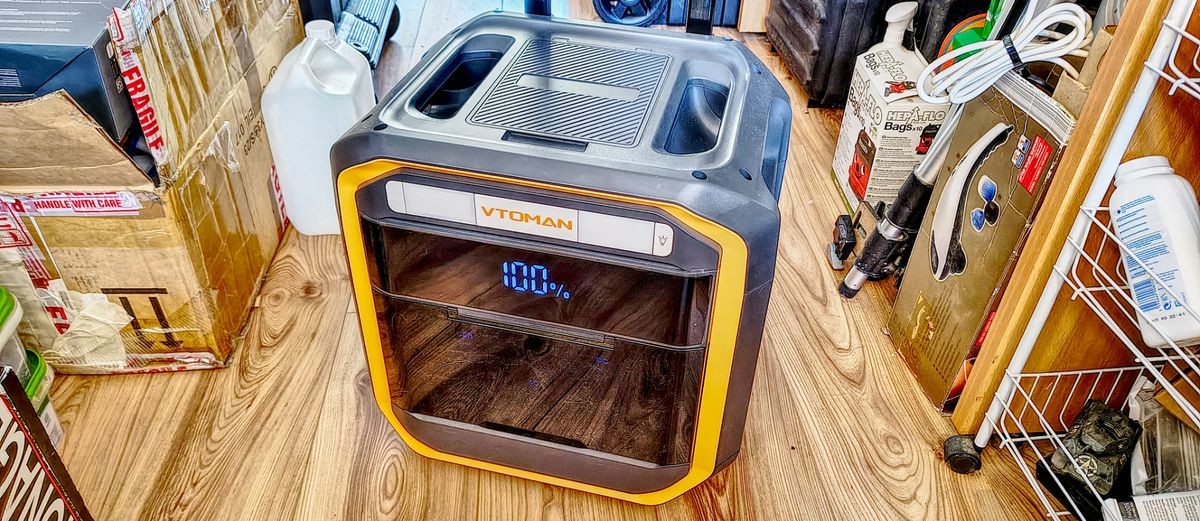
For those who need portable power, the VTOMAN FlashSpeed Pro 3600 provides enough capacity and output to be genuinely useful. But the current configuration treats integration as unnecessary and, as a result, cuts out a large part of the plug-in solar market.
Pros
- +
Massive 3 kWh LFP battery capacity
- +
Expandable up to 6 kWh with an additional module
- +
IP65 rated for outdoor use.
- +
Wheels and a telescopic handle make it easier to move
- +
All cables can be stowed in the device
- +
Works as a 20ms UPS
Cons
- -
Weighs 38 kg, making it a two-person job to lift
- -
Lacks Bluetooth and WiFi or any app control
- -
Solar DC inputs need an adapter not included
Why you can trust TechRadar We spend hours testing every product or service we review, so you can be sure you're buying the best. Find out more about how we test.
VTOMAN FlashSpeed Pro 3600: 30-second review
The FlashSpeed Pro 3600 V-Beyond is VTOMAN's biggest power station yet, built around a 3,096Wh LiFePO4 battery, 3,600W of continuous AC output, and a claimed two-hour full recharge from the wall. It rolls on built-in wheels, carries an IP65 rating, and undercuts most rivals of similar capacity on price.
Launched about a year ago in the USA, this hardware now has regional versions with outlet connections for the UK and Europe.
While this unit could be used at home to provide backup power during a power cut, its true calling is for those going off-grid, perhaps on a building site or while camping, where they need to power appliances away from the power grid.
With its expansion battery option, it offers up to 6kWh of capacity and 3600W of output (peaking at 7200W for high-demand starts). That’s enough for most tools and appliances, and it won’t be exhausted after a few minutes.
It can be charged from the mains, with 12V automotive connections, or using solar DC inputs, and that power can be delivered to numerous outputs that can be run simultaneously.
The primary competitor to the VTOMAN FlashSpeed Pro 3600 is EcoFlow’s DELTA Pro 3, which costs almost twice as much in the UK for a 4kWh model. The extra battery alone for the DELTA Pro 3 costs more than the VTOMAN FlashSpeed Pro 3600 and its 3kWh expansion battery combined.
The price difference might be justified by the device's remote-control sophistication, and EcoFlow products are certainly superior in that respect.
Are you a pro? Subscribe to our newsletter
Sign up to the TechRadar Pro newsletter to get all the top news, opinion, features and guidance your business needs to succeed!
What VTOMAN has focused on with the FlashSpeed Pro 3600 is offering high capacity at an affordable price, and the design largely ignores home installation users. For the capacity and price, this device offers exceptional value, making it impossible to ignore.
Is it one of the best portable power stations? Probably not, but for those looking to have easily transportable power to operate off-grid, it could be incredibly useful.
VTOMAN FlashSpeed Pro 3600: Price & availability
- How much does it cost? £1,289/€1,499
- When is it out? Available in the USA, UK, and Europe
- Where can you get it? Direct from VTOMAN and through online retailers
The current asking price for the VTOMAN FlashSpeed Pro 3600 V-Beyond is $1299.99 in the US direct from VTOMAN, and £1289.99 from the UK site.
In the UK, it can also be bought with the 3kWh expansion battery for £1799, making it one of the cheapest ways to get 6kWh of mobile battery capacity available.
Amusingly, the VTOMAN website suggests, with a struck-through price of £2599, that this is an even bigger bargain than it already looks. However, in the UK and Europe, this isn’t something you should do unless you actually sold any at this price, as trade rules prohibit this sadly common practice.
In addition to the expansion bundle, VTOMAN also offers four other options that include folding solar panels. Another £110 gets you 200W panels; £200 doubles that to 400W, and there are also bundles that include those panels and the extra-capacity battery.
As I’ll talk about later, the connection to the solar inputs on this unit isn’t standard, so if you decide to use existing solar panels from another brand, you will incur the extra expense of a £30 conversion cable.
Comparing the VTOMAN FlashSpeed Pro 3600 to what other brands offer for the 3kWh power station market, the best-known alternatives are the Jackery Explorer 3000 v2 or 5000 Plus, AFERIY Portable Power Station 3600W 3840Wh, Anker SOLIX F3800, Goal Zero Yeti Pro 4000, Bluetti Apex 300, and the aforementioned EcoFlow DELTA Pro 3.
Of these, the cheapest is the Bluetti Apex 300, which is only $1498.99 in the USA and £1799 in the UK, but with only a 2764.8Wh LFP battery, it's slightly short on capacity unless you buy it with the 2764.8Wh expansion battery, which costs another £1099 or $1078.98.
The Jackery Explorer 3000 v2, as the name implies, is a revamp of the Explorer 3000 model, which has 3072Wh of capacity and costs £1,699 on Amazon.co.uk in the UK and only $ 1,499 on Amazon.com in the USA. My only concern about this product is the lack of expansion options.
In terms of features and capacity, an interesting option is undoubtedly the Anker SOLIX F3800 that sells for $1999.99 on Amazon.com but horrifically £3699 for UK customers directly from the maker’s website. The F3800 and F3800 Plus are great products, but they are more focused on home users, and their prices are excessive.
The EcoFlow DELTA Pro 3 is expensive at $2,399 or £2699 depending on where you are, although it does have some advantages in terms of management and expandability. The VTOMAN can only be expanded to 6kWh, whereas the EcoFlow can be extended to 12kWh with extra battery packs. Easily the most sophisticated product, but also one of the most expensive.
The only device that I think has an even better battery value than the VTOMAN product is the AFERIY Portable Power Station 3600W 3840Wh (AF-P310G1/AF-P310-EC-H). It is priced at only £1298.99 from Amazon.co.uk and $1,169 from Amazon.com, for a 3840Wh battery.
With the possible exception of the AFERIY, the VTOMAN is one of the cheapest ways to get 3kWh of battery capacity in an easily portable package.
- Value: 4 / 5
VTOMAN FlashSpeed Pro 3600: Specs
Swipe to scroll horizontally
Product name |
VTOMAN FlashSpeed Pro 3600 |
Battery capacity |
3,096Wh |
Battery type |
LiFePO4 |
Dimensions |
378 x 418 x 581mm (14.9 x 16.4 x 22.9 inches) |
Weight |
38kg (83.8lbs) |
Operating temperature |
-4°F to 131°F (-20°C to 55°C) |
Cycle life |
3,000+ cycles, quoted 10-year lifespan |
US port selection |
4× AC, 2× 100 W USB‑C, 2× DC, 4× USB‑A, 2× Cigarette port |
Continuous AC output |
4 x 230V/50Hz outlets, 3,600W total |
Peak AC output |
7,200W |
AC input |
2,200W |
AC recharge time |
0 to 100% in around 2 hours, per VTOMAN. To be timed independently on the review unit. |
Solar input |
Anderson port, 12-80V, up to 800W. |
USB-A output |
2 x 5V/2.4A, 12W max |
USB-A QC3.0 output |
2 x 18W max |
USB-C PD output |
2 x 100W max, output only |
DC5521 output |
2 x 12V/10A |
Cigarette lighter port |
2 x 12V/10A |
Total output ports |
14 |
UPS switchover |
Under 20ms |
Ingress protection |
IP65 |
Expansion |
Compatible with a FlashSpeed Pro 3600 extra battery, taking total capacity to 5,912Wh. |
Warranty |
2-year |
Jump start |
US: X7 jump starter (included in bundle here). UK: Not supported. VTOMAN explicitly states this unit is not compatible with jumper cables, unlike some other models in its range. |
VTOMAN FlashSpeed Pro 3600: Design
- Built for indoors and outdoors
- Has wheels and a handle
- Battery and microinverter in one
A short disclaimer before we go any further: I’m not an electrician, and therefore any information I provide about plugging things in should be considered as being my understanding, and not an irrefutable fact.
Looking not entirely unlike a piece of luggage, the VTOMAN FlashSpeed Pro 3600 is effectively 3096Wh of LiFePO4 in a convenient box with two wheels at the rear and a telescoping handle to make dragging it about relatively straightforward.
It needs wheels and a handle because the weight of this box is 38kg, and even with carry handles, one person might struggle to carry it any distance. Personally, if this was in the rear of my vehicle, I’d ask someone to help me take it out before wheeling it to where it is needed.
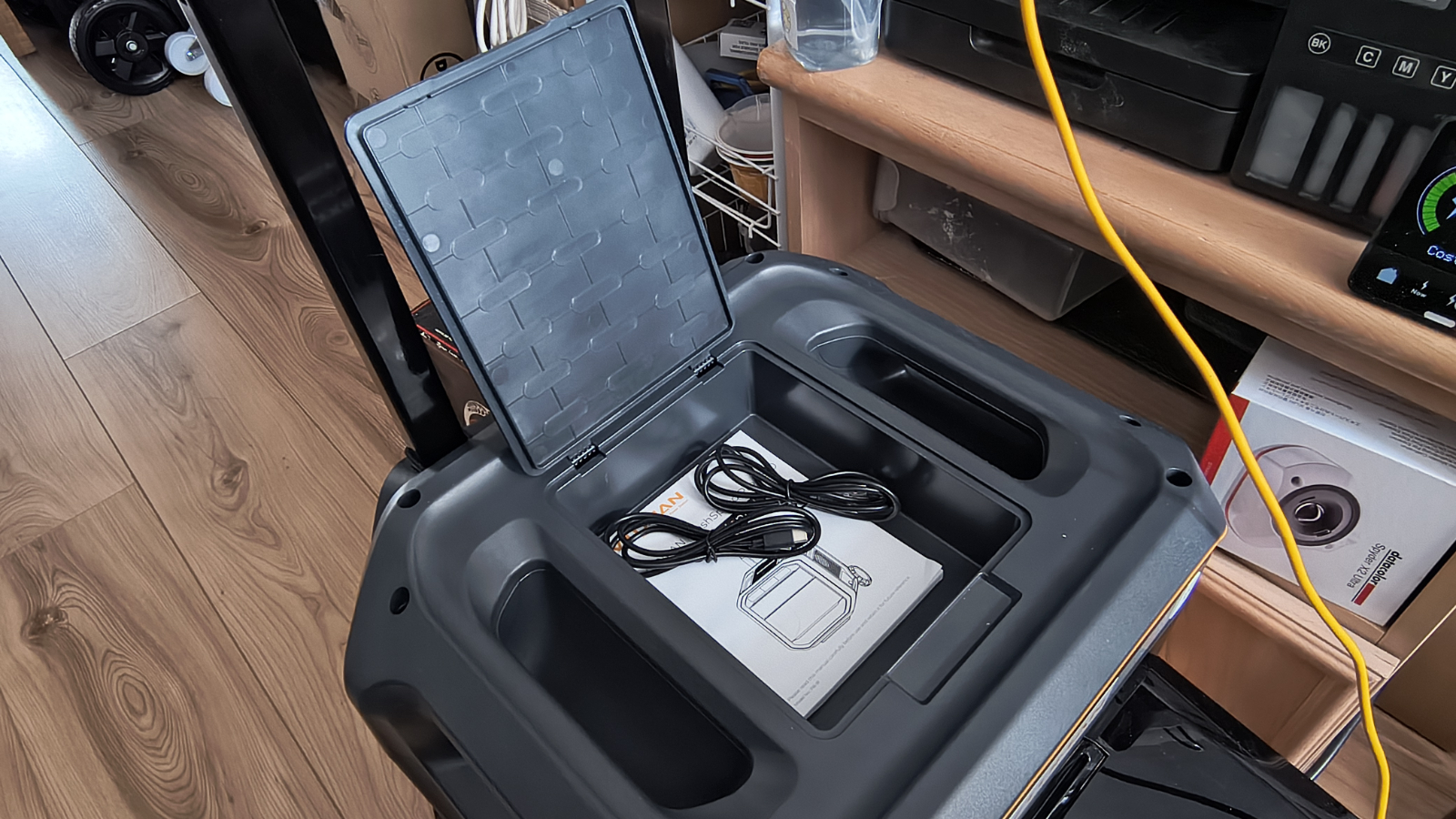
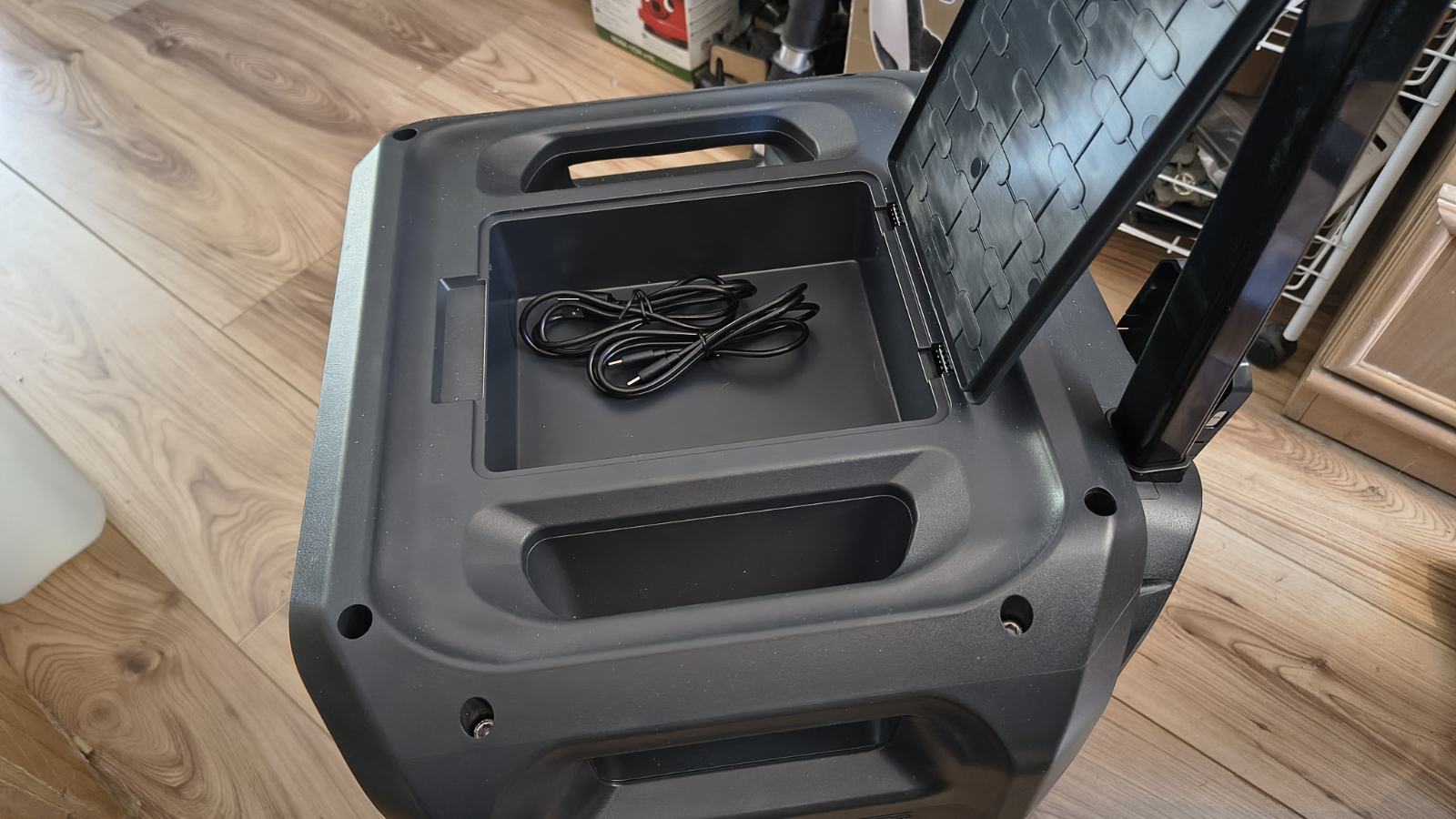
It’s evident that ergonomics was of the utmost importance to the designer, because there are two hidden compartments for carrying cables and the manual. One on top is ideal for the USB cables, and another at the back, between the handle rails, is perfect for the power cable.
Out of the box, the unit comes with a charging cable, a USB-A-to-USB-C cable, and a USB-C-to-USB-C cable. The disappointment here is that there is no cable for attaching solar panels, but we’ll get to that omission later.
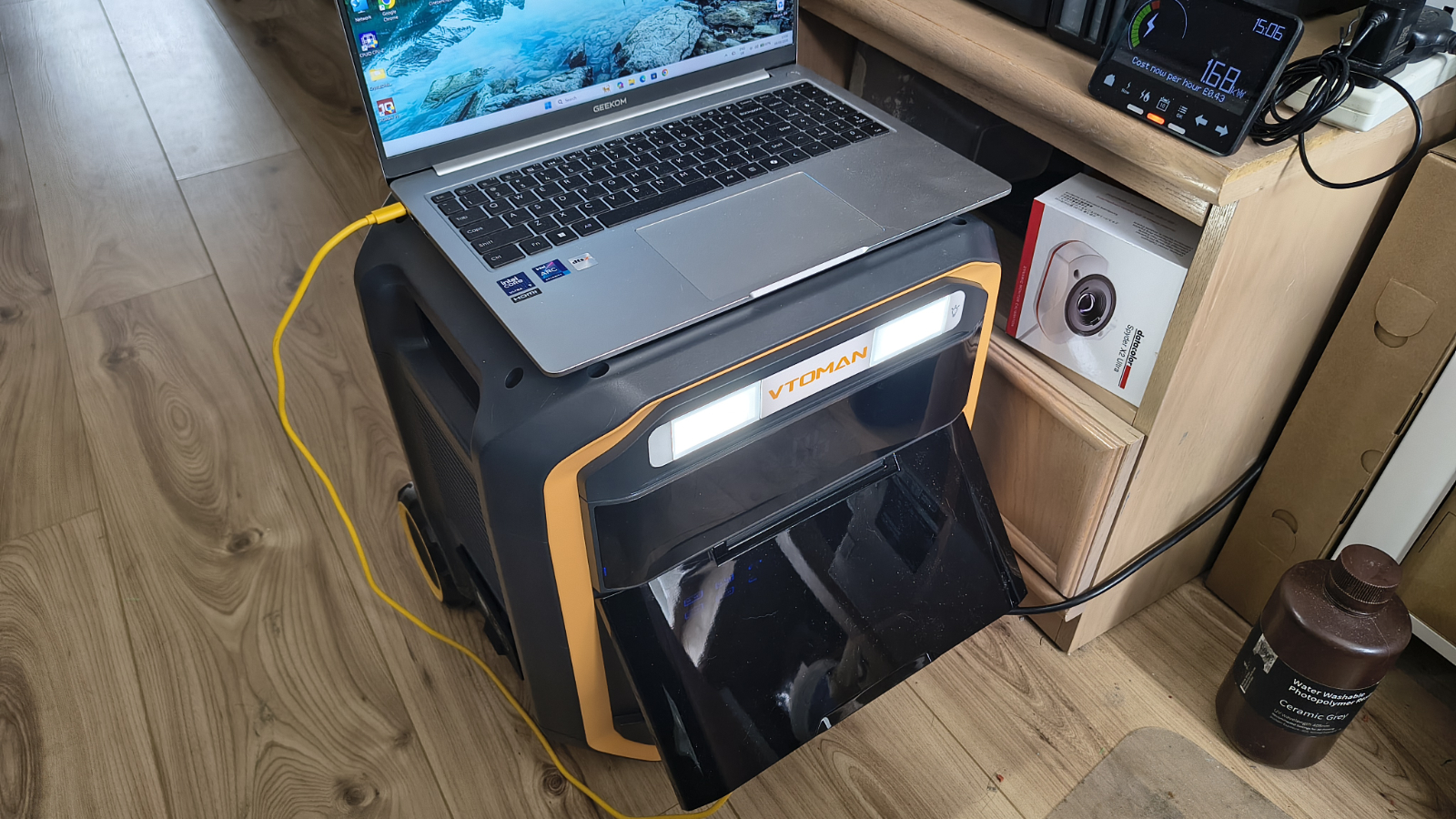
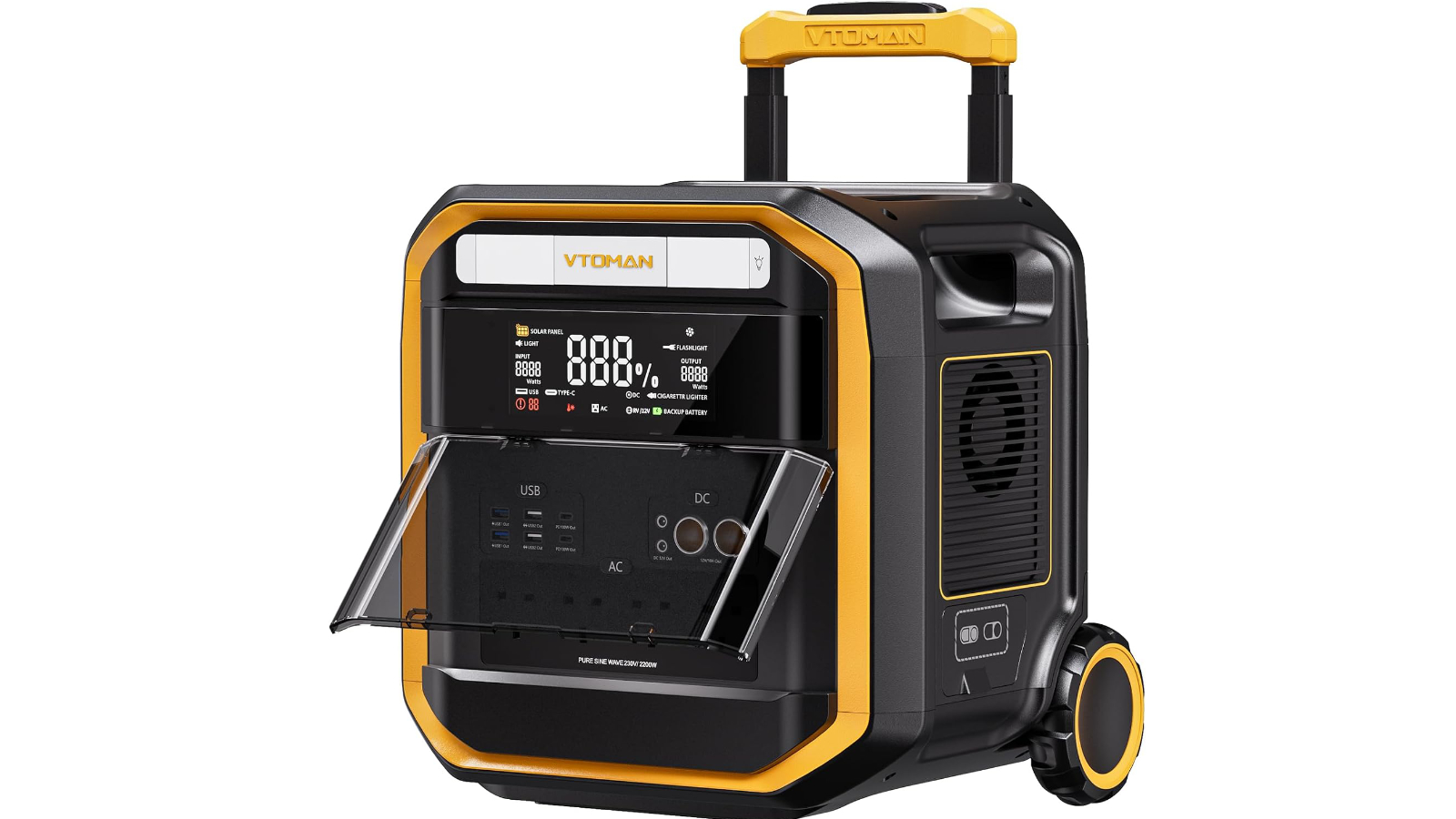
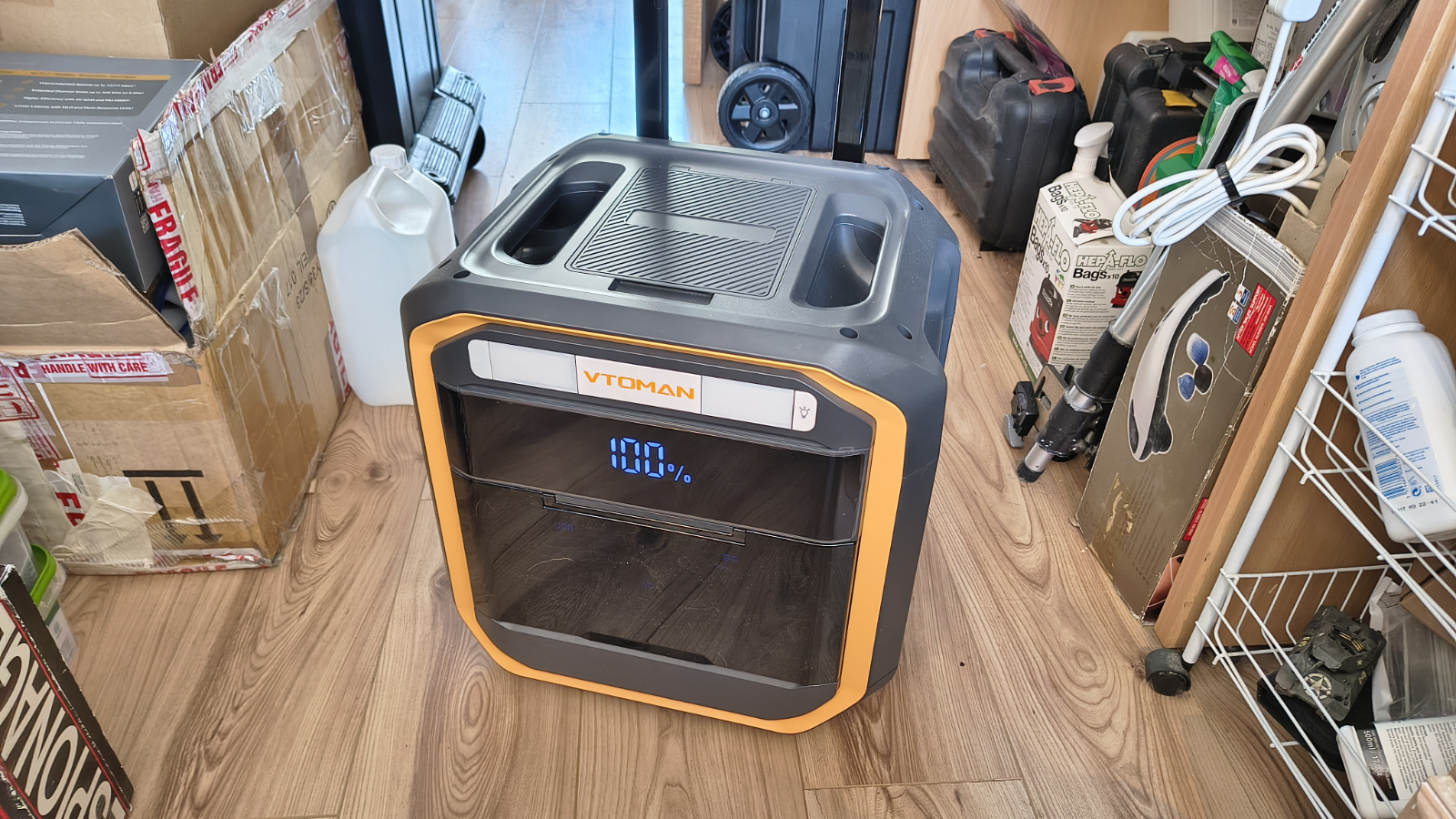
The front-mounted LCD screen provides a readout of the battery capacity as a percentage and what services are active, and a light bar built into the case can switch between white and red lighting in various modes. The light is activated via a button along the top and cycles between two standard white light modes of different brightness, then a red light mode, and finally a red light where the flashing spells out SOS.
Beneath the display is a flip-up panel that covers the outputs, which are divided into USB, DC, and AC areas, and each can be activated or disabled with one button.
There are four USB-A outputs split into pairs of 12W and 18W capable ports, and two USB-C ports, each capable of 100W charging. The DC section has two 12V/10A cigarette lighter outputs and two DC5521 ports with the same specs.
And, on the UK model provided for this review, the AC section has four three-pin sockets for standard appliances that can handle 3600W sustained output, and 7200W peak for devices that demand more briefly.
But that’s not the end of the ports. There are two locations on the side protected by rubber covers. On the left are solar inputs (Anderson port, 12 to 80V, up to 800W), and the IDC connection for the mains cable.
On the right is an RV connection with its own on/off button and a port for connecting the expansion battery. That battery is meant to sit on top of the VTOMAN FlashSpeed Pro 3600, and the case is shaped accordingly to accept it.
The positive aspects of this design are that everything is relatively compact and straightforward, and with the handle and wheels, it should be easily movable by most adults. Using it requires that the user knows how to power the unit on, plug in what they need and press the button to power that function; that’s all.
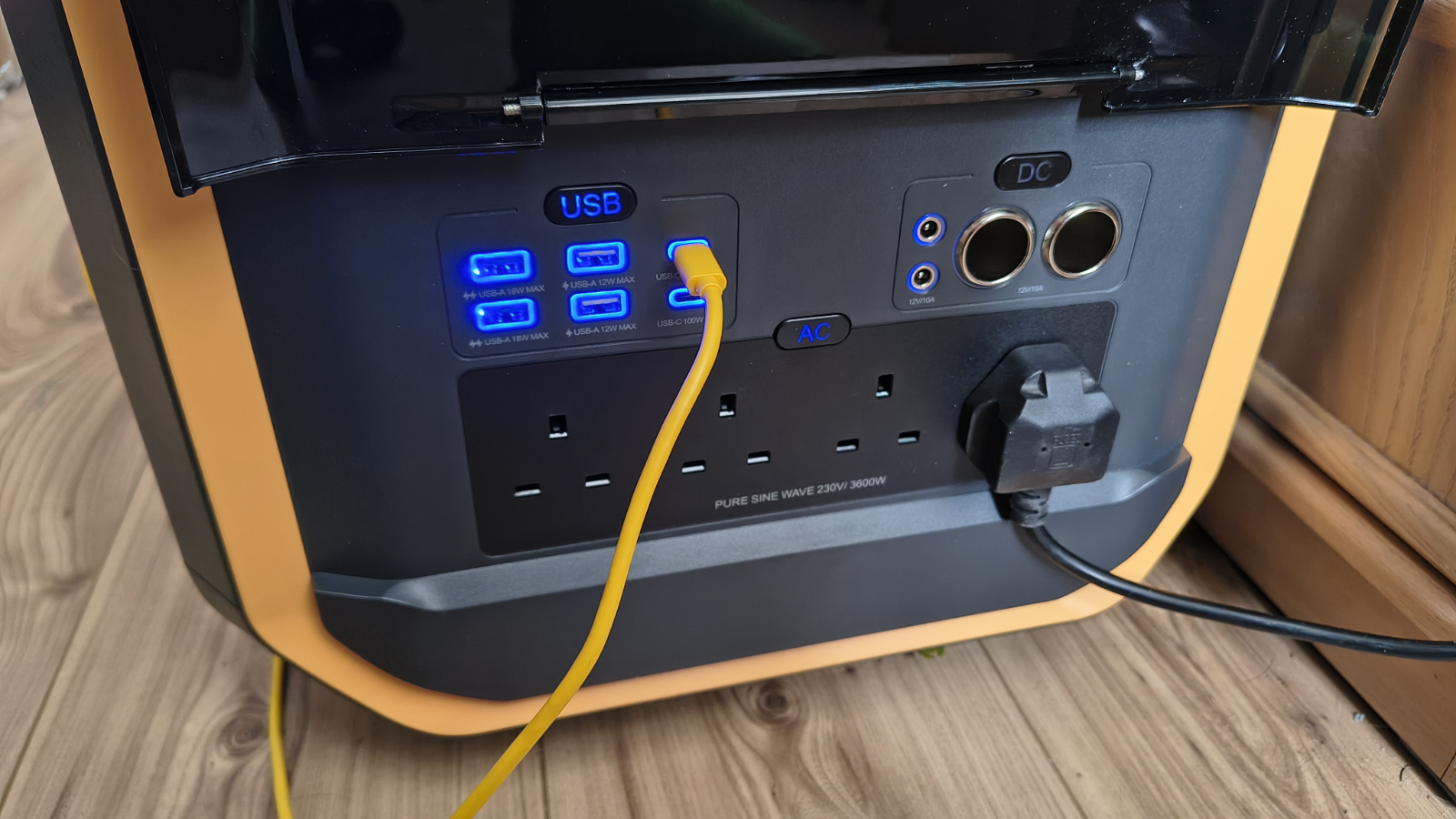
There are, however, a few things that might have been done better. My first complaint is the length of the power cable, which seems remarkably short. In my kitchen, placing the battery on the floor next to a cabinet, the power cable barely reached the wall socket.
The temptation is to then use an extension, and given how much power this device can pull while charging, that might be a bad idea.
What’s clearly a strength of this design is the number of ports, but I do wonder about the choices made about some of these given the current market for power stations and solar products.
VTOMAN has decided that all its solar panels should use Anderson connectors to connect to this power station, even though every other panel maker, including VTOMAN, has standardised on the MC4 connection.
That means you need to spend another £30 getting conversion cables if you use panels that aren’t by VTOMAN. The conversion cable does come with VTOMAN panels, but all this might have been avoided if MC4 connectors had been used on the FlashSpeed Pro 3600.
My final issue is the cover that is used to protect the front-facing ports. It hinges at the top and, in normal use, can be placed vertically for easy access. Except when it's in this position, it entirely obscures the display, which is rather unhelpful.
I can understand why they hinged it at the top, so that rain wouldn’t hit any of the ports, should it shower. A better solution might have been to also hinge the display, so that you can tilt it for easier viewing at all times. Often, it's necessary to crouch to read the display, and having it angled at 45 degrees would make it easier to see while standing.
- Design: 4 / 5
VTOMAN FlashSpeed Pro 3600: Features
- Big fast-charging battery
- 3600W power on demand
- 2-year warranty
In terms of what this product offers at its core, this is enough LPR cells for 3096 Wh of capacity tied to a small DC inverter for solar and vehicle recharging, and the electronics to convert the internal 48V service into 220-230V outlets and the 5V USB sockets.
None of these parts is especially clever or innovative, since many Power Stations offer much the same thing.
The headline feature is undoubtedly speed. VTOMAN's CHARGECORE system is claimed to take the FlashSpeed Pro 3600 from flat to full in around two hours on a standard UK wall socket, which would be a genuinely useful figure for anyone who needs to top up quickly ahead of bad weather or a job that cannot wait.
But I found that this two-hour recharge number has almost certainly migrated from the US version of this hardware, where the power inlets are 110V.
On a UK plug, it can easily pull over 2000W, and I recharged the whole 3096Wh from zero in just 90 minutes.
Another area where this unit exceeded my expectations was the solar inputs, because typically power stations are limited to 50-60V DC and 500W/15A, while the ones on this unit go from 12V-80V and 800W in total.
As most 200W panels provide 20V output, the maximum number of panels I could reasonably connect to my EcoFlow Delta 2, for example, is two, since it’s limited to 60V DC and 500W. But depending on the panel, it might be possible to plug four 200W panels into the FlashSpeed Pro 3600 and charge at twice the speed.
Under optimal conditions, it might be possible to recharge the FlashSpeed Pro 3600 in under four hours with 800W of panels connected. But I’d make sure with a multimeter that you are not trying to inject more than 80V into the battery, or unfortunate things might occur.
Another part of the specification I like is the UPS (uninterruptible power supply) mode of this hardware. With a switchover time under 20 milliseconds, that's fast enough to keep a PC running, positioning it as a serious option for protecting networking gear or other sensitive electronics through a power cut, not just a portable battery for the odd device. There are caveats to doing this I’ll mention later, but compared with a rack-mounted 3096Wh UPS, the VTOMAN option is highly affordable.
One area where power stations tend to get criticised, and often unfairly, is that they won’t power everything. The idea that you have one of these devices, and in the event of an unexpected power loss, it will power your whole home or office is entirely unrealistic.
Many power stations struggle with boiling a UK kettle, but this one is made of sterner stuff.
VTOMAN's V-BEYOND output technology is pitched as improving compatibility with resistive loads such as kettles, ovens, and washing machines, which tend to be harder on cheaper inverters. These often pull high loads initially, as the elements reach operating temperature, and then the demand falls once they do.
To cope with these scenarios, the battery can deliver an impressive 7200W for short periods, although its nominal load is 3600W. In this respect, you could run an oven or a washing machine on this battery, but I’d probably avoid running two high-demand appliances at once.
The obvious concern with discharging cells this rapidly is how those components will stand up over time. The battery uses LiFePO4 cells with VTOMAN's LifeBMS protection system, and the company quotes over 3,000 charge cycles and a 10-year lifespan. That all sounds great until you realise that the warranty on this hardware is just two years, followed by another three years of after-sales service.
To put that in perspective, almost all EcoFlow Delta series batteries come with a 5-year warranty from the outset, and the brand's new Stream units come with a 10-year warranty. That’s not wonderful, although VTOMAN might be factoring in the unpleasant things that could happen to their equipment when it's being rolled through a build site or forest.
However, the warranty could be better, and after-sales service doesn’t cut it.
- Features: 4 / 5
VTOMAN FlashSpeed Pro 3600: User Experience
- Lacks any external control
- No Bluetooth, no Wi-Fi, nada
To clarify, this section is mostly about the user experience rather than an electronics analysis, since I’m not remotely qualified to do the latter.
From my experience with the VTOMAN FlashSpeed Pro 3600, it outputs the power that the makers claim, and the sorts of demanding appliances it should. And it charges up quickly.
I should also say that because this model is 220V, it would work with European appliances with basic adapters, though I’d be careful about trying to run an oven using a cheap travel adapter.
But what I most wish to talk about is the user experience, which wasn’t quite what I’d anticipated, mostly because I’ve got lots of EcoFlow hardware in my home.
When I first got this battery, I noticed that VTOMAN has Android and iPhone applications and assumed, wrongly, that these would be able to connect to its flagship Power Station product. It can’t, because, shockingly, VTOMAN didn’t put Bluetooth or WiFi in this device.
Let that thought sink in for a moment, because it sort of blew my mind for a while while thinking about this. Other VTOMAN Power Stations do have Bluetooth and WiFi, but not this one, bizarrely.
Therefore, other than crouching next to it, there is no way to find out how much battery is left, how many watts are currently being drawn, and, critically, when the power is likely to run out.
If it did have the connectivity, the existing app would provide some of these answers, I believe, but VTOMAN decided not to include it.
Using other products, naming no names, it's possible to connect them to the grid using a smart socket and control when they recharge and discharge using the UPS function. It is possible to control this battery using the same method, but there is no feedback data loop.
So you can’t build a script that, for example, when the power drops to 5%, reconnects the mains power to recharge using Home Assistant or something similar. That's frustrating.
My research indicates that even the VTOMAN products that support the mobile app don’t have an API for someone to build their own smart plugin for this hardware, which makes this product much less interesting to someone interested in smart home power management or plug-in solar.
I can rationalise that this hardware was designed probably two years ago, when these things weren’t significant requirements, but they are today.
If you hate technology and just want a battery and buttons to push, the FlashSpeed Pro 3600 is perfect for you. But if you want to know that your battery powering the fridge during a power failure is about to run out while you are away, then it probably isn’t the solution to pick.
- User Experience: 3 / 5
VTOMAN FlashSpeed Pro 3600: Final verdict
For those renovating a chateau or seeking a few days in a remote location with enough power to run lighting and charge devices, the VTOMAN FlashSpeed Pro 3600 is an excellent choice. But given where the likes of EcoFlow and other brands are going, this brand hasn’t built much on this platform in the last year to address some of the most obvious shortcomings and give it a chance to grab a slice of the plug-in solar pie.
There are lots of things to like about the VTOMAN FlashSpeed Pro 3600. Especially if you are looking for a large battery to take on a camping trip or onto a construction site to run wired power tools. There is plenty of capacity, and that amount can be doubled, and the 3600W of output is sufficient for some demanding uses.
The wheel and handle mechanism makes moving this 38kg lump relatively easy, if the ground is firm, and you can plug lots into it at the same time.
Where it becomes less compelling is in respect of the home user, because while this will work well as an uninterruptible power supply, it won’t send you an email to warn you when the battery is down to 10%.
As I mentioned, I had issues with the VTOMAN app that aren’t unique to me, and this whole aspect of the product needs a serious overhaul. The app needs to work for most people, and what it enables when it does needs to be more useful.
VTOMAN also needs to release an API so that the battery can work with smart plugs and other devices, because that’s where most of its competitors are heading or have already arrived.
Then the VTOMAN FlashSpeed Pro 3600 would become part of a broader power solution rather than an isolated island.
VTOMAN FlashSpeed Pro 3600: Report card
Swipe to scroll horizontally
Value |
Not cheap, but plenty of capacity for the money |
4 / 5 |
Design |
Easy to wheel and carry (for two), and lots of ports |
3.5 / 5 |
Features |
Fast charging, 3600W output, only 24 month warranty |
4 / 5 |
User Experience |
Easy to use. No app or API connection |
3 / 5 |
Overall |
Highly functional but not intergrated |
4 / 5 |
Should I buy a VTOMAN FlashSpeed Pro 3600 V-Beyond?
Buy it if...
You want a lot of capacity for the money
At 3,096Wh and £1,289.99, the FlashSpeed Pro 3600 undercuts rivals with similar or smaller batteries. If the pricing proves genuine, this is a strong capacity-to-cost ratio.
You need fast recharging and UPS backup
A claimed two-hour full charge and a sub-20 millisecond switchover time make this a reasonable option for storm prep or protecting sensitive equipment through outages, pending independent confirmation.
Don't buy it if...
You need a jump starter as well as a power station
VTOMAN is explicit that this model does not support jumper cables, unlike some others in its range.
You want a plug-in solar solution
Without the ability to integrate this into a wider system and send power back into the house, this unit has significant limitations if you want it to extend power use at home. There are other products that you should consider.

Mark is an expert on 3D printers, drones and phones. He also covers storage, including SSDs, NAS drives and portable hard drives. He started writing in 1986 and has contributed to MicroMart, PC Format, 3D World, among others.
You must confirm your public display name before commenting
Please logout and then login again, you will then be prompted to enter your display name.
What's Your Reaction?
 Like
0
Like
0
 Dislike
0
Dislike
0
 Love
0
Love
0
 Funny
0
Funny
0
 Wow
0
Wow
0
 Sad
0
Sad
0
 Angry
0
Angry
0










Comments (0)