

Want to Capture the Lunar Eclipse Tonight? Here Are Some Tips
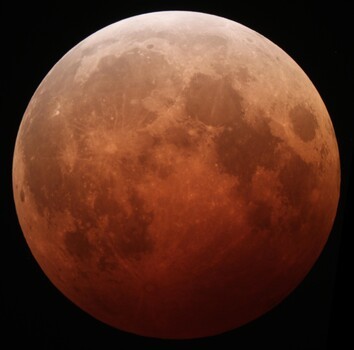
If you missed the big solar eclipse earlier this month, you have a shot tonight and early tomorrow morning at seeing a deep partial lunar eclipse, where about 96% of the Moon will be covered by the Earth's shadow. The result should be a very reddish, blood-moon-like appearance.
Unlike a solar eclipse, no special eye protection is needed for a lunar eclipse. The reddish color comes from sunlight passing through the Earth's atmosphere before reaching the Moon, with more of the red and orange wavelengths making it through while shorter blue wavelengths are scattered away.
This eclipse will be the most dramatic across North and South America, with the entire eclipse visible from the East Coast and Midwest. Viewers on the West Coast will see the Moon rise with the eclipse already underway, but will still see the maximum eclipse during the evening.(image courtesy thesuntoday.org)
In Europe and Africa, the eclipse will be visible in the early morning skies, with the best views in western Europe and western Africa. In general, observers farther west will have more time to watch the eclipse before the Moon sets.
While not as dramatic as a solar eclipse, people with clear skies should get a memorable event. Binoculars can make the changing color and the boundary of the Earth's shadow easier to appreciate, but no telescope is required. Parts of western and northern North America will see a total lunar eclipse on Dec. 31, 2028, while a total lunar eclipse visible much more broadly across the U.S. follows on June 25–26, 2029.
Getting Photos of the Eclipse
Everyone has different cameras and lenses, so I'll be general. During the eclipse, you'll have plenty of time to make adjustments and save the best images. A sturdy tripod will be a big help, and a remote shutter release or short self-timer can reduce camera shake.
When the Earth's shadow is the deepest, try 1–2-second exposures at an aperture of f/2.8 and ISO 800–1,600. That's a good starting place, but see what you've captured and make adjustments. If you're using a long focal length, check your images closely for motion blur and shorten the shutter speed if the lunar detail starts looking soft.
Photographers can also bracket their images to be sure they get something they'll want to save. Near maximum eclipse, the remaining bright portion of the Moon and the much darker shadowed area can differ considerably in brightness, so trying several exposures makes sense.
If you want to go deeper into night-sky shooting, Fstoppers' Photographing the World 2: Cityscape, Astrophotography, and Advanced Post-Processing covers astrophotography and post-processing in much more detail.
Owners of the newer smart telescopes have an easier job of it. Scopes like the Seestar S30 Pro and DWARF 3 smart telescopes can steer to the Moon and track it automatically. They can also create time-lapse videos.
Even with a Seestar S30 Pro or DWARF 3, it's worth doing a quick test before maximum eclipse so you can confirm the tracking, focus, and exposure while there's still plenty of time to make adjustments.
Eclipse Timing for North America
Here's the timing for North American observers using EDT; adjust for your time zone:
- Penumbral Phase Begins: 9:23 p.m. (Aug. 27) – subtle dimming.
- Partial Phase Begins: 10:33 p.m. – Earth's dark shadow starts covering the Moon.
- Maximum Eclipse: 12:13 a.m. (Aug. 28) – peak coverage and red glow.
- Partial Phase Ends: 1:52 a.m.
- Penumbral Phase Ends: 3:01 a.m.
Good luck and good weather.
Lead image by Alfredo Garcia, Jr, [2] - Flickr [1], CC BY-SA 2.0, https://commons.wikimedia.org/w/index.php?curid=36095092, cropped.
What's Your Reaction?
 Like
0
Like
0
 Dislike
0
Dislike
0
 Love
0
Love
0
 Funny
0
Funny
0
 Wow
0
Wow
0
 Sad
0
Sad
0
 Angry
0
Angry
0








Comments (0)