

What’s the Sigma’s FP2 for? making sense of a camera that fits between the usual categories
Its basic feature set might seem pared back, but it can be many cameras to many people. And not just for video.
 DPReview.com
The Sigma FP2’s modular camera concept means there are two ways to look at it: you can try to assess it based on what it is, or based on what it can be.
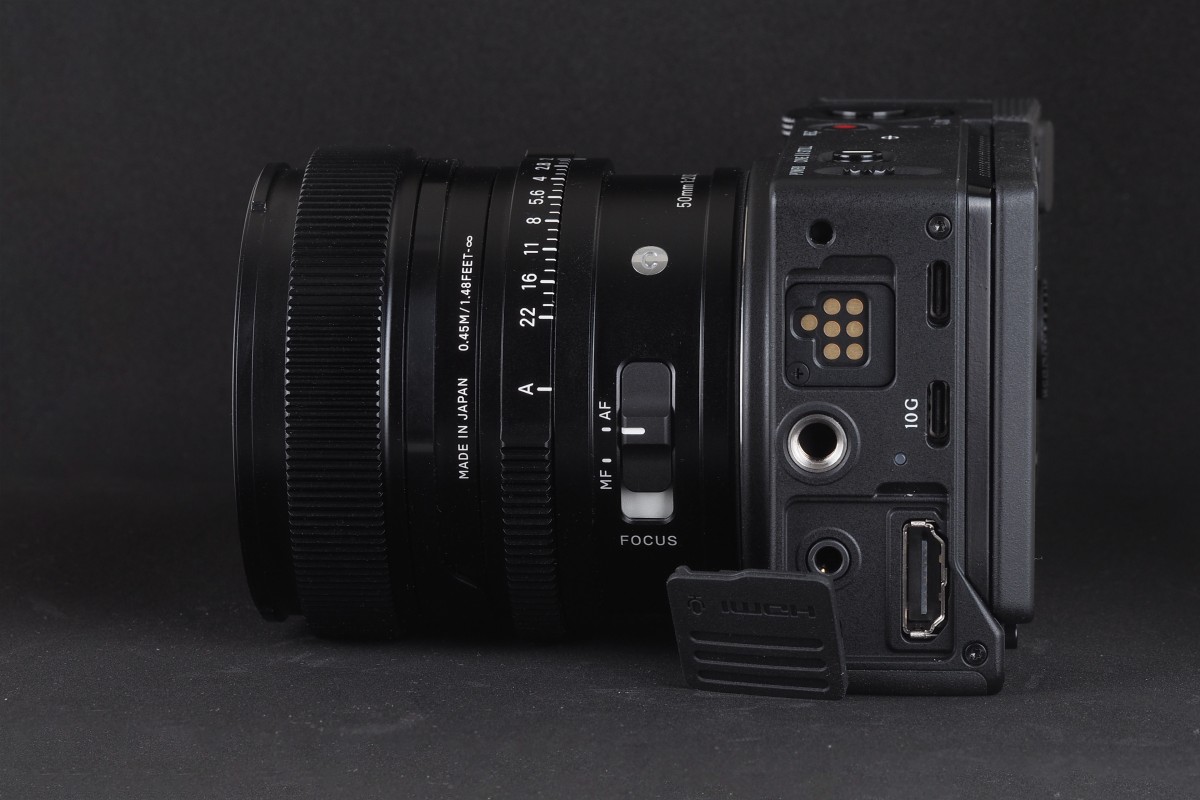
So, for instance, you can say “what good is it for video without a headphone socket?” or you can recognize that either of its USB ports can be used for attaching headphones and that that’s one potential setup. Meanwhile, a different user might build it into a rig with an external monitor or recorder that has a headphone out, with audio being delivered over HDMI.
 The Sigma FP2’s small size and flexible connectors mean it can be used in a variety of ways.DPReview
Likewise, stills photographers who want the smallest possible camera need not add a grip, but those who’re less squeezed for space can add one. It’s the same story again with viewfinders or the flash hot shoe. If these are features you need, the FP2 can offer them, but it doesn’t impose those decisions on other users. So a videographer wanting the least possible mass and the least awkward center of gravity can set up an FP2 on a gimbal more easily than most cameras, but the photographer who wants a grip and viewfinder can have that combination, too. On the days they want it.
How it compares
Its modular approach means that the Sigma FP2 doesn’t have any direct competitors or, at least, any to which it can be easily compared, as most rivals tend to have more complete intrinsic feature sets, rather than being designed to expand and adapt. In many cases, if your needs exactly dovetail with the features of a camera a major manufacturer has decided to make, then that will be the most cost-effective option. Especially as Sigma is a small-scale manufacturer in comparison to some of the electronics giants it’s up against. But it’s in situations where your needs haven’t been precisely anticipated by one of the big camera makers that the FP2 becomes an interesting option.
It’s in situations where your needs haven’t been precisely anticipated by one of the big camera makers that the FP2 becomes an interesting option.
We’re comparing the FP2 to Panasonic’s small, low-cost, vlogging-focused S9. It uses a slower 24MP sensor and has in-body stabilization, but no option to add a viewfinder or shoot flash. Nor does it have the ability to use Panasonic’s 32-bit float / XLR accessories, which the Sigma can, if you add the hotshoe accessory. We’re also comparing the FP2 with the Nikon ZR, a higher-end video camera than the Panasonic. It’s 40% larger than the Sigma but, like the Panasonic, is stabilized. It has a built-in hotshoe and manages to sync with a flash one third of a stop faster than the Sigma, despite being based on the same sensor.
Once you start considering the Nikon ZR, Canon’s very good EOS R6 V also comes into play, but it’s 50% heavier and at least twice the size of the Sigma, making it quite a different prospect.
| $2200 | $2200 | $1500 | $1900 |
| 24.5MP | 24.5MP | 24.2MP | 24.6MP |
| BSI CMOS (Partially stacked) | BSI CMOS (Partially stacked) | BSI CMOS | BSI CMOS |
| No | Sensor-shift | Sensor-shift | No |
| 20 JPEG/Raw | 20 JPEG only | 30 JPEG/Raw | 18 JPEG/Raw |
| Optional (5.76M dots, 0.88x mag) | No | No | Optional (3.86M dots, 0.83x mag) |
| 1/50 sec (with opt. hotshoe) | 1/60 sec | N/A | 1/30 sec |
| ProRes Raw (to SSD) H.265/L-Log 6K (10-bit) H.264 (8-bit) -6K Open Gate ≤ 30p -6K 16:9/1.89:1 ≤ 60p (30p in Raw) -4K 3:2 OG/16:9/1.89:1 ≤ 60p -4K 16:9/1.89:1 ≤ 120p w/ crop | N-Raw/R3D NE ProRes Raw H.265/N-Log (10-bit) H.264 (8-bit) Raw: -6K 16:9 Raw ≤ 60p (30p in PR Raw) -4K 16:9 Raw ≤ 60p -4K 16:9 Raw ≤ 120p with crop (60P in PR Raw) H.264/H.265: – 5.4K 16:9 ≤ 60p – 4K 16:9 ≤ 60p – 4K 16:9 ≤ 120p w/ crop Open Gate promised in 2027 | H.265/V-Log (10-bit) H.264 (10-bit) (4K/2K only) -6K Open Gate/16:9/1.89:1 ≤ 30p -4K 16:9/1.89:1 ≤ 30p -4K 16:9/1.89:1 ≤ 60p w/ crop | Cinema DNG (to SSD) H.264 (8-bit) -4K ≤ 30p |
| Yes (with opt. accessories) | Yes | No | No |
| Focus peaking Zebras Shutter angle False color Waveforms Desqueeze 709 Display Assist Timecode in | Focus peaking Zebras Waveforms LUT Display Assist Desqueeze promised in 2027 | Focus peaking Zebras Shutter angle Waveforms Vectorscope Desqueeze LUT Display Assist | Focus peaking Zebras Shutter angle False color EL Zone |
| Yes | Yes | Yes | Yes |
| Via USB | Yes | No | Yes |
| Yes | No | No | Yes |
| Yes (70GB) | No | No | Yes |
| Full Sized | Micro | Micro | Micro |
| 1 x USB-C (10Gbps, SSD, Charge/Power Delivery, UVC/UAC, Mic, Headphones, Remote) 1 x USB-C (480Mbps, Charge/Power Delivery, Mic, Headphones, Remote, Viewfinder) | 1x USB-C (10Gbps, Charge/Power Delivery, UVC/UAC) | 1X USB-C (10Gbps, Charge/Power Delivery) | 1x USB-C (5Gbps, SSD, UVC, Charge) |
| None | Wi-Fi 5 | Wi-Fi 5 | None |
| 370 | 350 | 470 | 280 |
| 113 x 70 x 42mm (4.4 x 2.8 x 1.6″) | 133 x 81 x 49mm (5.2 x 3.2 x 1.9″) | 126 x 74 x 47mm (5.0 x 2.9 x 1.9″) | 113 x 70 x 45mm (4.4 x 2.8 x 1.8″) |
| 460g (16oz) | 630g (22oz) | 486g (17oz) | 422g (15oz) |
The elephant in the video studio is the FP2’s lack of stabilization which, combined with its lack of front-facing screen pretty much rules it out for vlogging. But turn to more formal video, shot from a gimbal or sticks, and the Sigma suddenly becomes very competitive. Its Raw video isn’t as size-optimized as Nikon’s R3D NE but Pro Res RAW is an industry standard format. Its full-sized HDMI port makes it better suited to use with an external recorder or monitor and it offers a series of features, such as open gate shooting and desqueezed preview that the Nikon isn’t getting until some time in 2027.
The S9 is the better camera for handheld shooting and vlogging but the Sigma offers a Raw option and some very competitive high-res output. It can also support 4-channel audio and 32-bit float (the latter, ironically, through the use of Panasonic accessories that the S9 doesn’t support). And, of course, its more modern sensor halves the rolling shutter, making it much more usable in modes such as open gate.
For stills
We’ve mainly focused on its competitors with comparable sensors and no mechanical shutters, which has meant video-first cameras. And that absence puts the FP2 at a disadvantage as a stills camera, as its modular approach doesn’t extend to you being able to add one.
That said, the FP2 is the smallest full-frame mirrorless on the market and a well-built one, at that (you do feel you’re getting a high-quality product, for your money). Its improved autofocus and flip-out screen, along with the much larger battery, make it a big step forward for photographers, compared with the original fp. If size is important to you, the FP2 is a strong contender and has the option to add a grip or viewfinder when needed (and to remove them, when not). We also think it’s significantly nicer to use, for stills, than the S9.
 Stills shooters can add the very flexible 5.76M dot viewfinder when they need it. Or remove it when they don’t. Its tilting design is likely to be appreciated by some video shooters, too.DPReview
The relatively sparse selection of stabilized lenses in the L-mount system, combined with its lack of in-body stabilization holds it back as an everyday all-rounder. And, unsurprisingly, the bigger camera makers have addressed those needs very effectively. But, paired with small primes that have less need for stabilization and play better with its compact ethos, the Sigma delivers the most image quality available in a camera this size. And we don’t doubt there will be photographers willing to work with its limitations to gain those capabilities.
Follow DPReview to ensure our independent journalism reaches your feeds.


What's Your Reaction?
 Like
0
 Dislike
0
 Love
0
 Funny
0
 Wow
0
 Sad
0
 Angry
0











Comments (0)