

Why Your Rim Light Looks Weaker Every Time You Raise the Fill
Rim light and fill light pull against each other in a high-key portrait: brighten one, and the other suddenly looks weak. Getting the two to share the frame is what separates a bright, clean beauty shot from one that looks flat or burned out.
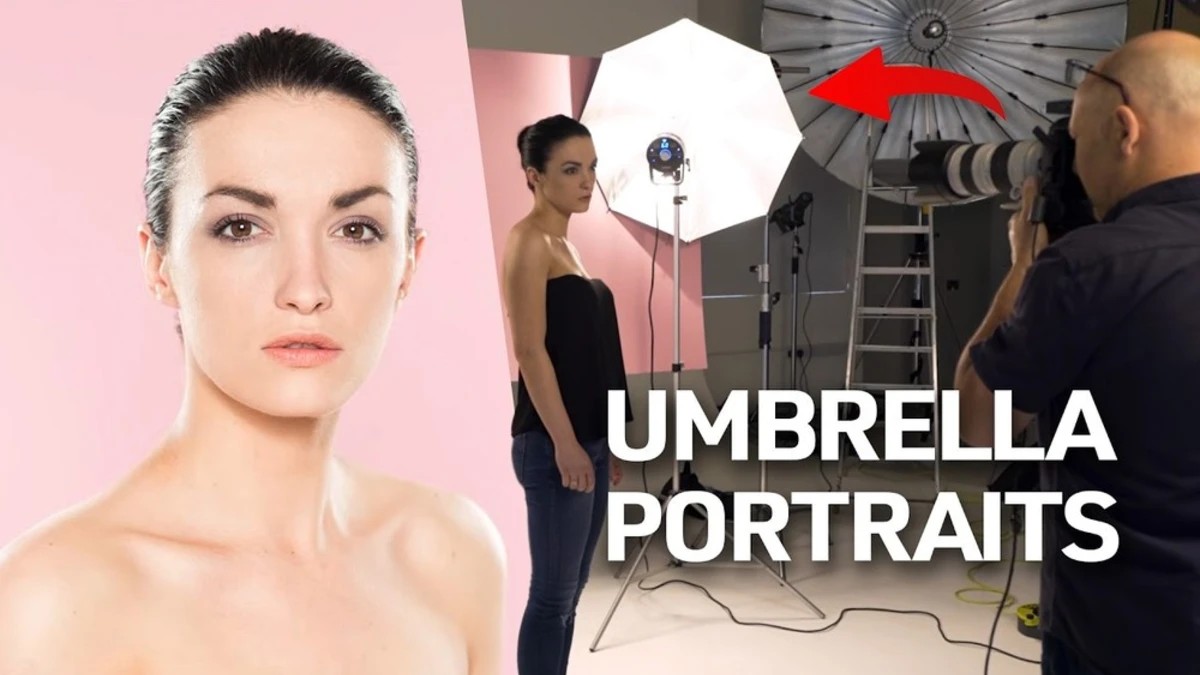
Karl Taylor of Visual Education builds a pop art beauty portrait from three umbrellas: two silver ones behind the model at 45 degrees and a Broncolor Focus 110 deep umbrella in front. The background is a sheet of hardboard painted pink, hung close enough to the rear umbrellas that their spill turns it a pale pastel. Taylor accepts that the wash won't be even, since the board sits closer to one light than the other, and he notes that tilting it would add a gradient if the unevenness became a problem. The model's hair is slicked back, and her shoulders are bare so the rim light can wrap around the hair, neck, and shoulders without anything breaking the edge. He shoots on a 70-200mm zoom at 70mm, at f/4, 1/60 s, and ISO 100.
Instead of testing each light on its own, Taylor fires all three at once. The front light is directional enough to hit the background, and with only three lights in obvious positions, he can read what each one is doing from a single frame. Before the first shot, he catches a mistake: one rear head is 400 J and the other is 800 J, so matching power settings leave them a full stop apart. His first test shows a strong rim and a fill that's badly underexposed. Raising the fill two stops makes the rim nearly vanish, and raising the rim two stops makes the fill look dark again. Each light's brightness only reads correctly next to the other, so a change to one effectively changes both.
Photographers usually describe that relationship as a lighting ratio, counted in stops. A one-stop difference between two lights is a 2:1 ratio, two stops is 4:1, and so on. Studio strobes like Broncolor's use a power scale where one whole number equals one stop. Speedlights on manual do the same thing in fractions, with each step from 1/1 to 1/2 to 1/4 cutting output by a stop. Taylor's back-and-forth works on any of these systems: change one light, look at the edge and the face together, and move the other light by a known number of stops. Deep parabolic modifiers have also spread well beyond high-end studios. The Profoto Umbrella Deep lets you slide the light along the shaft to make the beam tighter or wider. That puts the control Taylor works with into smaller kits.
The model's head position turns out to change the rim as much as the power dial does. With her body angled away, her head turns naturally toward one rear light, and more light glances off that side of her face. Taylor drops that light half a stop. The two edges then look even, even though the lights are no longer set evenly. On the way there, he tries pushing everything up half a stop and finds the front light has gone too far at 7, so he brings it back to 6.5 and leaves the rims raised. The fill ends up a touch brighter than before, because some of the extra light from the rear umbrellas bounces back onto the face. After that, he takes the reflector off the light in the Focus 110 and slides the head in and out along the shaft, comparing how hard the shadow under the jawline gets with each change.
To see those jawline comparisons and how the front light behaves in each position, watch the video above.
Get more Fstoppers in your Google feed: follow us on Google, and add us as a preferred source in Search.
What's Your Reaction?
 Like
0
Like
0
 Dislike
0
Dislike
0
 Love
0
Love
0
 Funny
0
Funny
0
 Wow
0
Wow
0
 Sad
0
Sad
0
 Angry
0
Angry
0









Comments (0)