

Would an Ansel Adams Photo Flop on Instagram Today?
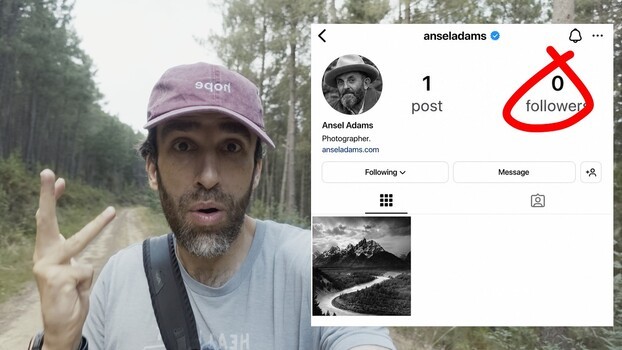
Strip Ansel Adams of his name, his reputation, and his place in history, then hand him a fresh account with zero followers. How many likes does "Monolith, the Face of Half Dome" actually pull? That thought experiment cuts straight into how you judge your own images and whether follower counts have anything to do with artistic worth.
The question comes from Adrian Vila, who admits upfront that he loves Adams' work and has read almost the entire library, including "The Camera," "The Negative," and "The Print." Vila's argument is simple: the masters didn't make their work in a vacuum. Adams shot at a specific moment and a specific place, pushing both the artistry and the technology of the American West farther than anyone before him. He wasn't the first to photograph those landscapes. He was working at the cutting edge of the gear available, hauling heavy equipment into remote spots and hiking with it just to photograph a rock or a tree, and few people could afford the cameras or the darkroom he had at home.
That context reshapes how you read "Monolith," made 99 years ago. Vila points out that the image means something entirely different now than it did in 1927. Back then, the accomplishment was producing such a detailed print of a landscape at all. Today an image like it would barely gain traction, because the technology, the expectations, and the culture have all shifted underneath it. He extends the same logic to Henri Cartier-Bresson in street photography and to Michael Kenna, whose work directly influences Vila's own long-exposure approach. Each of them was disruptive when they arrived, and in most cases the work was dismissed before it settled into the thing later photographers now call "traditional" or "real."
There's a useful principle sitting inside this for anyone shooting today. Recognition runs on a delay. What reads as canonical now was once strange enough to get ignored, and the gap between making the work and the work being understood can stretch across decades. That pattern holds well beyond photography. The photographers we treat as reference points were rewarded for stepping past what came before them, not for reproducing it, which puts the endless recreation of famous shots in a clearer light. Standing on the same overlook as a master and making the same frame teaches you plenty about craft. Treating that copy as the finish line is where the trouble starts, because the images that eventually get called "real" art tended to break from the reference rather than repeat it.
Vila is honest that this might sound irrelevant to most of us, since the vast majority aren't shooting to leave a mark on photography's history. He still makes the personal case for it. Going to locations and remaking images that other photographers have already made is how he learns, and he has no problem admitting it. The point is to move past that at some point, following your own gut and your own instincts even when the work gets no attention. Staying true to yourself matters more than the traction, and maybe in 15, 20, or 100 years that overlooked work becomes settled art. The evolution doesn't have to be total. Some shift just has to happen.
He frames the whole reflection around a slow stretch, admitting photography hasn't been treating him well lately and that the harsh midsummer light isn't helping. That framing keeps the video grounded rather than preachy, and it lands the actual takeaway: separate the artist's name from the artwork and you're forced to confront what you genuinely value in an image.
Watch the full breakdown in the video above to hear how Vila connects Adams, Cartier-Bresson, and Kenna into a single argument about finding your own voice.
What's Your Reaction?
 Like
0
Like
0
 Dislike
0
Dislike
0
 Love
0
Love
0
 Funny
0
Funny
0
 Wow
0
Wow
0
 Sad
0
Sad
0
 Angry
0
Angry
0






Comments (0)