

A $395 Lens Just Beat a $900 Nikon at Its Own Game
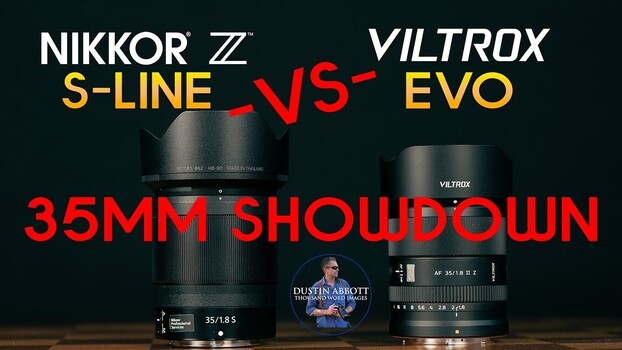
For years, Nikon's f/1.8 S-line lenses stood almost alone: premium optics at a maximum aperture where you rarely find premium anything. That comfortable spot is now under real pressure, and a head-to-head test shows exactly how much.
Dustin Abbott pits the Nikon Z 35mm f/1.8 S against the newer Viltrox EVO 35mm f/1.8 on Z mount, scoring them across build, autofocus, video, and optics. The price gap frames the whole thing. The EVO carries a $395 MSRP, while the S-line lens lists near $900 and sits around $796 discounted. Abbott notes the Viltrox is also the smaller lens at 69 mm in diameter versus 73 mm, though the Nikon is actually lighter by 11 grams on his scale. Both carry nine aperture blades and some weather-sealing, but the sealing story differs in ways worth hearing him spell out.
Features tilt hard toward the EVO. Abbott points out its clickable aperture ring with a de-click switch, a custom button, and an AF/MF switch, against the S-line's single ring handling focus, aperture, and other duties. The Nikon claws back points where you might not expect: it focuses closer at 25 cm for a 0.19x magnification, against 34 cm and 0.15x on the Viltrox, a difference he calls very noticeable in practice. First-party support and a full professional grade of weather-sealing with roughly eight seal points also go Nikon's way. Autofocus lands close, with both using stepping motors and trading almost nothing on speed or accuracy, though the EVO runs slightly quieter.
The video round is where the S-line lens shows its best form. Abbott rates this his favorite of the S-line primes he has tested for video, crediting its cinematic, well-damped focus pulls and notably lower focus breathing. The EVO answers with better ring performance, a more precise manual focus feel, and a dedicated aperture ring that avoids the lag he found when racking aperture through the Nikon's single ring. That lag runs about two stops, meaning the camera reads f/8 while the ring is still traveling toward f/11. Both lenses stay effectively silent for stills.
Then comes optics, and the score swings. Abbott finds the EVO sharper in the center, mid-frame, and corners wide open, and it extends that lead when stopped down. He also credits its apochromatic design for much lower fringing on three-dimensional subjects, plus better flare resistance, softer bokeh, and stronger micro contrast. The full breakdown of where the S-line stays competitive is worth watching him walk through.
The broader signal here is bigger than one focal length. For most of the Z mount era, third-party glass on Nikon's platform was thin, since Nikon was slow to license the mount and slower to see independent makers fill the gaps that Sony E shooters took for granted. Viltrox's EVO line arriving with clickable aperture rings, apochromatic corrections, and shared 58mm filter threads across the range reflects how quickly that landscape has flipped. If you shoot Z mount and have been waiting for the affordable-but-serious tier that E-mount owners enjoyed, this is the shape it takes. Standardizing on one filter size across a whole lens family is a quiet convenience that adds up fast when you stack circular polarizers and neutral-density filters across several primes, and it is a planning detail worth weighing before you commit to a system.
Watch the full comparison above to see how every round scored and where the final tally landed.
What's Your Reaction?
 Like
0
Like
0
 Dislike
0
Dislike
0
 Love
0
Love
0
 Funny
0
Funny
0
 Wow
0
Wow
0
 Sad
0
Sad
0
 Angry
0
Angry
0









Comments (0)