

Which Canon Camera Is Best for Filmmakers?
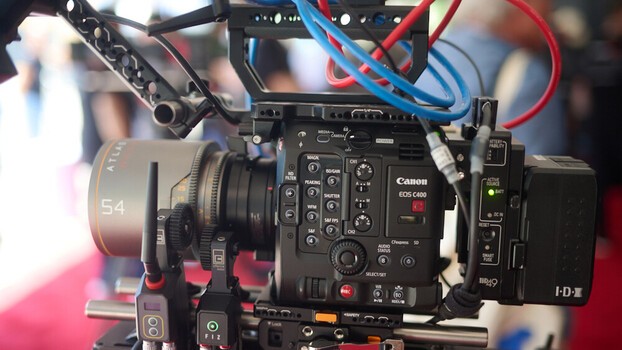
Canon has been busy lately, producing a variety of cameras aimed at satisfying a wide array of users. But which one is right for you?
I've shot films and commercials with pretty much every brand of camera on the market by this point. At the moment, I own primarily RED cameras for my motion work and tend to rent Alexas when the budget allows. But I've owned multiple Canon systems over the years, from workhorses like the C200 to mirrorless hybrids like the R5 C. But having gone a couple of years since I last owned a Canon camera, I'd lost track of the exact shape of their product line. This is why I made a special point at a recent Cine Gear event of stopping by the Canon booth to get a rundown on what they have to offer, with a specific focus on filmmaking.
This won't be a review, since I haven't actually used all of the cameras on this list. And there's no such thing as a perfect camera, only the camera that's perfect for you. But with that in mind, I thought it would be helpful to look at what differentiates the cameras in Canon's cinema line and try to identify which market segments are best suited to each option.
Note that we will be discussing the video-focused cameras today, so we will not go in depth into higher-resolution, stills-oriented cameras like the R5 II or R1. Also, as some features overlap between these cameras, I will try to focus more on what sets them apart than on what they all share in common, so as to better inform your purchasing decision. If you want to brush up on the fundamentals of moving from stills to motion work, Canon shooters making that jump may also find Introduction to Video: A Photographer's Guide to Filmmaking a useful primer.
So let's go from least expensive to most expensive and discuss what sets each apart.
Canon EOS R6 V — $2,499
Starting our list is the newest kid on the block, the Canon EOS R6 V. The smallest of the bunch, this hybrid mirrorless option is geared toward the video side of things. In build type, it looks similar to something like the ZR or FX3, with the fully articulated LCD but lacking an EVF.
Key Features
32 MP full-frame CMOS sensor
7K 60
Open gate
15 stops of dynamic range in C-Log 2
1 CFexpress Type B slot
1 SD slot
Tripod mount on both bottom and side for vertical shooting
Full-size HDMI
Internal Canon Raw
False color, focus peaking
Speed zoom rocker
No EVF
IBIS
GPS
No mechanical shutter
No anamorphic desqueeze
Who Is This For?
With its small size and portability, this seems to me like a camera designed for content creators. With no EVF or mechanical shutter, I'm not sure this would be my first choice if I were someone who shot a lot of stills. But if you are primarily a video shooter and weight and portability are a major concern, this might be a good place to start.
Canon R6 III — $2,799
I know I said I wouldn't talk much about photo-centric cameras, but I think the R6 III deserves specific notice here as a real alternative to the R6 V, depending on your shooting style, specifically the addition of a built-in EVF.
Key Features
32 MP full-frame CMOS sensor
7K 60
Open gate
15 stops of dynamic range in C-Log 2
1 CFexpress Type B slot
1 SD slot
Full-size HDMI
Internal Canon Raw
False color, focus peaking
Built-in EVF
Electronic and mechanical shutter
No anamorphic desqueeze
IBIS
GPS
Who Is It For?
While a whopping 9 grams heavier than the R6 V, the R6 III has a number of advantages that may appeal to certain types of shooters. While the recording options are essentially the same between the R6 V and the R6 III, the R6 III adds a built-in EVF. This is merely a matter of preference, but for someone like me who only shoots stills with an EVF, and whose eyesight is deteriorating to the point where I also shoot video with an EVF, not needing to find an external EVF solution is huge. While the R6 III is $300 more, that number pales in comparison to the price of a decent external EVF, and it takes away the hassle of rigging. Additionally, for photographers specifically, the mechanical shutter option may be a big advantage, depending on your lighting situation.
Canon EOS C50 — $3,899
The lowest-cost option in the official Canon "cinema" line, the C50 has many of the same specs as the R6 III and R6 V, but inside a more robust and riggable body. Halfway between a mirrorless camera and a deeper box-style camera in ergonomics, the C50 adds a crucial element for those going beyond solo content creation and venturing into more professional filmmaking: a dedicated timecode port. It also has a dual base ISO of 800 and 6400 and comes with a top handle that adds dual XLR audio inputs. Unlike the smaller cameras, the C50 also adds anamorphic support. Notably for run-and-gun shooters, the C50 does not have IBIS. For many filmmakers, this is actually a plus, but it's worth noting for those who rely on it.
Key Features
34.2 MP full-frame CMOS sensor
7K 60
Open gate
16 stops of dynamic range in C-Log 2
1 CFexpress Type B slot
1 SD slot
Full-size HDMI
Internal Canon Raw
False color, focus peaking
Speed zoom rocker
Anamorphic desqueeze
Simultaneous crop recording
Supports Cooke /i lens communication
No IBIS
Dual base ISO at 800 and 6400 (variable based on color space)
Who Is This For?
While the C50 is capable of taking stills and is somewhat mirrorless-shaped, the focus here has clearly shifted toward video. Adding anamorphic desqueeze and a dedicated timecode port, the C50 takes on those base elements that are absolute requirements in a team workflow. Additionally, the simultaneous crop recording, which lets you shoot both vertical and horizontal versions of your footage at the same time and record them to separate cards, may be a big advantage for shooters working primarily in the social media space.
Canon EOS C80 — $5,499
Slightly more robust and all-in-one, the C80 (the successor to the popular C70) adds a triple base ISO to the mix at 800, 3200, and 12,800. While the C50 has XLR inputs via the top handle, the C80 provides dual mini-XLR inputs on the body itself. Speaking of the body, in addition to the vertical mounting point that makes this camera handy for social content, the base of the camera features a far more robust mounting plate, allowing for maximum riggability. The C80 adds built-in NDs, key for exterior shooting on the go. Canon advertises 16 stops of dynamic range. Importantly, the C80 adds an SDI port alongside the full-size HDMI. The larger the project and the larger the crew, the more likely it is that you will be operating in an SDI world, so this distinction is crucial for many shooters.
Key Features
19.05 MP full-frame BSI stacked CMOS sensor
6K 60
Open gate
16 stops of dynamic range in C-Log 2
Triple base ISO (800, 3200, 12,800)
2x SD card slots
Tripod mount on both bottom and side for vertical shooting
SDI connection
BNC timecode port (shared with video out)
Full-size HDMI
Internal Canon Raw
False color, focus peaking
Speed zoom rocker
Anamorphic desqueeze
Simultaneous crop recording
Supports Cooke /i lens communication
Built-in NDs
2x mini-XLR ports
IBIS
Who Is This For?
Continuing to progress toward higher-end working models, the inclusion of an SDI port is a major advantage for established filmmakers working with a multitude of SDI-attached devices. With the mini-XLR ports built directly into the body, the C80 adds mounting options beyond the C50, which requires the top handle for XLR input. The triple base ISO makes this camera well suited for run-and-gun-style shooting in a variety of situations.
Canon EOS C400 — $8,799
The big brother of the bunch, the C400 is Canon's most complete cinema camera. A true box-style camera, this is the cinema camera for the Canon shooter who works in elevated production scenarios and can't make excuses. The body is covered in mounting points, making it infinitely riggable. It easily integrates with third-party power solutions and gold-mount/V-mount plates.
Key Features
19.05 MP full-frame BSI stacked CMOS sensor
6K 60
Open gate
16 stops of dynamic range in C-Log 2
Triple base ISO (800, 3200, 12,800)
Dedicated timecode, genlock, and return video ports
1 CFexpress Type B slot
1 SD card slot
Lens communication (Cooke /i)
Tripod mount on both bottom and side for vertical shooting
2x SDI connections
1x full-size HDMI
Internal Canon Raw
False color, focus peaking
Speed zoom rocker
Anamorphic desqueeze
Simultaneous crop recording
Supports Cooke /i lens communication
Built-in NDs
2x mini-XLR ports
IBIS
Who Is This For?
The C400 is for the filmmaker who needs to be ready for the demands of a full production crew. The multiple SDI ports are critical when you need to send a signal to video village and/or a focus puller simultaneously. The built-in NDs add efficiency in the field, and the triple base ISO is ready for all situations. Additionally, the two mini-XLR ports add real audio capabilities for capturing audio in camera.
Which Is Right for You?
Well, only you can tell which of these Canon cameras is the right fit for your workflow and budget. Hopefully, this list gives you some idea of the differences between the models. Suffice it to say, there's a little something for everyone, from the high end to the low end. The main differentiator in most cases is the form factor of the camera itself and the connectivity options, as well as the addition of multiple base ISOs on the high end. Only you know what's best for your particular situation, so which of these cameras is the perfect tool for you?
What's Your Reaction?
 Like
0
Like
0
 Dislike
0
Dislike
0
 Love
0
Love
0
 Funny
0
Funny
0
 Wow
0
Wow
0
 Sad
0
Sad
0
 Angry
0
Angry
0





Comments (0)