

BNB Chain Tokenized Equities Near 50 Percent as bStocks Surges
TLDR:
- BNB Chain tokenized equities now represent roughly 45% of tracked supply, placing the network near half of the $2.9 billion market.
- bStocks supplied most of the increase, surpassing $500 million in assets under management while cumulative trading topped $19 billion.
- Ethereum still controls about 45% of the broader RWA market, supported by Treasuries, private credit, funds and other asset classes.
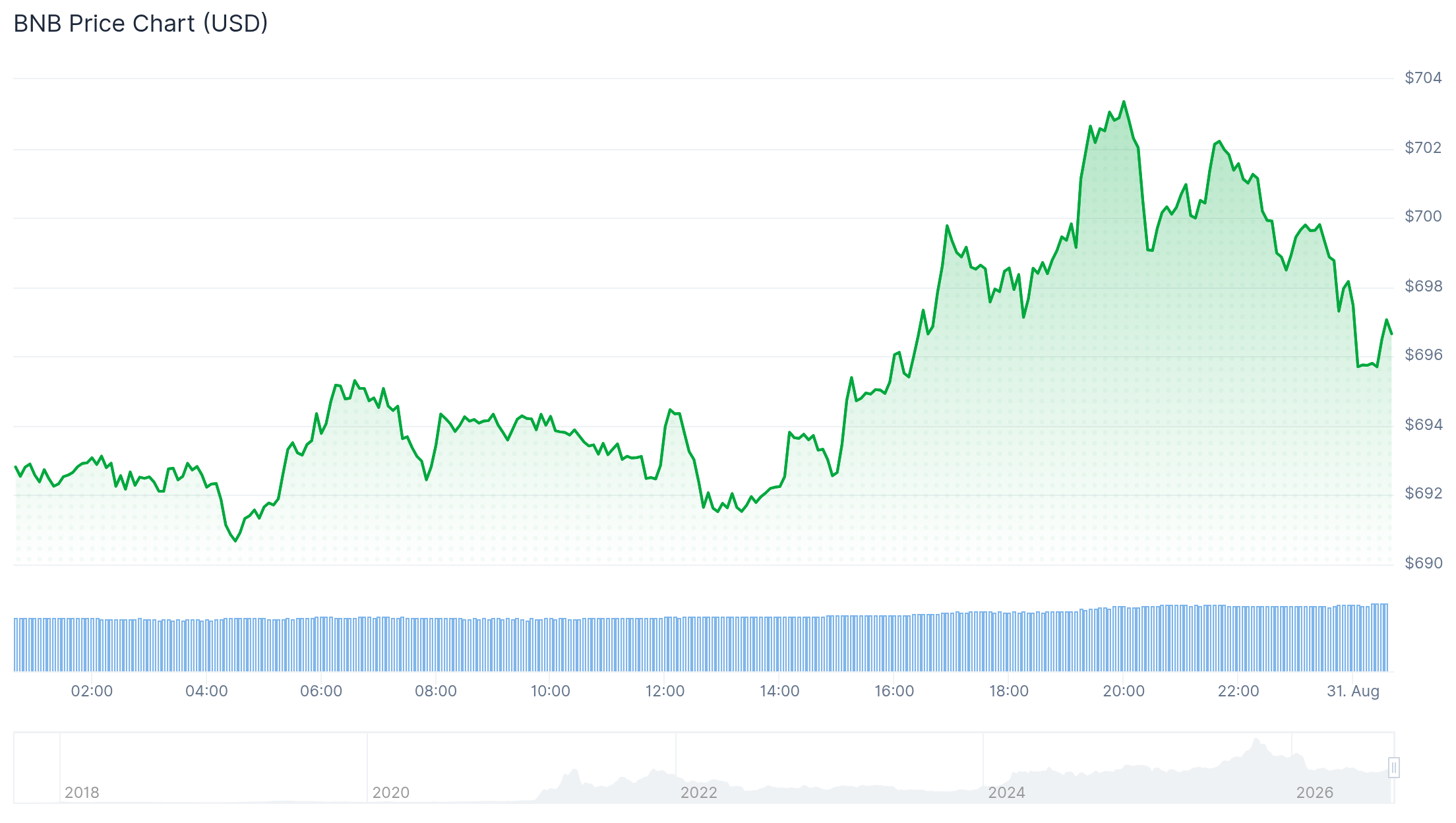
- BNB faces resistance near $700, with $720 as the next upside level; losing $680 could expose the $660 to $670 support zone.
BNB traded near $700 after a 0.91% daily rise, matching the broader crypto market’s positive move. Meanwhile, BNB Chain tokenized equities moved above $1.3 billion, giving the network nearly half of the $2.9 billion tracked supply. Ethereum held about $800 million during August, while Solana reached roughly $550 million on-chain.
Avalanche carried close to $170 million, and smaller chains contributed little. The shift followed bStocks’ June launch, which quickly expanded issuance and trading on BNB Chain. This concentration explains the lead and its risk. One product family drives much of the network’s growth amid demand for round-the-clock equity exposure worldwide.
Binance Coin (BNB) PriceBNB Chain tokenized equities climb through bStocks demand
Before June, Ethereum led tokenized-equity supply. BNB Chain stayed below $500 million after months of steady growth. bStocks changed that order within weeks. BNB Chain tokenized equities passed $1.3 billion by August’s end, while Ethereum stood near $800 million.
The figures place BNB Chain tokenized equities at roughly 45% of the measured market, supporting the “nearly 50%” description. Blockworks tracks supply across issuers, networks, stocks, exchange-traded funds and indices. Its methodology measures tokenized exposure, not conventional shares in brokerage accounts.
bStocks drove most of the increase, rather than equal growth across issuers. The product accumulated over $500 million in assets under management after its June launch. It crossed that threshold within seven weeks, after starting with $5.6 million.
The platform expanded from five tickers to over 46 by late July. Market figures now place the active roster above 67 assets. Cumulative volume has surpassed $19 billion, indicating regular turnover rather than dormant issuance.
That activity helps explain why BNB Chain tokenized equities advanced so quickly. Users can trade eligible products around the clock and convert between tokens and underlying securities. On-chain settlement also allows supported assets to connect with exchanges, lending markets and automated strategies.
Those features require an important legal distinction. Binance states that bStocks are certificates representing financial instruments, not direct company shares. Holders therefore do not automatically become registered shareholders of the underlying businesses. Availability also depends on jurisdiction, eligibility rules and approved offering documents.
Concentration creates a measurable test for BNB Chain. Continued bStocks issuance could support liquidity, transactions and decentralized exchange activity. Slower adoption would expose how much of the network’s lead depends on one product family.
Ethereum still leads the broader real-world asset market
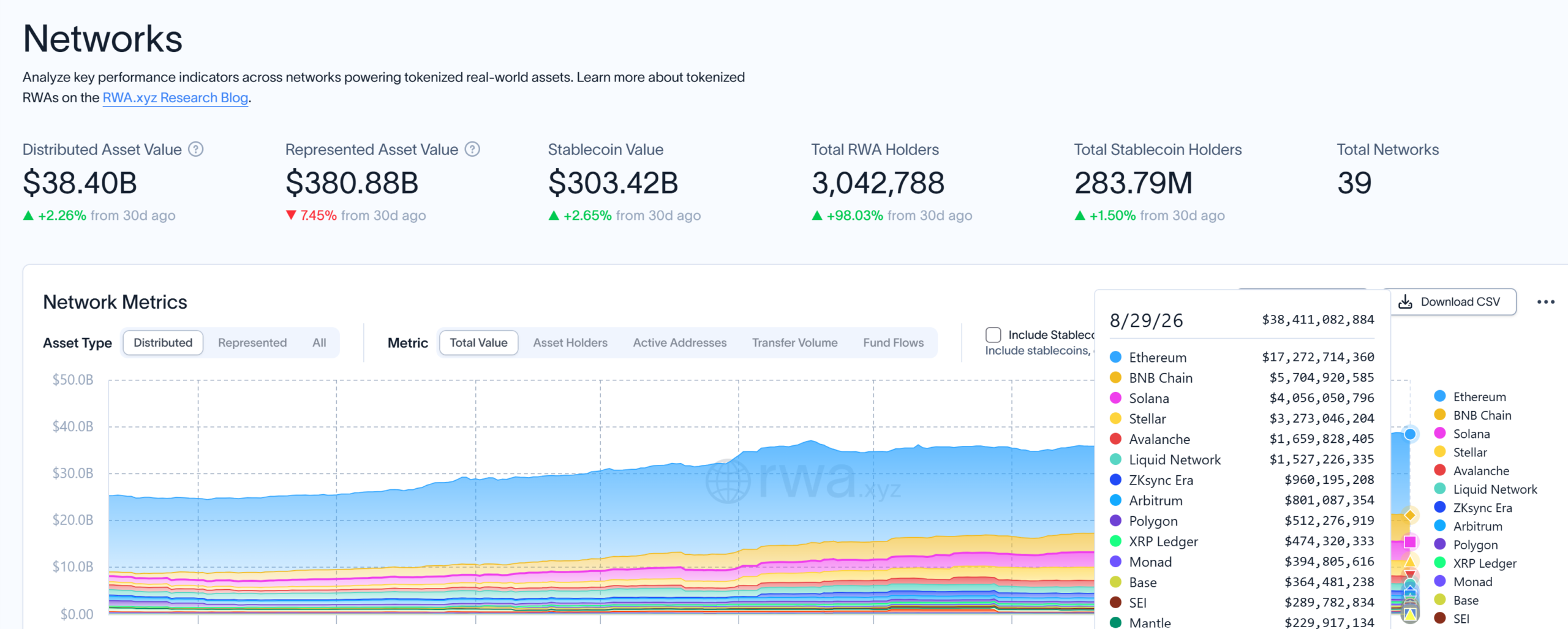
BNB Chain tokenized equities do not lead the full real-world asset sector. RWA.xyz places the network near $5.7 billion within a $38.4 billion market. That equals about 15%, below Ethereum’s roughly $17.27 billion and 45% share.
 Source: RWA.xyz
Solana follows BNB Chain with about $4.06 billion in wider RWA value. Ethereum draws capital from Treasuries, private credit, funds and other instruments. This broader mix reduces reliance on tokenized stocks.
BNB Chain tokenized equities therefore represent a strong product lead, not overall RWA dominance. Expansion into Treasuries and funds could diversify capital sources and improve retention. Without that mix, slower equity issuance could widen Ethereum’s advantage across real-world assets.
The network still benefits from existing stablecoin liquidity and decentralized trading venues. These rails can shorten the path between issuance, secondary trading and collateral use. Liquidity depth, redemption terms and legal access will determine whether supply growth produces durable activity.
BNB’s price move currently appears tied more closely to market beta than this RWA milestone. A reported 81% 30-day correlation between crypto market capitalization and gold points to shared macro sensitivity. It does not establish that tokenized-equity growth caused the daily gain.
Technically, $700 remains the immediate resistance after BNB traded around $699.82. A sustained break could expose $720, while $680 provides initial support. Losing $680 would reopen the $660 to $670 area, particularly if Bitcoin fails to hold $79,000.
The post BNB Chain Tokenized Equities Near 50 Percent as bStocks Surges appeared first on Blockonomi.
What's Your Reaction?
 Like
0
Like
0
 Dislike
0
Dislike
0
 Love
0
Love
0
 Funny
0
Funny
0
 Wow
0
Wow
0
 Sad
0
Sad
0
 Angry
0
Angry
0












Comments (0)