

Can Laowa's New Ultra-Macro Lens Replace Canon's MP-E 65mm?
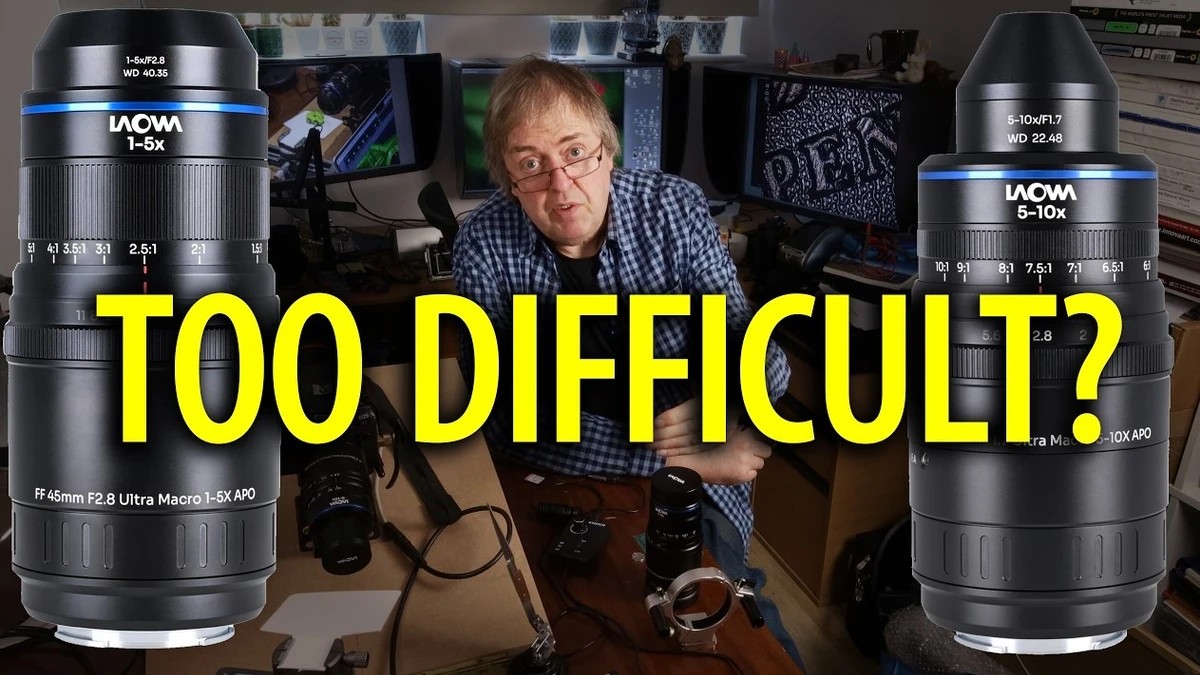
Laowa's two new Aksen Ultra Macro APO lenses cover everything from life size to 10 times life size. At that scale, depth of field shrinks to a sliver, light drops off as you zoom, and the gear around the lens decides as much about the result as the glass does.
The lower-magnification Laowa Aksen 45mm f/2.8 1-5x Ultra Macro APO gets the most hands-on time when Keith Cooper puts both lenses through commercial-style work on a Canon EOS R5, shooting electronic components, a memory module, and a miniature rose. Cooper has used the Canon MP-E 65mm f/2.8 1-5x Macro Photo for years, and the newer lens behaves differently in one useful way. On the Canon, the lens extends and the focus point moves as you change magnification. On the Laowa, you turn the ring and the image grows while the focus point stays essentially fixed in front of the lens, so you don't have to rebuild your setup every time you want a tighter view. The lens has no electronics or contacts at all, which means the camera has no idea what's mounted. Cooper also found it noticeably cleaner than the older Canon for both lateral and longitudinal chromatic aberration.
Aperture works differently up close, and Cooper spends real time on what that means in practice. As you increase magnification, the image gets darker at the same marked f-stop, so you'll be adjusting ISO or shutter speed as you zoom. On the 1-5X, he saw very little sharpness difference between f/2.8 and f/4, though f/4 bought a slightly thicker slice of focus that helps when stacking. At low magnifications, f/5.6 still held up well, while higher magnifications showed diffraction softening clearly. The miniature rose took 60 to 70 frames to stack, and the memory module at 5x took around 90, each shot separated by tiny movements on a motorized StackShot rail controlled through Helicon Remote and merged in Helicon Focus. Dust is a constant problem too: Cooper figures a freshly unpacked component gives you 25 minutes to half an hour before airborne dust settles on it.
The darkening Cooper describes follows a simple rule. The effective f-number is roughly the marked f-number multiplied by one plus the magnification, so f/2.8 at 5x behaves close to f/17, and at 10x it lands near f/31. A focus rail fills a role that in-camera tools can't here. Bodies like the R5 offer focus bracketing, but that feature drives a lens' autofocus motor, and a lens with no electronics has nothing for the camera to drive. Moving the whole camera on a rail is the only way to step through the subject, which is why a Cognisys StackShot or similar rail ends up being part of the kit rather than an optional extra. Coaxial lighting, which appears on the higher-magnification lens, comes from industrial inspection and microscopy, where light is sent down the same path the lens looks along. That arrangement is built for flat, reflective surfaces like wafers, polished metal, and circuit traces, which bounce the light straight back into the lens. If most of your subjects are matte, textured, or curved, that origin tells you a lot about where the feature will and won't shine before you ever try it.
The Laowa Aksen 17.5mm f/1.7 5-10x Ultra Macro APO asks for far more care than its sibling. Cooper lets everything settle for a couple of seconds between each step of the rail, and he recommends the electronic shutter when your lighting allows it, to cut every possible source of vibration. His subject platform is a homemade board with a piano hinge, wedged at different angles and built on adjustable mounting plates, since at this scale moving the subject is easier than moving the camera. He also shoots small parts on textured mount board so the stacking software has detail to lock onto; perfectly smooth surfaces give it nothing to find. One 10x stack of two tiny chips took a couple of hundred frames, and Cooper works out how many more a slightly wider aperture would have required. The coaxial version adds a side port, an internal prism, and a USB-powered dimmable light that sends a small, slightly bluish beam out the front of the lens, and Cooper tests it on both chips and an embossed coin to show how differently the two subjects respond.
Cooper's coaxial light results and more are in the video above.
What's Your Reaction?
 Like
0
Like
0
 Dislike
0
Dislike
0
 Love
0
Love
0
 Funny
0
Funny
0
 Wow
0
Wow
0
 Sad
0
Sad
0
 Angry
0
Angry
0










Comments (0)