

Claude Fable 5 brings Mythos to the masses — Anthropic's new frontier model is 'state-of-the-art on nearly all tested benchmarks'

 (Image credit: Anthropic, AMD)
Ever since Anthropic first made the earth-shaking disclosure of its incredibly capable Claude Mythos AI model back in April and the steps it was taking toward a safe release of that product, the AI public has been waiting with bated breath to get its hands on its capabilities to give them a spin. Now, with today's release of Claude Fable 5, Anthropic says it finally has a model of this class that's "safe for general use." Anthropic is also releasing the unrestricted Mythos 5 model to members of its Project Glasswing program for use in sensitive cybersecurity and biology contexts.
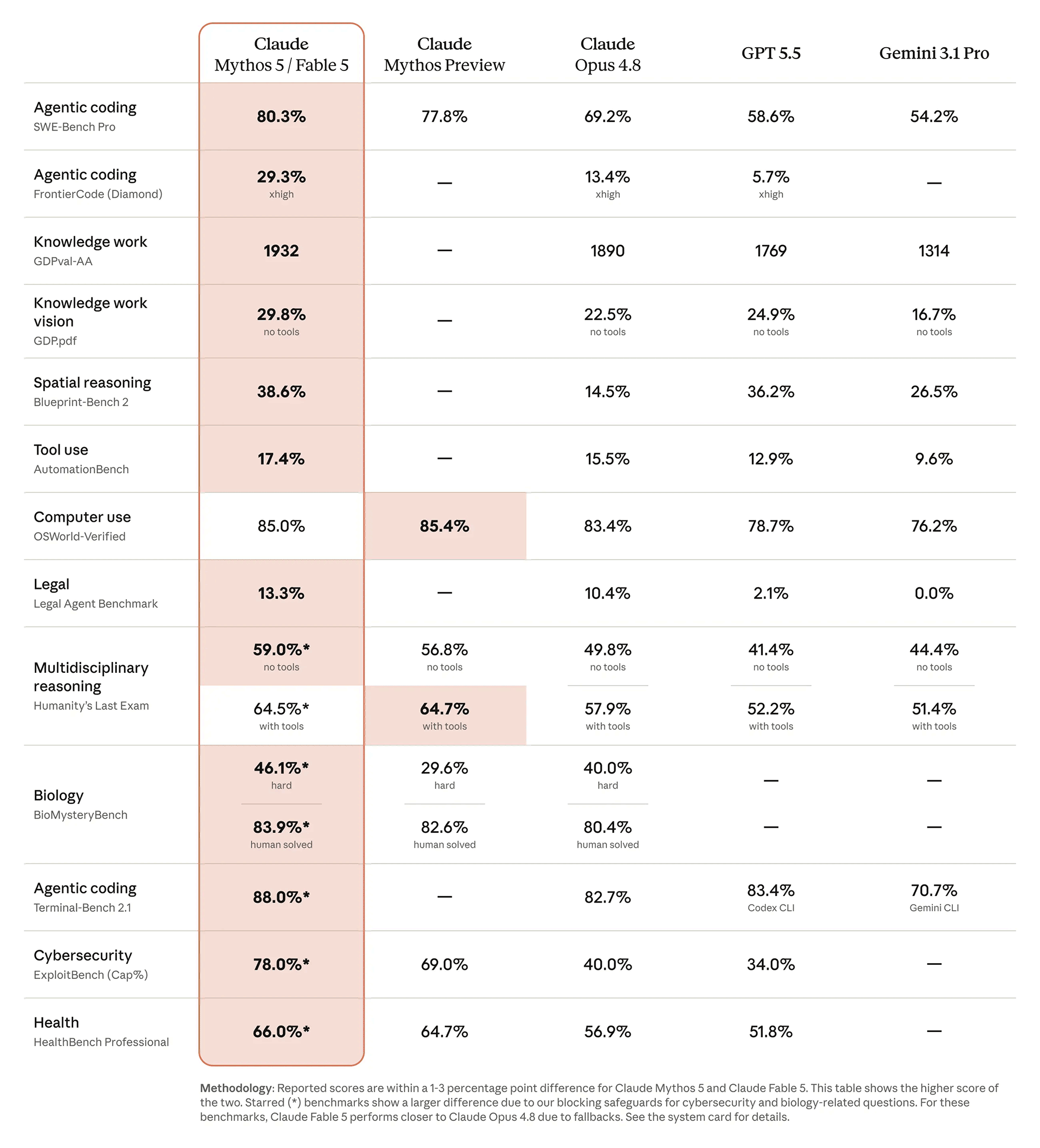
As with every new cutting-edge model from frontier labs, Anthropic has a selection of benchmarks of Fable 5's performance across a range of widely accepted tests that highlight its state-of-the-art-ness, but those numbers aren't as interesting as the specific use cases that the company highlights for this level of capability.
For example, the company highlights how Stripe was reportedly able to perform the migration of a 50-million-line Ruby codebase in a single day that would have otherwise required two months of team effort had it been performed by hand. That sort of task compression on a job of such massive scope illustrates how Fable 5 and Mythos 5 "can work autonomously for longer than any previous Claude models," in addition to their high overall level of capability.
Claude Fable 5 beats Pokémon FireRed only using vision - YouTube
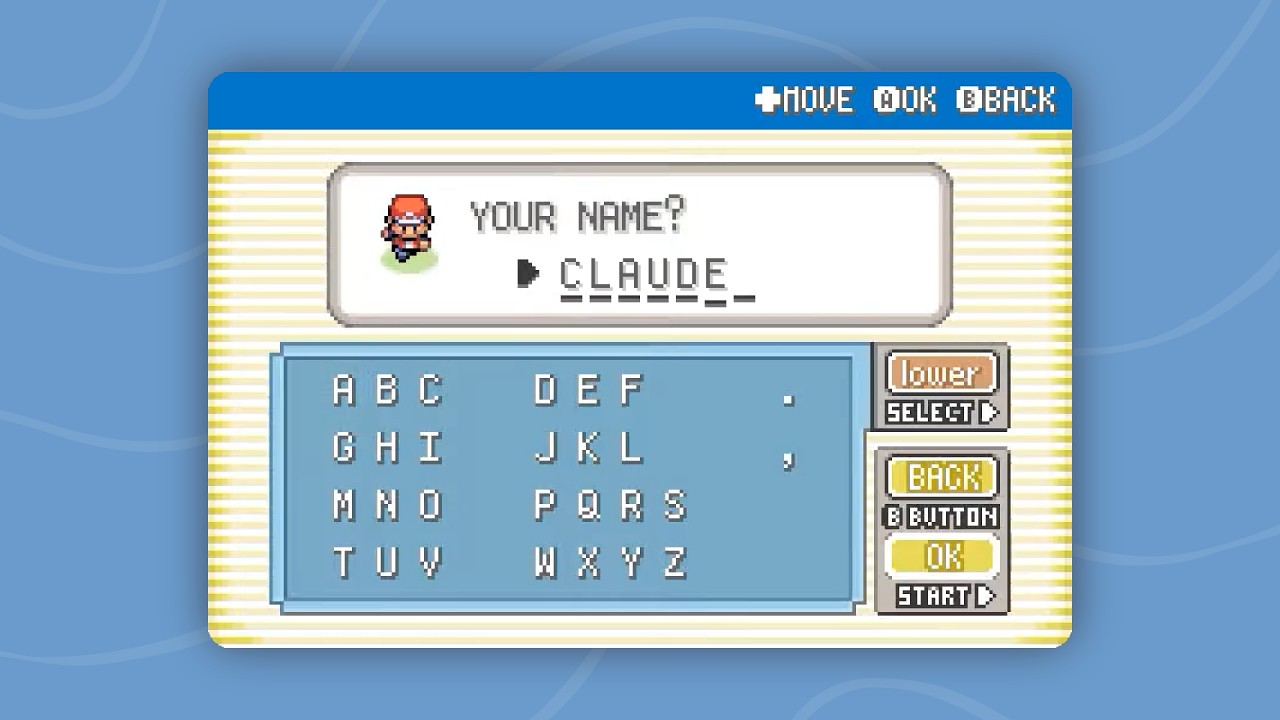
For vision tasks, Anthropic simply says that Fable 5 is "the new state-of-the-art model." Among other accomplishments, the company says it was able to play through Pokemon FireRed in its entirety using only a "minimal, vision-only harness." Past models apparently struggled to complete this task even with the ability to seek outside help via tool-calling.
Wharton School professor and AI blogger Ethan Mollick also has vivid examples of what Fable can do. Among other tasks, he describes how he gave Fable a 19-page spec document for the development of a categorization and analysis tool for unstructured survey answers. He describes how the model worked for "nine and a half hours" to generate an "extremely sophisticated" tool that "researchers have needed for years but was never profitable to create."
In order to keep Mythos-level capabilities out of the hands of malicious actors, Anthropic says it will be redirecting queries on certain topics, namely "cybersecurity, biology and chemistry, or distillation," to the last-gen Claude Opus 4.8 instead. The company says that users will be informed whenever this redirection occurs, and that it should trigger in "less than 5%" of interactions with the model.
Mollick, however, says these limitations trip "at the faintest hint of a security problem," suggesting that even the well-intentioned won't be able to use Fable 5 to bolster the security of their code bases.
Get Tom's Hardware's best news and in-depth reviews, straight to your inbox.
According to its model card, Fable 5 will also be nerfed in instances where a user attempts to use it to further cutting-edge AI or ML research, which is likely not only motivated by the company's recent concerns around AI self-improvement but also likely to be motivated by competitive concerns with other labs and with geopolitical actors.
Within those guardrails, Anthropic says Fable 5 is available everywhere today, and that access to it will be billed at $10 per million input tokens and $50 per million output tokens via the company's API. That's twice the cost of the now-last-gen Opus 4.8 and just over 3X the cost of Sonnet 4.6.
Those on Anthropic's Pro, Max, Team, and Enterprise subscription plans will have a short gratis access window to Fable 5, from now until June 22. After that point, access to the model will require paying for usage credits. The company says it will restore access to Fable 5 through these plans "as quickly as we can" when it has the compute capacity to do so.
The world hasn't ended as of this writing now that a public Mythos-class model is available. It'll surely be interesting to see what problems people are able (and aren't able) to tackle with an AI model of this level of capability—and with this degree of restriction around its capabilities. The only thing we can say for certain is that things are only going to get weirder from here.

Follow Tom's Hardware on Google News, or add us as a preferred source, to get our latest news, analysis, & reviews in your feeds.
As the Senior Analyst, Graphics at Tom's Hardware, Jeff Kampman covers everything that has to do with graphics cards, gaming performance, and more. From integrated graphics processors to discrete graphics cards to the hyperscale installations powering our AI future, if it's got a GPU in it, Jeff is on it.
What's Your Reaction?
 Like
0
Like
0
 Dislike
0
Dislike
0
 Love
0
Love
0
 Funny
0
Funny
0
 Wow
0
Wow
0
 Sad
0
Sad
0
 Angry
0
Angry
0










Comments (0)