

Covering the ICE Protests at Delaney Hall
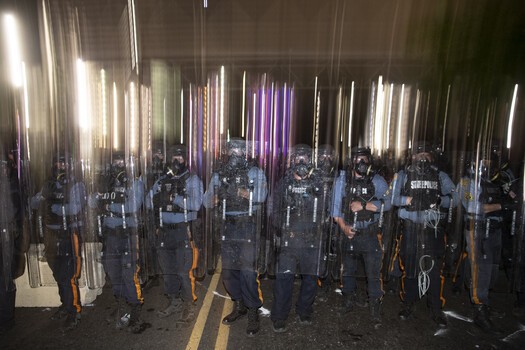
People keep asking me what it's like photographing the anti-ICE protests outside Delaney Hall in Newark.
The general perception is of a nonstop war zone. That's probably the biggest misconception people have after scrolling through photographs online. They see the pepper spray, the flashbangs, the clouds of CS gas drifting through the street, officers in riot gear, protesters in zip ties, and they imagine the whole day unfolds like an action movie stuck on repeat.
It doesn't.
Most of the day is waiting.
Waiting beneath an oppressive summer sun, feeling the back of your neck turning into a chunk of baked leather. Waiting while protesters chant, journalists compare notes, officers stand around looking equally bored, and everyone quietly watches everyone else. Then, almost imperceptibly, something changes. Voices get a little louder. The crowd presses a little closer. Police begin shifting people around or repeatedly checking their gear. You can feel the atmosphere slowly tightening like a wire. By sunset, everyone knows what's coming. Nobody can say exactly when or how it'll happen, only that it usually does.
Compared to my time documenting the protests in Minneapolis, Newark felt strangely compact. Minneapolis sprawled across an entire city. You chased caravans of unmarked SUVs, followed rumors of raids, and bounced from neighborhood to neighborhood hoping to arrive before everyone packed up and disappeared. Delaney Hall is different. Everything revolves around one fenced compound wrapped in razor wire. There's no chase. Just a single pressure cooker where everyone eventually arrives.
The first day I covered the protests happened to be the day ICE handed responsibility for the outer security perimeter to the New Jersey State Police.
For a brief moment, it almost felt like cooler heads might prevail.
ICE personnel disappeared behind the tall fences surrounding the detention center while state troopers took their place along the street. Compared to the federal officers draped in Crye uniforms, plate carriers, and enough tactical nylon to suggest they were preparing for a raid somewhere halfway across the globe rather than crowd control in northern New Jersey, the state troopers looked almost reassuring in their standard blue-gray uniforms.
For about 90 minutes, you could almost convince yourself that things weren't about to turn violently stupid.
Then the sun started to go down.
The same troopers returned wearing helmets and gas masks and carrying plexiglass riot shields. Following a brief warning that they were going to start tearing down the medical tent, things went ugly fast. CS gas drifted across the roadway while flashbangs cracked overhead and on the street with that familiar metallic concussion that makes your chest tighten before your ears catch up. From behind the facility fence, ICE officers added pepper-ball fire into the crowd. The brief illusion of normalcy disappeared beneath smoke.
When the first flashbangs landed, I hurriedly pulled on my eye protection and mask.
Unfortunately, I'd grabbed the wrong goggles.
Years earlier, the military had issued me a pair designed to keep out dust, flying debris, and whatever unpleasant things happen around helicopters. They were excellent at that job. They were absolutely terrible at stopping CS gas. The vented sides—great for preventing fogging—also provided a convenient doorway for pepper spray and chemical irritants.
By the time I realized my mistake, my eyes were already watering hard enough that I could barely see. For the next several minutes, I was photographing almost entirely on instinct, trusting my Nikon Z9's autofocus and face detection more than my own vision. Fortunately, the camera performed better than I did.
Then came the horses.
Mounted officers would surge forward, forcing the crowd backward before peeling away so the shield line could re-form. More 40 mm gas rounds floated overhead in slow, lazy arcs that almost looked graceful until they landed. More flashbangs. More shouting. More police screaming "move back" as they moved forward in lockstep. The whole sequence repeated itself with an oddly mechanical rhythm, as if everyone involved had memorized the choreography.
Eventually, protesters were pushed away from Delaney Hall. Riot police deployed a thick screen of concealing smoke and then simply… left.
It was one of the stranger endings to a confrontation I've covered.
The street was littered with empty 40 mm casings, smoking CS canisters, and spent flashbangs. The protesters hadn't really gone anywhere; they'd simply been redistributed over half a mile of roadway. I honestly couldn't tell you how many arrests had been made. The evening felt less like a decisive police operation than an eruption that had happened simply because momentum demanded it. The seemingly meaningless hour of violence reminded me of Minneapolis in that respect. I'm sure there was an objective. Standing there afterward, surrounded by debris and chemical residue hanging in the air, that objective felt difficult to define.
I've had a number of photographers ask how to prepare for assignments like this. I won't pretend there's a formula, but there are a few lessons I've learned the hard way.
First: Pack Light
Lighter than you think you should. This isn't the place for every lens you own. You'll spend more time running than shooting, and you'll rarely have the luxury of changing lenses. Two bodies. Two lenses. A reliable flash. Fresh batteries. Empty memory cards. A lightweight laptop if you're transmitting from the field. Everything should earn its place in your bag, because eventually you'll be carrying it for miles.
Second: Know Your Protective Equipment, Not Just What It Is, but How It Actually Works
My mistake with the goggles nearly cost me the assignment. The wrong piece of safety gear is sometimes worse than none at all, because it convinces you you're protected when you aren't. I now carry a full-face gas mask whenever I expect chemical agents, though even that has become complicated, as New Jersey State Police have increasingly restricted these kinds of items near the facility. Carry a proper first-aid kit. Know how to use everything inside it. Better yet, make sure the people you're working beside know where it is too.
Third: Never Work Alone if You Can Avoid It
One or two trusted people can make all the difference. Someone notices problems you don't. Someone watches behind you while you're looking through a viewfinder. If you're injured, detained, or your equipment disappears, someone can notify your editor, your family, or simply tell people where you were last seen. Before anyone leaves the car, have a plan. Pick rendezvous points. Decide what happens if phones stop working. Hope you never need it.
And finally, the most important piece of advice I can offer:
Have a Reason to Be There
Not because it looks exciting. Not because conflict photography has a certain mythology attached to it that has very little to do with reality. Not because social media rewards dramatic pictures. Those reasons evaporate the first time you're choking on CS gas or trying to make sense of a crowd that's suddenly running in every direction.
Be there because the story matters to you. Be there because you're on assignment and have a job to do. If you don't know why you're standing there before the first flashbang goes off, you're probably standing in the wrong place. The adrenaline wears off. The bruises heal. Eventually, the sounds of all of it stop ringing in your ears or keeping you up at night. The photographs and the reasons you made them are the only things worth taking home.
What's Your Reaction?
 Like
0
Like
0
 Dislike
0
Dislike
0
 Love
0
Love
0
 Funny
0
Funny
0
 Wow
0
Wow
0
 Sad
0
Sad
0
 Angry
0
Angry
0







Comments (0)