

Tamron’s OEM Lens Sales Plummet As Company Considers Sony’s Takeover


Tamron’s financial results are always interesting thanks to the company’s candor in breaking down its own-brand versus OEM lens production and sales data. However, Tamron’s latest results are made even more compelling by the fact Sony is actively trying to acquire the lens maker, a very interesting move with huge potential implications.
With Sony’s reported $1.2 billion offer looming in the background, Tamron’s financial results are all the more interesting. While a single good or bad quarter will not make or break a deal of this magnitude, a general trajectory does change the overall optics of a major business deal.
In light of Sony’s acquisition attempt, it is notable that Tamron’s FY2026 Q2 financial presentation leads with a slide covering Tamron’s medium-term management plan and long-term corporate vision. One of Tamron’s biggest goals over the next decade is to transform itself from a lens manufacturer into a “comprehensive optical and sensing solutions company.”
Tamron hopes and expects that by 2035, it will have 20 billion yen or more in new business annually, which is about $125 million. That is twice as high as Tamron’s previous target. The company clearly has significant growth ambitions, which arguably changes how it might contemplate an acquisition offer like Sony’s right now. If Tamron truly believes it can grow significantly in the next decade or so, it may be less likely to accept a buyout offer that is anything less than extreme.
As for what Tamron is doing right now, its latest quarter was a mixed bag. The company’s net sales increased 11.4 percent year-over-year, but operating income dropped 14.5 percent. For the entire first half of the year, net sales are up 3.8 percent while operating income is down 16.5 percent. Tamron blames US trade policies, a weak yen, and increasing costs.
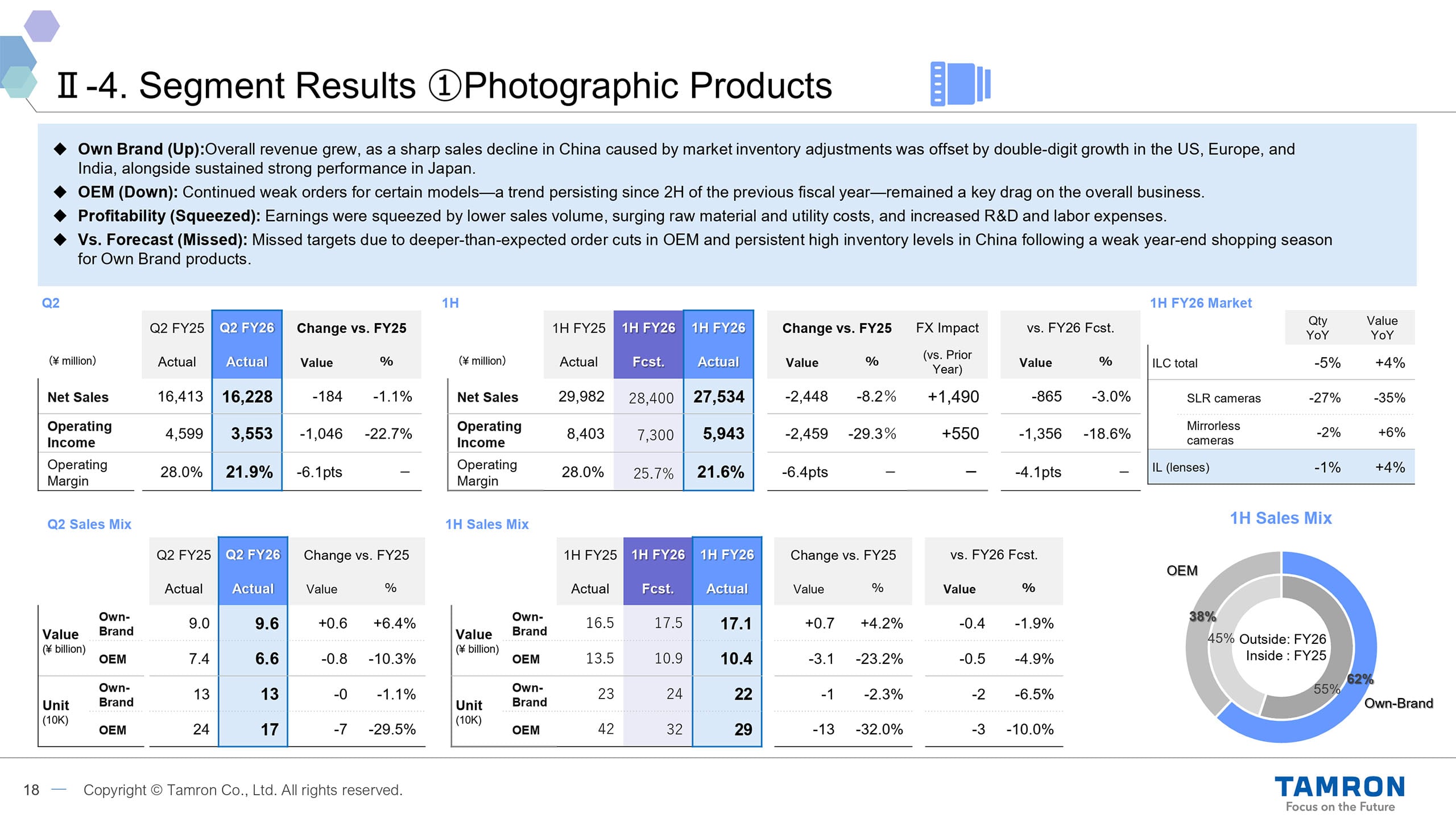
In the Photographic Products segment, Tamron’s net sales dipped 1.1 percent while operating income plummeted 22.7 percent year-over-year in Q2. Operating income for the first half of FY2026 fell 29.3 percent compared to FY2025 1H.
Just as some other photography companies said last week, Tamron’s own-brand lenses experienced a “sharp decline” in China. In FY2025 1H, 26 percent of Tamron’s sales were in China. So far this year, that number is just 14 percent. Sales growth rates dropped 43 percent year-over-year in China.
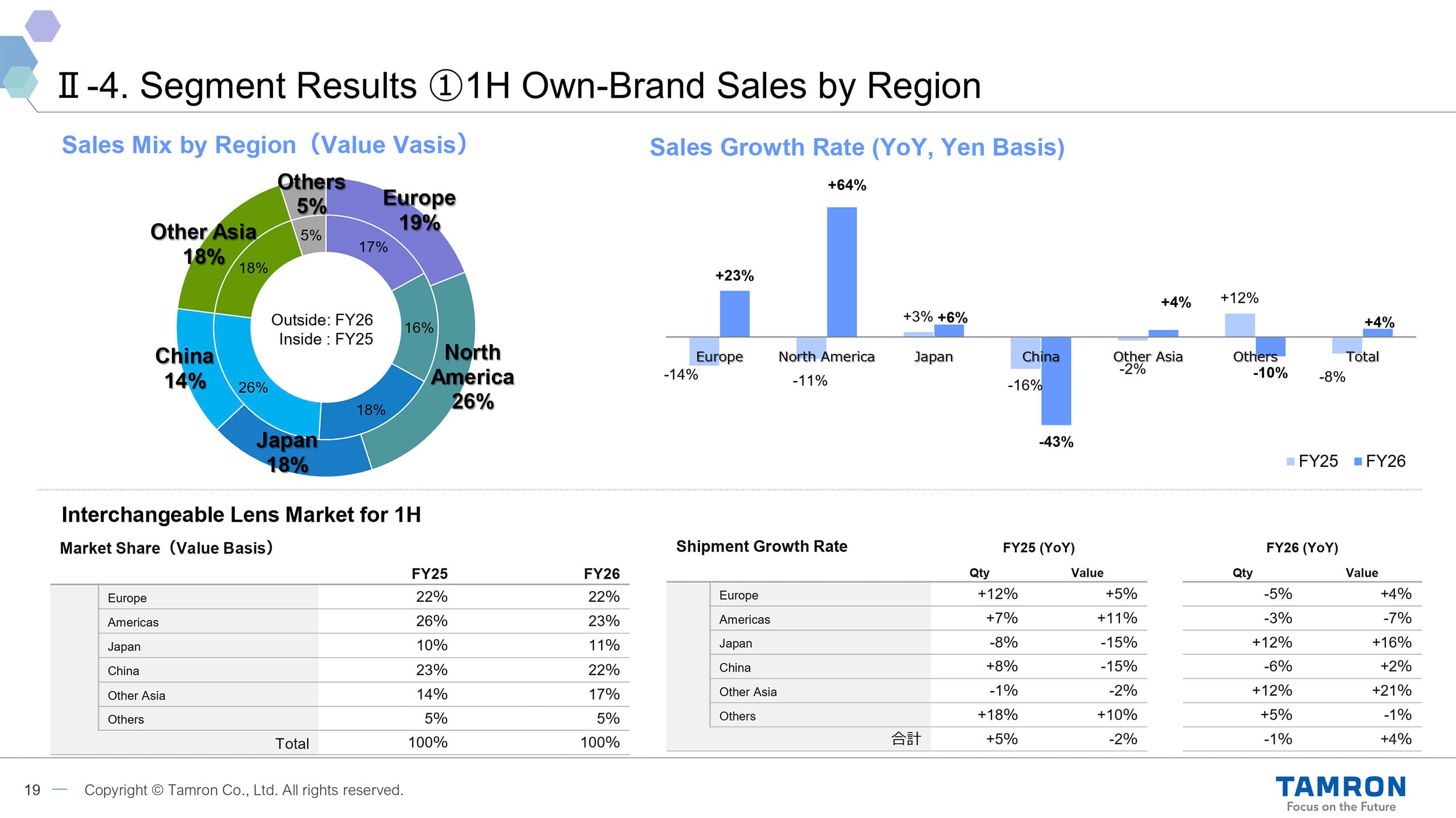
However, fortunately, Tamron’s own-brand lenses experienced double-digit growth in the US, Europe, and India, alongside good performance in its home market of Japan. North American sales surged 64 percent year-over-year, and Europe was up 23 percent.
As PetaPixel has explained before, a historically significant part of Tamron’s business is making lenses for other companies. These OEM lens sales are down, with Tamron noting “continued weak orders for certain models — a trend persisting since 2H of the previous fiscal year.” Tamron says this is a “key drag” on its overall business.
While in some years, nearly half of the lenses Tamron made were for other companies, that number has dropped a lot so far this fiscal year. During FY2025 1H, 45 percent of Tamron’s lens sales were OEM models, leaving 55 percent for its own branded optics. In FY2026 1H, OEM sales dipped to just 38 percent. Unit sales of OEM lenses dipped 29.5 percent, and the value of these lenses dropped 10.3 percent.
Although more evidence of the death of DSLR cameras is not required, Tamron does offer some up here, too. Sales of its DSLR lenses dropped 27 percent year-over-year.
Returning to Tamron’s long-term goals to be more than just a photographic lens company, it is worth noting that, as of now, 88 percent of Tamron’s operating income comes from photographic products. If the company intends to be much more diversified by 2035, it has some serious work to do.
One final note here on Tamron’s financial results. In February, Tamron said it would release 10 new lenses this fiscal year, a goal the company wants to have for every year moving forward. It is sticking to that target. So far it has released six lenses. Well, sort of.
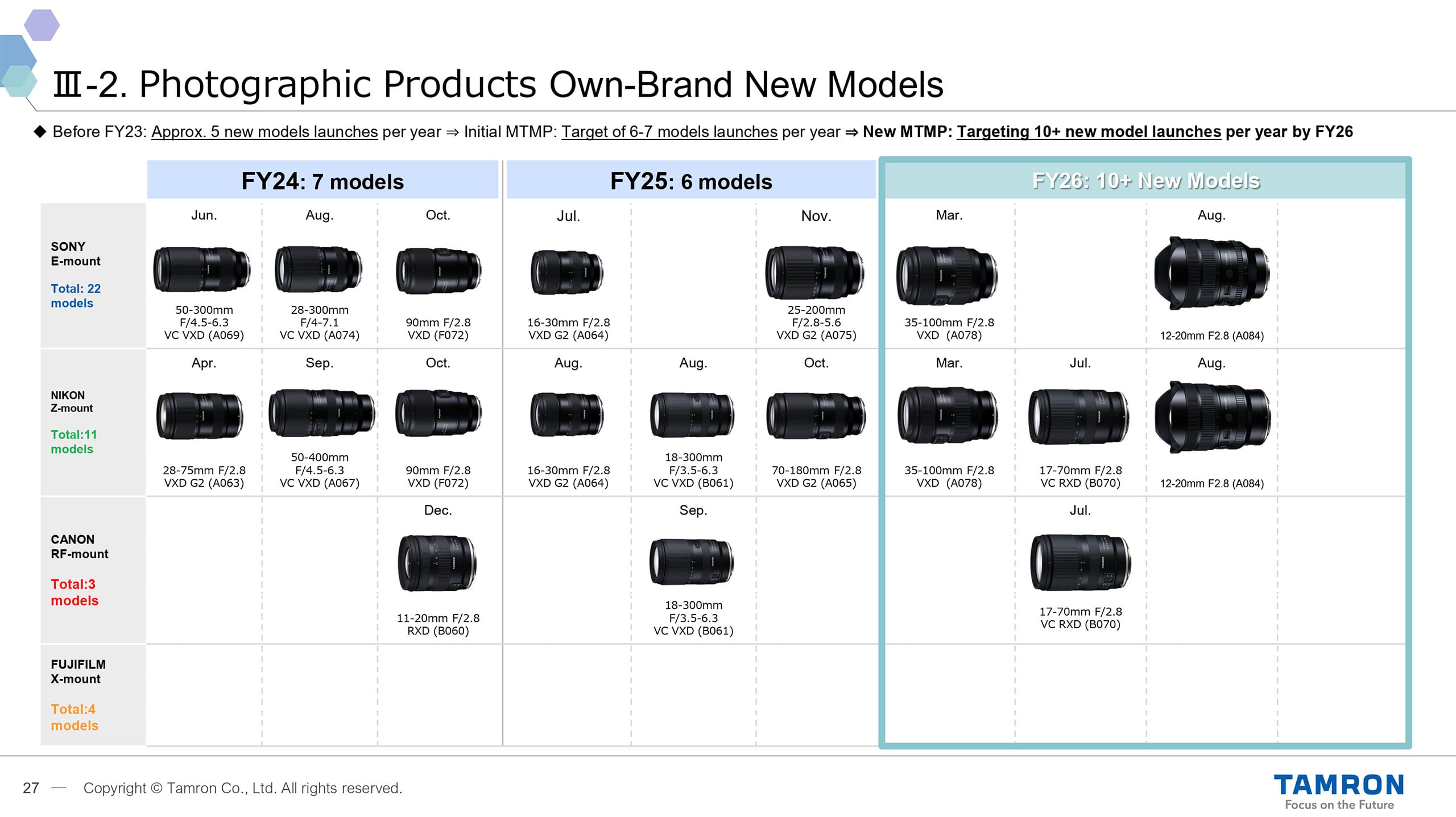
Tamron counts existing lenses in new mounts as new lenses, and if it releases a new lens for two systems at once, that’s two new lenses. This wacky arithmetic means that although there are still four new Tamron lenses left to launch this year, they may very well not be “new” in any useful sense of the word. Most likely, Tamron will release one or two new lenses in multiple mounts, and that will satisfy its promise.
So far there have been two totally new Tamron lenses in 2026, the 35-100mm f/2.8 and the 12-20mm f/2.8. They are, at the very least, excellent zoom lenses.
Photographers ought not hold their breath that any of Tamron’s next lenses will be primes.
Image creditsTamron. Header photo created using an asset licensed via Depositphotos.com.
Affiliate Disclosure PetaPixel articles may include affiliate links; we may earn a commission if you buy through one.
What's Your Reaction?
 Like
0
Like
0
 Dislike
0
Dislike
0
 Love
0
Love
0
 Funny
0
Funny
0
 Wow
0
Wow
0
 Sad
0
Sad
0
 Angry
0
Angry
0









Comments (0)