

Eerie Photo Shows How Our Sun Will Die
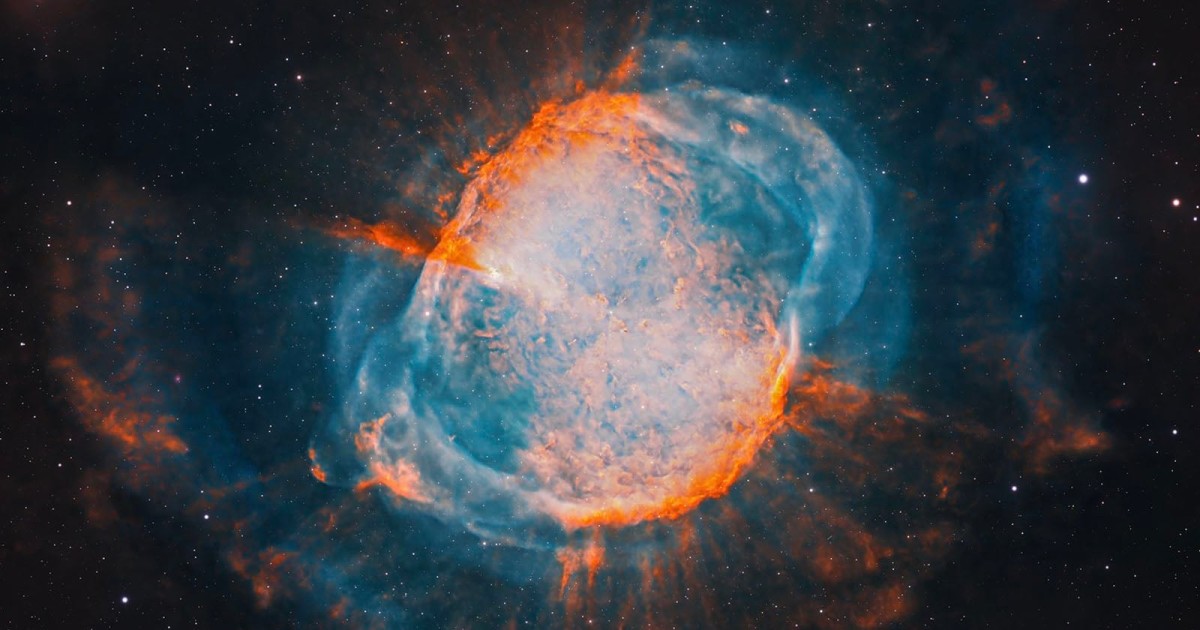
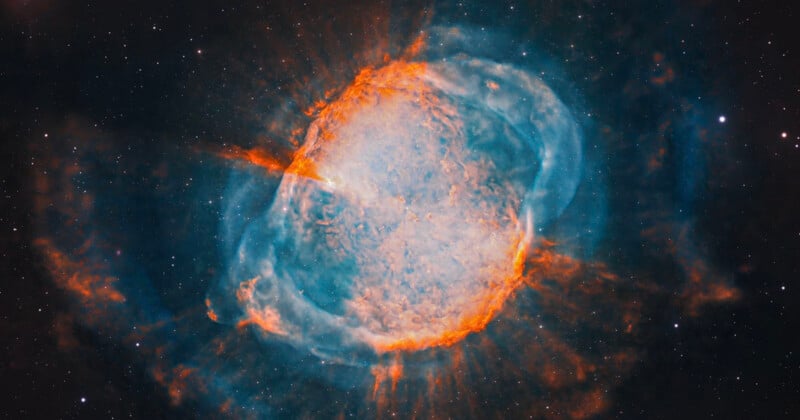 ‘The Fate of Sol’ by Andrew McCarthy. The startling image is a “reminder that even our solar system has an expiration date.”
January is widely considered the bleakest month of the year, and astrophotographer Andrew McCarthy, who is putting together his cosmic calendars for 2027, chose the first month to feature an unnerving glimpse into the future.
For the starting photo in the 2027 Cosmic Background calendar, McCarthy chose an image of the Dumbbell Nebula that he captured over the course of 30 hours earlier this year.
The Dumbbell Nebula (Messier 27) is a planetary nebula, which is an expanding shell of glowing gas and dust thrown off by a dying star that was once similar to the Solar System’s Sun.
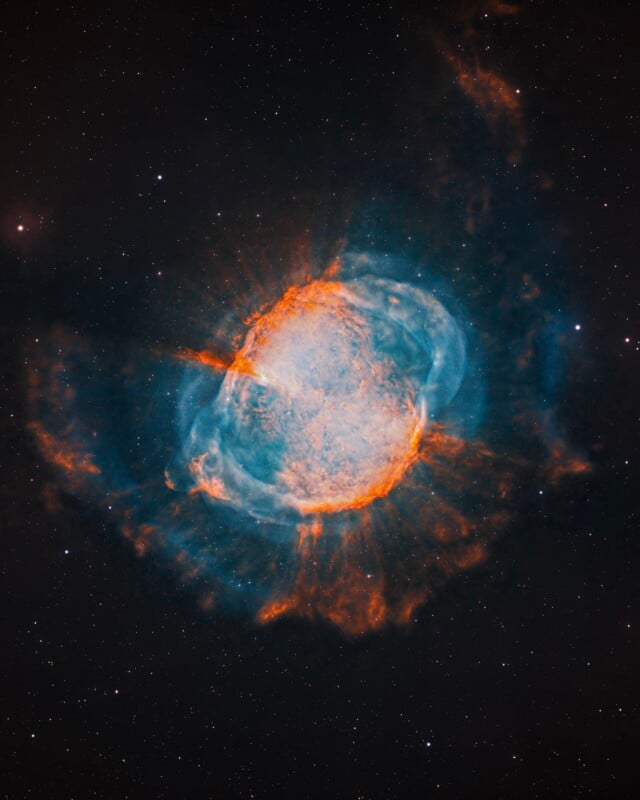
McCarthy explains in his newsletter that it is a “bright object located in Vulpecula.” It’s popular with amateur astronomers, as even “small backyard telescopes can see this object.”
“This 30-hour exposure captured with my 17-inch scope tells a more complete story of everything happening around this stellar remnant,” McCarthy explains. “An expanding shell of ionized gases frames the bright inner core, where material seems to be shredding away due to the immense pressure of the event.”
The image is a glimpse into the future of the Sun, which awaits a similar fate once its hydrogen fuel is depleted.
“The Sun will expand into a red giant, shed its outer layers, and collapse into a white dwarf,” McCarthy says.
“This is what happens when a star like ours reaches the end of its lifecycle, sheds its outer layers, and collapses into a white dwarf, spending the next many trillions of years cooling into a black dwarf while its stellar mass reaches into interstellar space, eventually contributing their elements to forming planets.”
McCarthy spent roughly 30 hours capturing photos of the Dumbbell Nebula, but over different nights since “otherwise the Sun and the Earth would get in the way.”
“I cycled through Hydrogen, Oxygen, and Sulfur-tuned filters to isolate the trace gases in the nebula, and then mapped those separate photos to corresponding color channels to create the color photo,” he explains.
McCarthy says that the photo is presented as his own hybrid of “Hubble Palette,” which is a “method of integrating narrowband images to get better color contrast and detail in a nebula photo.” He stresses that no colors were ever added and that the color filters he used were all visible spectrum.
“I’m often asked about color in these astrophotos, and while this one is technically false color due to how it was captured, it’s not too far off from the true color, which would have the oranges look more crimson,” he says.
“I use these narrowband filters to resolve better contrast in the structure, at the expense of more accurate color balancing. This is one of just two false color images in this calendar. The rest are true color.”
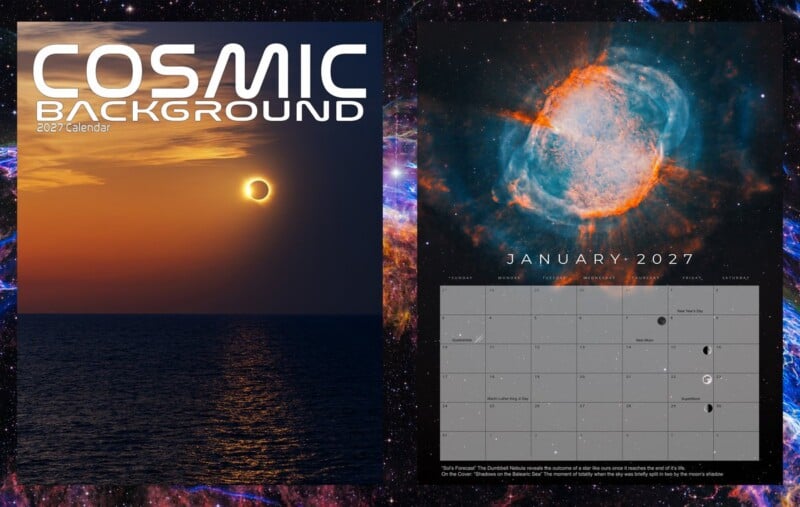 McCarthy’s cosmic calendar for 2027.
McCarthy is producing not one but three calendars for 2027. The Dumbbell Nebula photo will sit with 11 other images that showcase his work capturing deep space objects as well as celestial events closer to home, such as an airplane transiting the Sun.
The two other calendars include one that exclusively focuses on rockets, while the other one features nothing but his adorable cat Gregory.
“Putting together my 2027 cosmic calendar is one of my favorite activities. It’s a time to reflect on what I’ve achieved over the year and an opportunity to use my photography to tell a story,” McCarthy says.
McCarthy’s cosmic calendar can be purchased here. More of McCarthy’s work can be found on his Instagram, X, Facebook, and website.
Image creditsAll photos by Andrew McCarthy.
Affiliate Disclosure PetaPixel articles may include affiliate links; we may earn a commission if you buy through one.
What's Your Reaction?
 Like
0
Like
0
 Dislike
0
Dislike
0
 Love
0
Love
0
 Funny
0
Funny
0
 Wow
0
Wow
0
 Sad
0
Sad
0
 Angry
0
Angry
0











Comments (0)