

Fans Will Always Argue About Who Is the Best James Bond, but ‘Live and Let Die’ Makes the Answer Clear
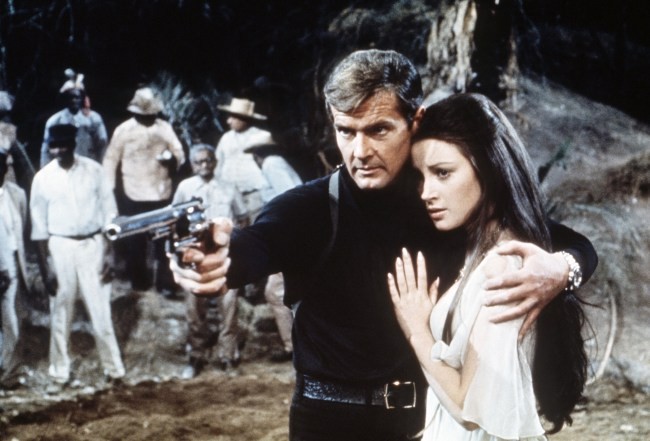
It’s been a good year to be a James Bond fan if you live in Los Angeles, primarily thanks to Quentin Tarantino. His Vista Theater and New Beverly Cinema have been on a bit of a Bond tear for the last few months, programming “The Spy Who Loved Me,” “Diamonds Are Forever,” and “The Man with the Golden Gun,” and this weekend the Vista will be screening a 35mm print of “Live and Let Die,” the eighth Bond film and the first starring Roger Moore as agent 007.
Replacing original Bond Sean Connery was a precarious endeavor for the producers Albert Broccoli and Harry Saltzman, who had received mixed reviews for their choice in 1969’s “On Her Majesty’s Secret Service,” George Lazenby. A model with no acting experience, Lazenby rubbed both his coworkers and the public the wrong way with his seemingly condescending attitude toward Bond, and he famously declined to sign a multi-picture deal for the series on the advice of an agent who thought the character would be all washed up by the early 1970s.


“On Her Majesty’s Secret Service,” though a commercial hit, was viewed as a misstep at the time (it’s now correctly considered to be one of the best Bond films, and seems to have been a major influence on Christopher Nolan), and Broccoli and Saltzman lured Connery back to the franchise for “Diamonds Are Forever” in 1971. After that Connery was done, however (at least until the aptly titled “Never Say Never Again” in 1983), and the producers were forced to attempt another reset, hopefully with more lasting success than their misstep casting Lazenby.
Moore had been considered for “On Her Majesty’s Secret Service” but was busy shooting the television series “The Saint”; by the time of “Live and Let Die” he was on a new show called “The Persuaders,” but he passed on a second season when he heard the role of James Bond was up for grabs once again. The producers screen tested Jeremy Brett, Julian Glover, and David Warbeck and even briefly considered Burt Reynolds (an idea that died quickly, given that he wasn’t British and wasn’t tall), but Moore was Broccoli’s first choice from the beginning and won the role with minimal resistance.
Which isn’t to say the filmmakers weren’t concerned. Screenwriter Tom Mankiewicz, a Bond stalwart, tried to avoid one-to-one comparisons between Moore and Connery by removing some of Connery’s trademark catchphrases and behaviors; one of the most shocking moments in “Live and Let Die” comes when Moore orders his first drink and chooses bourbon rather than the traditional “shaken, not stirred” martini. The early scenes of “Live and Let Die” are careful not to spring Moore on the audience too quickly, with this being the first Bond film since the first two to feature a pre-credits teaser focusing on the villains rather than Bond himself.
Yet once Moore took the screen in his first scene — a kind of self-contained bedroom farce in which Bond tries to hide a female agent he’s sleeping with from his boss M and M’s trusted assistant Miss Moneypenny — he appeared so at ease in the role that it might has well have been his from the beginning. Playing the part largely for laughs, Moore actually has more in common with Lazenby than Connery; his Bond is softer and sillier than the original, an approach Moore would double down on in later films — often to the chagrin of Bond purists.
 ‘Live and Let Die’Courtesy Everett Collection
To those for whom Connery will always be the greatest, if not the only, James Bond, Moore’s self-effacing, self-conscious style becomes a kind of parody with diminishing returns, but his differences from Connery are what make his Bond movies great in their own way — greater, I would argue, than the Connery films. When Moore signed on to play James Bond, he took his lead from a line in one of Ian Fleming’s novels that referred to Bond killing someone but not liking it, and while this idea is never explicitly stated in “Live and Let Die,” it informs the entire film and most of the Bond movies Moore made after it.
Connery’s Bond likes killing so much he’s virtually a sociopath; the early Bond movies are casually brutal in a way that’s still a bit shocking 50 or 60 years later. Moore shifts the character’s relish, so that he’s taking pleasure less in violence and dominance than in a kind of playful wordplay and bemused acknowledgement of how absurd his circumstances are. An uncharitable view of the Moore films could be to view the self-awareness as undercutting the movies’ tension, but who was ever watching James Bond movies for plausibility anyway?
From the get-go, “Live and Let Die” is a ruthlessly engineered entertainment machine, with eye-popping action set pieces (including a boat chase filled with spectacular stunts and an interaction with some live crocodiles that has to be seen to be believed) and a constant parade of lively supporting players and bad guys. A lot of the energy and exuberance comes from the milieu, which finds Bond up against heroin smuggler Yaphet Kotto in Harlem, New Orleans, and the Caribbean islands; the environments he inhabits and the people he faces off against breathe new life into the series, giving it as much in common with “Cotton Comes to Harlem” and “Across 110th Street” as “From Russia with Love.”
Putting 007 at the center of a Blaxploitation movie was a calculated decision on Broccoli’s part, and not the only time an old Bond novel would be reconfigured to capitalize on a current trend — the most blatant later example would be when James Bond went to space in “Moonraker” two years after “Star Wars” changed the film industry. (It’s also not a stretch to see the Daniel Craig Bond movies as imitations of and responses to the Jason Bourne style of action that had become ubiquitous in the time since Pierce Brosnan.)
 ‘Live and Let Die’Courtesy Everett Collection
The choice is as artistically fertile as it is commercial, however, adding a fish out of water quality to Bond’s adventures in “Live and Let Die” that dovetails beautifully with Moore’s comic strengths. There’s also a sense in “Live and Let Die” that Kotto and his colleagues are the most formidable adversaries Bond has been up against in some time; Mankiewicz fills the picture with genuinely suspenseful traps for 007 that seem impossible for him to escape. Rather than undercut the tension, Moore’s lighthearted approach complements it and sets it in relief, making “Live and Let Die” both more exciting and funnier than many of the more highly regarded Connery Bond films.
To be fair, Connery always got the joke just as much as Moore (in fact, in contemporary reviews of “Live and Let Die” critics like Roger Ebert argued that Connery was more self-aware and funnier than Moore), but he never seemed to be enjoying himself in the same way — from early on, he always seemed to have his eye on the door, looking for an escape from the franchise as quickly as one became available. The same thing would ultimately happen to Moore in “A View to a Kill,” a Bond movie with great villains (Christopher Walken, Grace Jones) that nevertheless suffers from Moore’s obvious apathy, but for most of his run he took a glee in playing Bond that was infectious.
It’s why “The Spy Who Loved Me” remains possibly the greatest of all Bond movies — it’s the one where Moore peaked in terms of his confidence and comfort with the character, and in which his command of his craft was matched by some of the series’ best set pieces and the best theme song (though Paul McCartney’s “Live and Let Die” is an undeniable banger).
“Live and Let Die” is where it all began though, and for those of us who hold the minority opinion that Moore made the best Bond, it’s Exhibit A in our argument for the defense.
“Live and Let Die” will screen this weekend at the Vista Theater.
What's Your Reaction?
 Like
0
Like
0
 Dislike
0
Dislike
0
 Love
0
Love
0
 Funny
0
Funny
0
 Wow
0
Wow
0
 Sad
0
Sad
0
 Angry
0
Angry
0







Comments (0)