

Filmmaker Josh Fox Knows All About the ‘Unfolding Disaster of Climate Change’ — His New Doc Tackles It from the Human Side
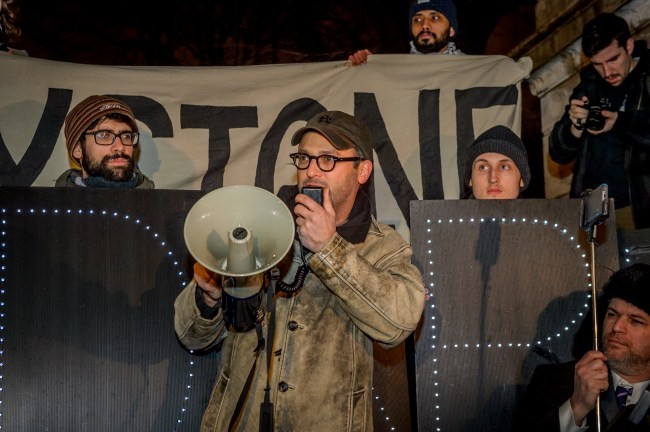
Josh Fox is best known as the Oscar-nominated, Emmy-winning writer/director of “GasLand.” He is internationally recognized as a spokesperson and leader on the issue of and climate change.
“GasLand” premiered at the Sundance Film Festival and was awarded the Special Jury Prize for Documentary before releasing on HBO. The film was nominated for the Academy Award for Best Documentary and won an Emmy for best non-fiction director, among numerous other awards. Fox was awarded his third Environmental Media Association award for Best Documentary for “How to Let Go of the World and Love All the Things Climate Can’t Change.”
Fox’s short series based on the film called “Climate Interruptions” on the viral video outlet NowThis garnered over 15 million views on Facebook over the span of just 9 weeks. Fox spent a large part of 2016 at the Standing Rock Sioux Reservation observing the Native-led resistance to the famed Dakota Access Pipeline (DAPL). The culmination of Fox’s work at Standing Rock has resulted in his latest film, “Awake, A Dream from Standing Rock,” which was released by Netflix.


When you really dig deep into the unfolding global disaster of climate change, it becomes impossible to believe in any kind of justice on earth. There is no way to look at a landslide that has buried an entire neighborhood or a fiery inferno that burned down a town and say “everything happens for a reason.” In the face of climate change, such woo woo aphorisms seem ridiculous, naive, and cruel.
But there is a strange and mysterious thread that connects us all. In times of disaster, you can see the frayed ends of it, and you can pull at that thread and see where it weaves us all together.
Every documentary filmmaker or journalist or investigator learns how to pull at that thread. It laces through our lives in ways that don’t seem to connect, but if you can follow it, you find that it loops through your instincts. Logic gives way and you tug at the mystery that connects us all.
“The Welcome Table” is a film about that thread, that deeper level of intuition. In a disaster, it compels us toward the instinctual communal generosity that can, for a moment, rise above the normal world to create a better one. The fabric of the best of all possible worlds is woven out of that care, that moment of contact, that will to give.
I arrived in Brazil to film a segment of “The Welcome Table” just after torrential mudslides ravaged the city of Sao Sebastiao. Scores of people had been killed and thousands were displaced. Whole city blocks buried under thousands of tons of mud.
 ‘The Welcome Table’
I thought I was prepared for all the worst of the climate horrors the floods, the fires, the droughts, the starvation. But nothing quite prepares you for when the earth decides to just rip itself out of its own foundations and bury whole neighborhoods alive in what seems like the blink of an eye.
Landslides have a type of brutality that I had not experienced before. Sao Sebastiao had experienced 700mm of rain in seven hours, more rain than some whole countries get in a year. Climate change is causing rain bombs to carren out of the sky.
I was there to follow Leo Farah, a disaster specialist, a firefighter turned famous first responder and author. His organization, Humus, had been hired by local philanthropist Maria Antonia Civita and her organization Verde Scola, a local after school program for disadvantaged kids that had turned into the hub of aid distribution after the landslides.
Leo had been to hundreds of disasters, mounting life saving operations in earthquakes, floods, landslides. Where there is horror and catastrophe, Leo is there, trying to pull survivors out of the rubble.
He had agreed to let me trail him three weeks after the landslides to observe recovery efforts. His job was not only to rescue but to welcome. “To welcome people is to give the best that you have at that moment,” he told me. He said, “It is my job to be the best person a survivor meets on the worst day of their lives.” Truly heroic.
He takes me to Vila Sahiy. Turning the corner, we see a river of mud frozen in place, standing atop where there used to be a neighborhood. All they could do was pull out the bodies. Leo says this is one of the smaller ones, in Rio de Janeiro, these landslides have killed thousands.
The inequalities are stark. The rich folks live down near the water, and the poor people who service their homes live up in the mountains, in the hills that surround the beach town. The shoreline is like the Hamptons, rich folks and lavish houses, but the on the dangerous mountain face above is the ghetto. The rich and poor are in such close proximity, and the mud crashed down into both.
But it is the favelas, the lively neighborhoods where the poor and middle class live, work, play and love that had it the worst, of course. Those neighborhoods are the most vulnerable to these landslides anywhere at the bottom of a hill, anywhere underneath a slope. And of course, the poorer you are, the further up you’ve got to live, the further up the mountain, the further up the long winding steps that ascend the slopes, and the more danger you’re in.
Leo tells me, surveying the horrific damage that people ask him to dig in the mud for their photos, their keepsakes, not their TVs or appliances. “They want their memories.”
After seeing the devastation of Vila Sahiy, Leo takes me to the place where people have been relocated. An empty apartment complex in a town called Bertioga, 45 minutes away. A temporary shelter, it has nothing of the vibrancy and aliveness of the favelas. It’s stark, Orwellian, naked, isolating, confronting, boring, oppressive. Like a prison. Everyone now remanded to a cellblock. No furniture, no rugs, no carpets, no art on the walls. No possessions.
And into this bleak landscape marches the blue-haired angel, Gabriel. A victim of the landslides himself, he lost his apartment and some family members, but he decided to pick himself up and walk over to Verde Scola, where he was recognized as a leader. As a compassionate person who didn’t lose his shit in the midst of this insanity. And now here he is, walking from house to house, person to person, apartment to apartment, asking people what they need.
Compassion. Asking people what they feel. Just being that shoulder to cry on. And that guy who says, OK, I’m going to try to get you a couch or a rug or some rice or psychological care. He does evaluations on the spot of how devastated people are.
Gabriel emerges as the second strand of the thread I am winding along.
He is a gay man who knew of his sexual orientation as a teenager, as most of us do. Homophobia and bias in his own family forced him to live in the streets, he was thrown out of his family home in Sao Paulo. It seems that in Brazil there is still brutal bigotry against the LGBTQ community.
But Gabriel is a leader here in San Sebastian. He found a community of acceptance, a place on the beach where he could be who he is, a place where he can live and dream. And now he’s one of the most valuable leaders in the community.
When I ask him if can he go to the church for aid he says, no, not really. “There’s so much bias against us. There’s bias against people who are outwardly gay.” And the thread begins to weave a part of the climate crisis that also is not spoken about so much. Climate change is homophobic. It reinforces the bias that exists in society. People who are LGBTQ are already struggling, but in a climate-related disaster, they’re going to be struggling that much harder.
 ‘The Welcome Table’
LGBTQ and trans people are already struggling all over the world, suffering horrible bias. In and after a crisis, that bias might be the difference between life and death. It might be the difference between having food and supplies and starving. It might be the difference between finding kindness in your community and finding hate.
After leaving Bertioga, I go to survey more damage in another favela, and then that weird thread began to pull again. That weird moment where you know your life’s about to change forever and something is about to occur that there’s no way you could have possibly planned for or anticipated. Down at the bottom of the ravine, while I was shooting a mangled mud filled washing machine that had crashed down the slope, a family passes right behind what looks like two women and a child. They lean over and say, hey, you know, if you’re doing videotaping of the landslides, the view is much better from up at the top. Karina, my translator and I realized that it was a welcome. And as we start to walk up the thousand steps up the mountain, they start to tell us their story.
Their house slid down the side of the hill. Today was the first day that they had off of work since the landslides. They went to the beach to have good time but they were harassed and someone stole their sandals yelling at them for being LGBTQ. Yelling at them for being queer.
Taunting them. Being violent, bigoted, and scary. But as they walked up those long, long steps in the unbelievable heat and humidity, they are calm and open. And this is quite a workout, at the top, all the way up, they told us about how their house had slid off its perch had collapsed down the side of the mountain, crashing to pieces. Now they were living with their whole extended family and a six, and in basically a hallway with a few bedrooms tacked on, no adequate oven or burner and no refrigerator.
They described the sheer terror that comes every time it rains, worrying, traumatized that this might happen one more time. Their new cramped house looking incredibly precarious up the side of this hill. And when we go to interview this person who says her name is Jessica, her eyes open up like waterfalls. She tells us of the bias that she suffered as a child.
When she was 13 years old, she was forced, just like Gabriel, to live on the streets.
Jessica then reveals that her pronouns are actually he/him and that his name is Jeff. Now the trust has been established Jeff can say he’s a he and Jeff can tell us all of his concerns, all of his worries, all of his fears.
Jeff is taking care of the family, of his brothers and sisters, and also of his wife’s brothers and sisters, all of whom are living in this same tiny little place, 30 people in all. And Jeff is cooking for the family out back, burning scavenged pieces of wood and pallets and working double shifts down at the restaurant that employs him. He says, “We all have jobs, and no matter how hard we work, we still have to live in the dangerous areas.”
It’s such a beautiful family. Such a beautiful person. It doesn’t make any sense to me that anyone would hold bias against this person. This person who is very clearly in their identity as a human being, a parent and a provider.
We learn that Jeff somehow has received no aid from anyone. The people from the state have been slow to help them, and Verde Scola and other mutual aid orgs missed him and his family. Jeff also refuses to go to the church for aid saying, “I’d rather have nothing than walk in there and receive their hate.”
Somewhere in Jeff’s eyes, somewhere in his incredible vulnerability and in his trust, that mystery is opening up. That door that says this is where welcoming truly happens. The moment when everything has been flung apart and is exploding in front of you. The moment where nothing makes sense and everything does all at once.
To find out what happens next, which is the wildest thread I have followed in years, you gotta watch the movie.
The film is a journey of nine years, watching that thread keep spinning and visiting ten communities on five continents. It gave me an enduring faith, to see a tapestry based on faith and mutual aid all across the world. In these dark times, our collective joy and love needs to be documented, embraced and cultivated. It is a stark contrast to the racism, bigotry, and xenophobia that dominates the ideological landscape in the USA on issues of migration.
The wall of xenophobia and bigotry, turned on its side, can be a table. A table of welcome.
When all the walls come down, we can choose to meet each other. We greet each other. We’re present. We’re here. We want to tell our stories. In spite of the agony and terror, the defiant desire is to be human, to meet, to stand in the midst of all that has fallen and embrace another person. What really matters has the chance to come out at that moment.
Rebecca Solnit tells us we can find a Paradise built in hell. That is our ultimate challenge when we face climate change. We can create a better world. We just have to keep asking, can we have faith that our kindness and connection to each other is stronger than the hate that wants to pull us apart?
Come watch the film, “The Welcome Table.” We invite you to sit with us and hear our stories, and watch that thread weave a tale of love and joy that we can use to fight back.
“The Welcome Table” will premiere on HBO on Thursday, July 23.
What's Your Reaction?
 Like
0
Like
0
 Dislike
0
Dislike
0
 Love
0
Love
0
 Funny
0
Funny
0
 Wow
0
Wow
0
 Sad
0
Sad
0
 Angry
0
Angry
0







Comments (0)