

Fujifilm Didn’t Actually Jump Ahead of Nikon in Mirrorless
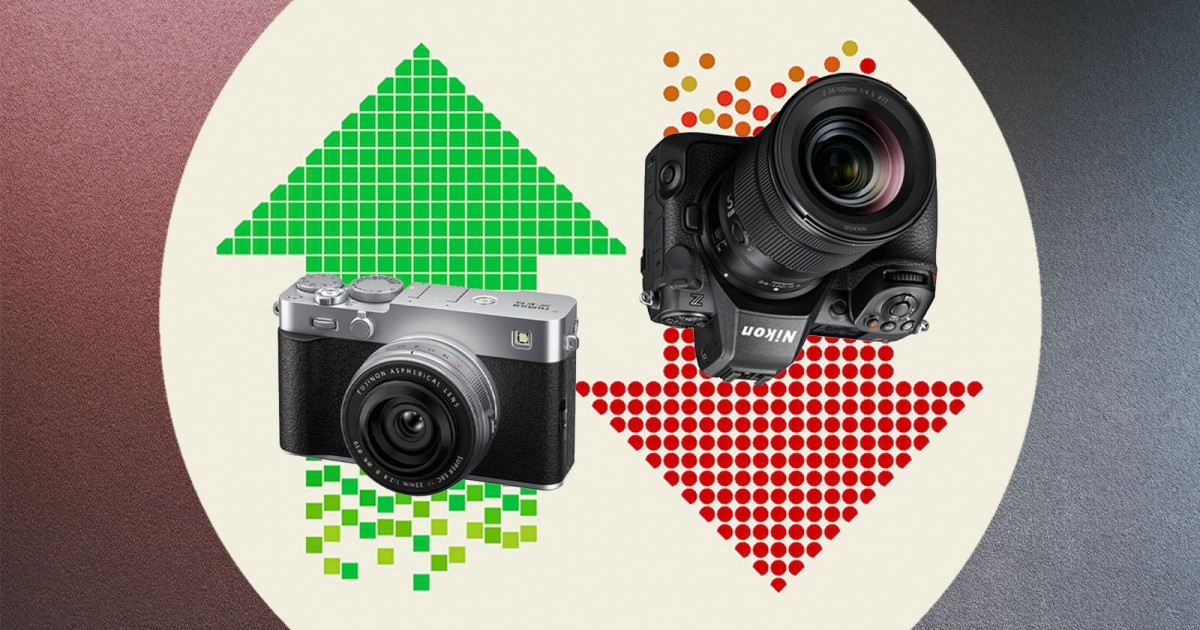
A lot has been made of the fact that in the Nikkei Industry Map, Nikon lost its third-place position to Fujifilm. However, what most discussions miss is why that happened and whether or not it’s actually a meaningful position swap. As I suspected, the conversation has missed important nuance.
Make no mistake, the Nikkei Industry Map is an excellent resource that provides valuable data about the state of the digital camera industry and how each of the major Japanese companies are doing. This year’s data showed that Canon extended its dominating lead over Sony in second place. However, what most people locked in on is that Nikon lost its third-place spot to Fujifilm, with Nikon’s market share falling from 11.7 to 8.9 percent and Fujifilm’s increasing from nine to 11.8 percent. The two companies basically flipped positions.
As I speculated, Fujifilm may have been significantly boosted by its digital Instax Evo series cameras. While these cameras live in the Instax line, primarily known for its instant film cameras, the Instax Evo cameras are digital cameras that can print digital photos onto instant paper. These cameras count in Nikkei‘s accounting, but arguably mean little about the core imaging business that most photographers care about. Another camera that counts is the X half, a bizarre little compact camera that was a very hot seller at first but ultimately became a pack-in bonus item with some Fujifilm X Series cameras at retailers.
Depending on the impact of Fujifilm Instax Evo and X half sales, the company’s success, and more importantly, Nikon’s failure, takes on an entirely different meaning that broad industry market shares cannot adequately reflect.
Thankfully, the very data we need for a meaningful discussion is now available through Toyo Kenzai’s annual “Japan Company Handbook Industry Map: 2027 Edition.” It sheds light on how many mirrorless cameras each of the Japanese camera companies produced last year. Of course, “produced” is not the same as sold, but this information is about the best that photographers can ever get and it also eliminates DSLR cameras from the equation. Sorry, Canon, all those entry-level DSLRs people keep buying don’t count this time.
The top two camera companies in terms of mirrorless cameras produced don’t change compared to Nikkei‘s broad digital camera industry map. Canon is still number one, although its margin of victory shrinks a lot. But importantly for Nikon, it sits comfortably in third place.
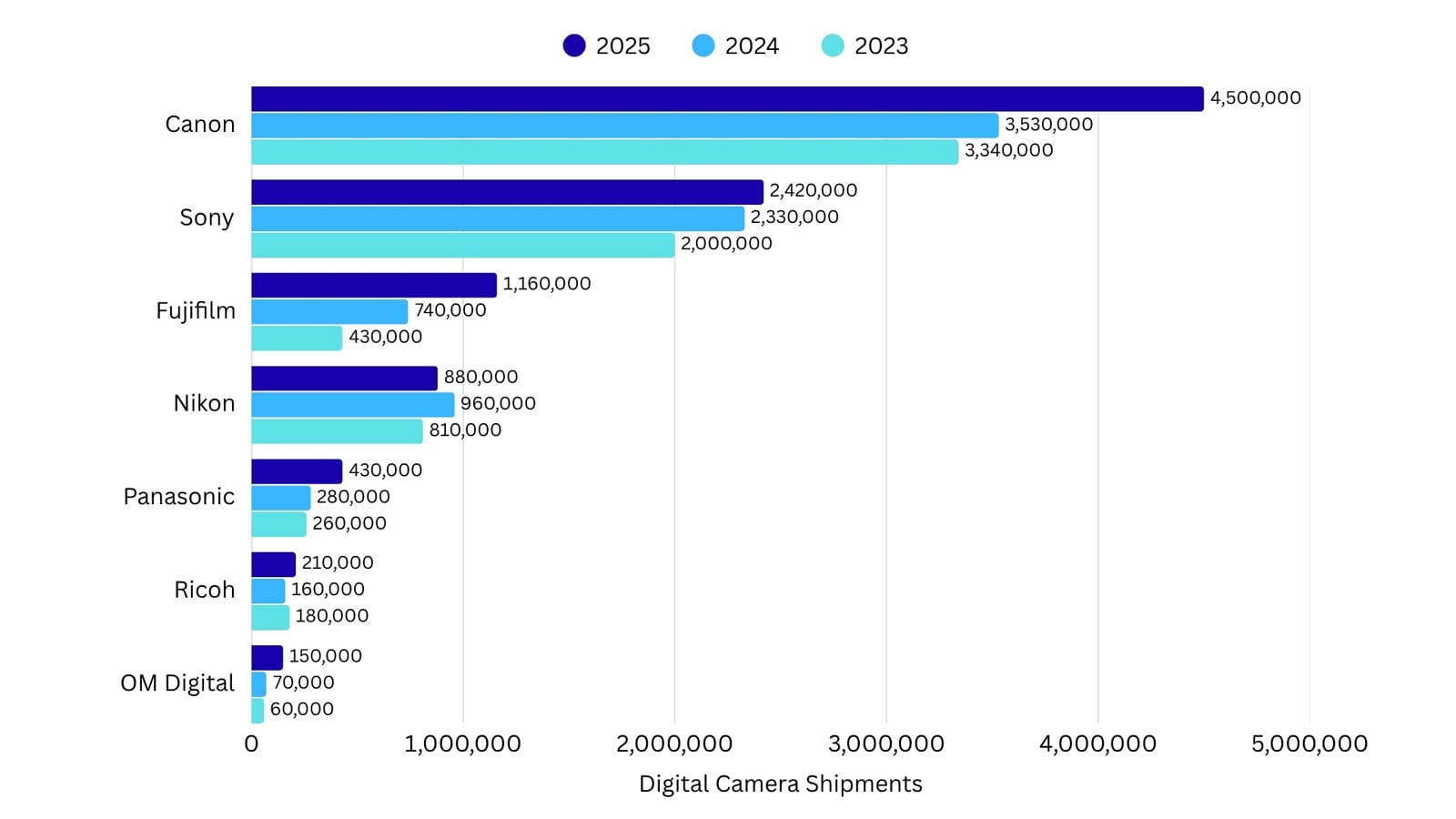 Nikkei Industry Map 2027
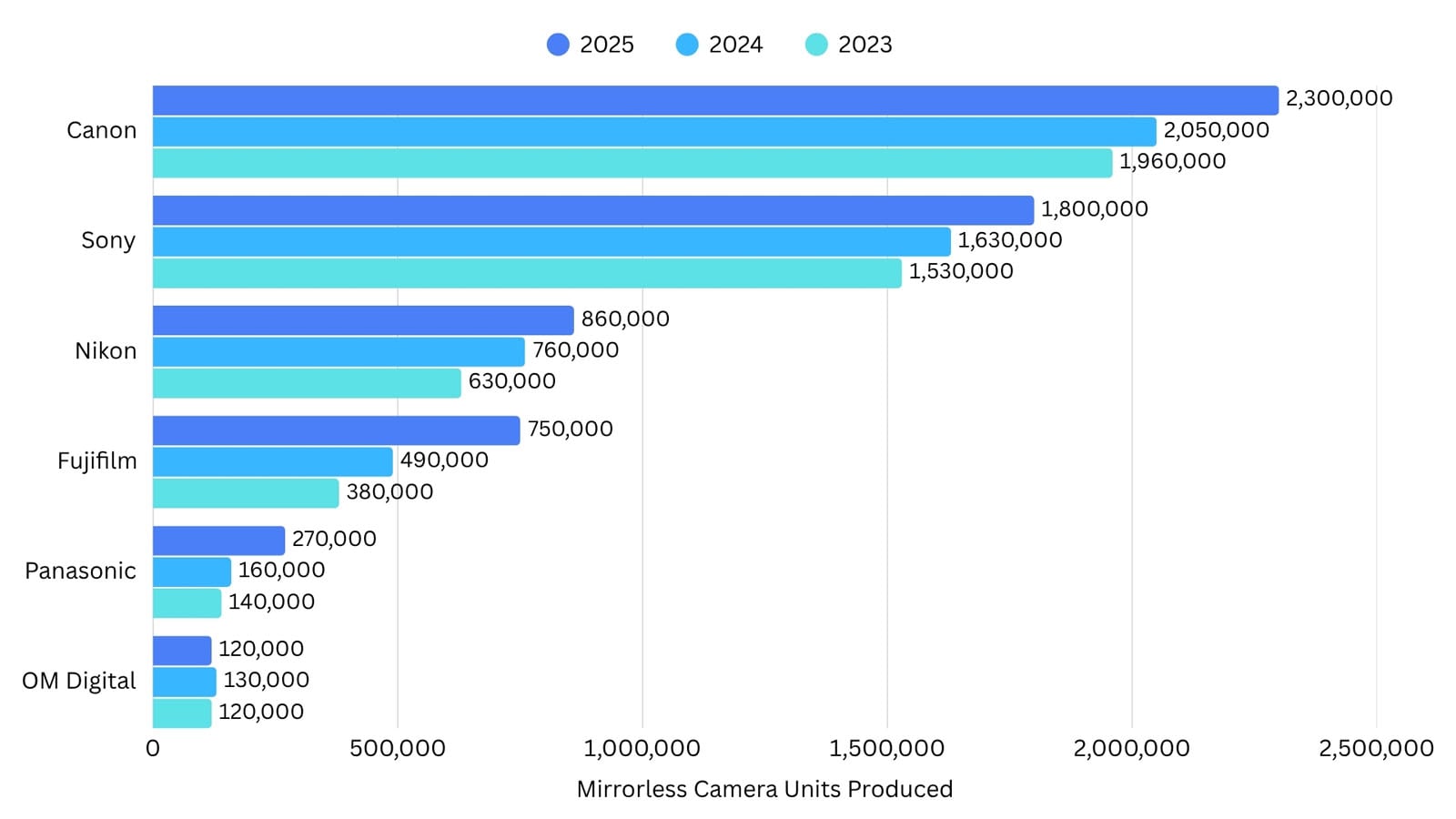 Japan Company Handbook Industry Map: 2027 Edition
Per Nikkei, Canon shipped 4.5 million total digital cameras in 2025. Per Toyo Kenzai, Canon produced 2.3 million mirrorless cameras over that same period. Canon sells quite a few DSLR cameras still, and even more PowerShot-branded compact cameras.
Sony shipped just over 2.4 million cameras last year, 1.8 million of which were mirrorless cameras. The gap between these two are presumably CyberShot models, some of which remain quite popular.
Nikon makes very few DSLR cameras anymore and has very few compact cameras of significance. Nikkei says Nikon shipped 880,000 cameras last year, which was down from 960,000 in 2024. Fujifilm ultimately passed Nikon in Nikkei‘s Industry Map, increasing from 740,000 cameras in 2024 to 1.16 million in 2025.
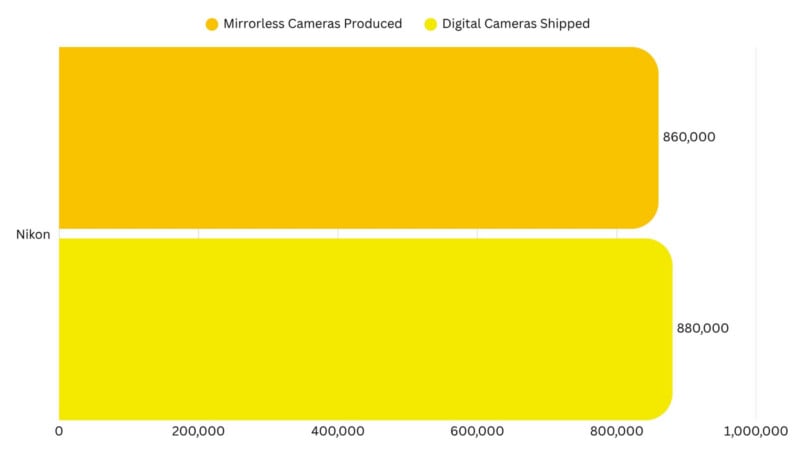
However, as Toyo Kenzai’s data shows, of the 1.16 million Fujifilm cameras shipped last year, only 750,000 were mirrorless cameras. That leaves a lot of relatively inexpensive Instax Evo and X half models.
Nikon is not having a particularly fantastic time overall right now, a topic that PetaPixel will analyze in greater detail very soon. But the company didn’t actually lose its longstanding third-place position in arguably its most important digital camera market: mirrorless. Nikon also actually produced more mirrorless cameras in 2025 than it did in 2024, up 130,000 units.
Where Nikon lost ground in Nikkei‘s industry map was DSLRs and compacts, two camera segments Nikon doesn’t seriously invest into at all. And a big part of where Fujifilm gained is in another segment Nikon doesn’t care about, digital instant cameras.
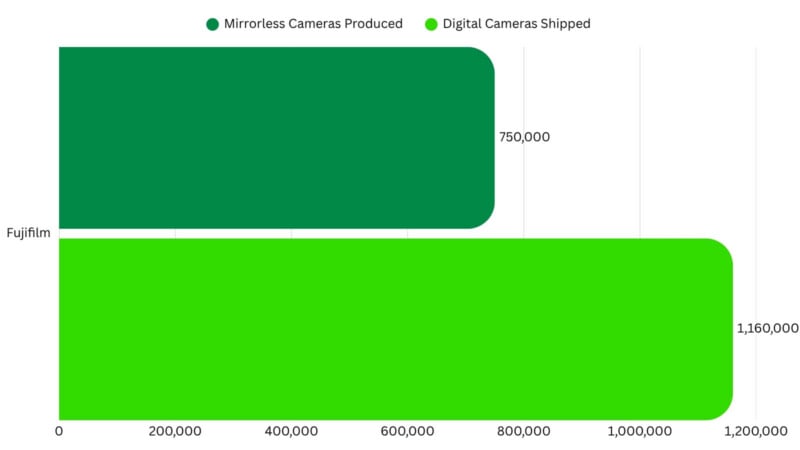
I’m not knocking Fujfiilm here, either. The company had a very nice 2025 when it came to making mirrorless cameras. 750,000 units is great and nearly half a million units beyond Panasonic in fourth place (270,000 units). It’s also a huge leap up from Fujifilm’s 490,000-unit production in 2024. The company is undeniably on the rise in all digital camera segments and making money hand over fist in a challenging market.
In a more positive overall sign, mirrorless camera growth isn’t unique to Fujifilm and Nikon. Canon, Sony, and Panasonic all made more mirrorless cameras last year than they did in 2024. The only company that dropped a bit was OM System, falling from 130,000 to 120,000 units year over year. Those same five companies that grew in 2025 also grew in 2024, by the way.
As the Japanese government itself recently said, there is strong evidence that the digital camera industry is in recovery and showing healthy signs. For the sake of photographers everywhere, hopefully the trend continues.
Affiliate Disclosure PetaPixel articles may include affiliate links; we may earn a commission if you buy through one.
What's Your Reaction?
 Like
0
Like
0
 Dislike
0
Dislike
0
 Love
0
Love
0
 Funny
0
Funny
0
 Wow
0
Wow
0
 Sad
0
Sad
0
 Angry
0
Angry
0











Comments (0)