

How 'Camp Miasma’s Crew Revived a Pre-CGI Technique with "Old-School Film Nerd" Ambition

Published Aug 10, 2026, 8:00 AM EDT
The movie's production designers break down its best and most impressive visual tricks
 Image: MUBI
Kris (Hannah Einbinder) walks into the darkness of an abandoned summer camp mid-winter, in the dead of night, and turns to the camera. Her face, framed by a thick, wooly hooded coat, looks clear and crisp, but behind her, the sky is a dreamlike swirl of blues, pinks, and purples. It looks like a dream, but that's just the magic of the old-school movie effects that director Jane Schoenbrun and their team resurrected for their new movie, Teenage Sex and Death at Camp Miasma.
The film follows Kris, a rising indie director chasing the rights to adapt Camp Miasma, a dated and sprawling slasher franchise whose legacy has curdled over the years. Kris makes her way upstate, hoping to convince the reclusive Final Girl from the original film, Billy (Gillian Anderson), to sign on — only to find her living in the camp where the movie was shot.
Teenage Sex and Death at Camp Miasma quickly evolves beyond that original premise to spin a twisty, trippy, meta-horror commentary that's equal parts funny and disturbing. But none of that would have been possible without the stunning visuals created by production designers Brandon Tonner-Connolly and Matt Hyland, who set out to revive a film technique so unique it's been in disuse for the past 50 years: matte painting.
“Nobody alive has really attempted this in this way,” Hyland tells Polygon. “Most matte painters and even production designers who dabbled in this stuff are either old, deceased, or out of reach. So we charted our own path with old-school film nerd, indie spirit ambition and Jane's encouragement, and eventually got there.”
 Image: MUBI
The matte backdrops were a part of Camp Miasma’s DNA from the start.
Also called glass paintings or glass shots, the technique has a long legacy in film history, from Ben-Hur and Black Narcissus to Superman: The Movie and Titanic. They can be as surreal or realistic as the film requires, adding to its scope by blending real-life settings and actors with painted details.
The process involves painting a backdrop onto a large sheet of glass, while leaving certain spots blank, and then placing it between the camera and the actors to create the illusion of sweeping, real-life scenery. The end result is a shot that looks like a natural blend of real-life elements and the fantastical, depicting the towering scale of classical Roman arches or the Fortress of Solitude without expensive CGI.
 Image: MUBI
In the case of Camp Miasma, the paintings bring the audience into Kris’ emotional landscape as she gets drawn further and further into Billy’s fantasy world.
“We designed a progression: the first painting, seen outside the hotel room window, feels distant, like a siren call from afar,” Tonner-Connolly says. “Each subsequent one gets closer.”
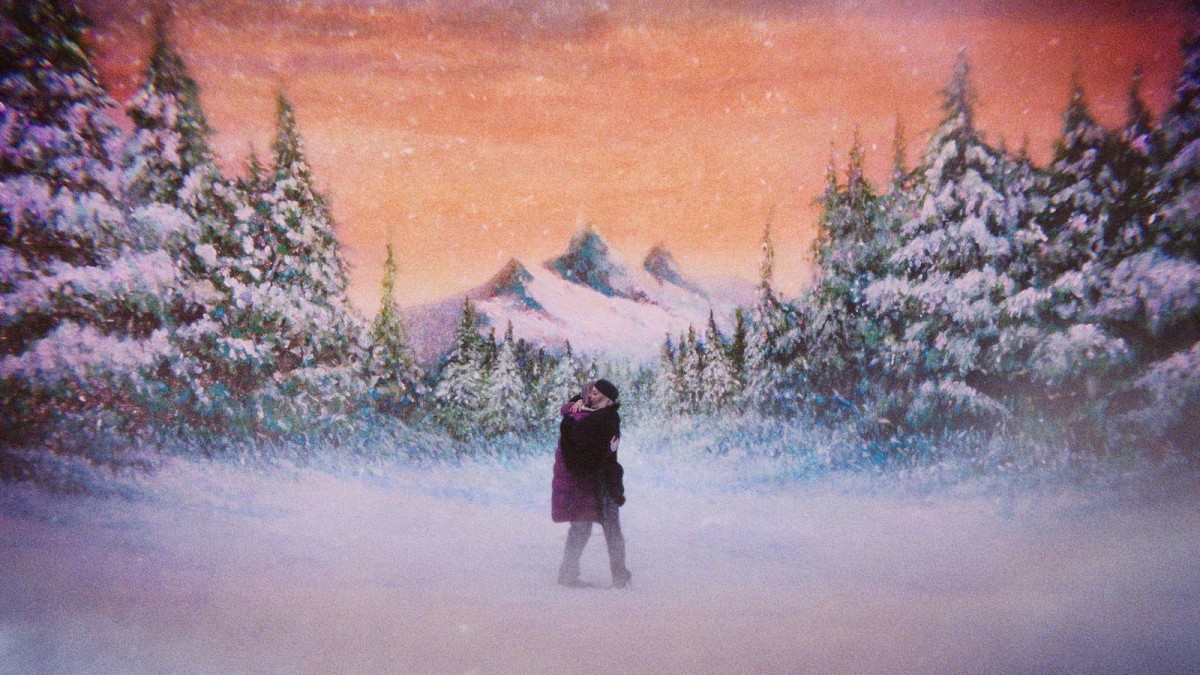
To achieve this immersion, the crew wanted to do at least one of these shots fully hand-painted. The scene in question introduces us to the camp's small movie theater, where Kris and Billy will spend an afternoon watching the original in-world Camp Miasma. In the shot, the structure of the real building is supported by a painting of a whimsical wintry backdrop of massive trees and a colorful night sky. The visual serves a key purpose in the film; without spoiling things, it's a prelude of what’s to come, when the story truly begins to blur the line between fantasy and reality.
 Image: MUBI
Behind the scenes, the physical process of putting it all together required a mix of art and ingenuity.
“We had the sheet of glass a few feet in front of the camera, painted with scenery that masks what's really behind it," Hyland says. "Leave certain areas unpainted, and you see the real world and real actors seamlessly combined into the final image."
There are a lot of moving parts involved, but the biggest challenge was figuring out how to correctly line up all the layers so every element worked properly onscreen.
 Image: Mubi
“It only works from one vantage point, and the painting has to be made for that exact vantage — lens choice, lens height, relationship to the characters, lighting, all controlled for,” Hyland says. “That was the real nail-biter.”
After the location was scouted and the painting was finished, all that was left was the moment of truth. Weeks later, with the actors on their marks and the crew holding its breath, they placed the painted glass in front of the camera. And the shot worked.
“It was stressful,” Tonner-Connolly laughs.
What's Your Reaction?
 Like
0
Like
0
 Dislike
0
Dislike
0
 Love
0
Love
0
 Funny
0
Funny
0
 Wow
0
Wow
0
 Sad
0
Sad
0
 Angry
0
Angry
0





Comments (0)