

Humanoid robots controlled by surgeons did world-first operation on live pigs
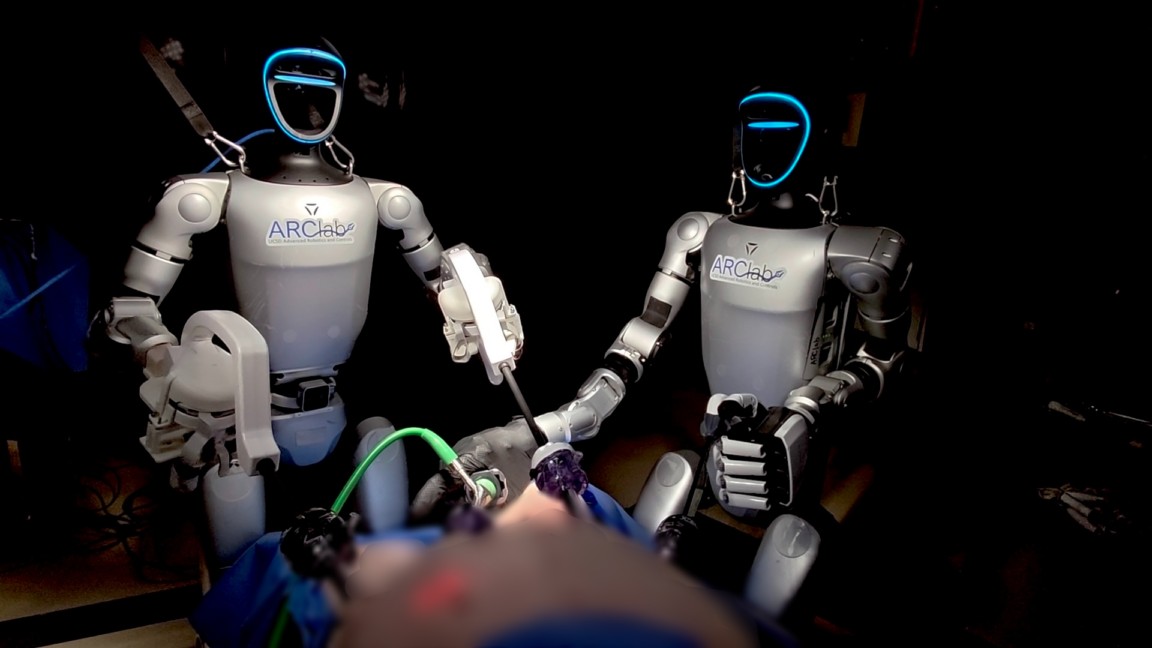
Humanoid robots have surgically removed the gallbladders from living animals in an unprecedented medical experiment—but not as autonomous machines capable of replacing human doctors. Instead, skilled human surgeons remotely controlled the robots’ movements in a new example of human-robot teamups.
The teleoperated humanoid robots completed two minimally invasive surgeries by removing gallbladders from live pigs during a preclinical trial that was published in the journal Nature. If this approach eventually proves clinically ready for human patients, surgeons could use such humanoid robots to remotely perform robotic-assisted surgical care in smaller hospitals and clinics that lack the resources to install specialized but expensive surgical robots.
“It’s a fraction of the cost and it takes a fraction of the space in an operating room,” said Shanglei Liu, an assistant professor of surgery at the University of California San Diego School of Medicine, in an interview with UC San Diego Today. “So it’s easy to deploy, anywhere from rural areas, to the battlefield, and even to space.”
The experiment used a Unitree G1 humanoid robot made by leading Chinese robotics company Unitree. The cheapest baseline G1 model with effectively non-functional hands has a starting price of $13,500 and shipping costs ranging between $300 and $1,200, whereas adding crucial upgrades such as dexterous robotic hands can easily push the cost beyond $67,000.
But such humanoid robots made in China are still significantly cheaper than specialized surgical robots like Intuitive Surgical’s da Vinci Surgical System, which can cost anywhere between half a million dollars and several million dollars.
The specialized surgical robots can also weigh about 1,800 pounds and take up considerably more space in operating rooms. By comparison, the Unitree humanoid robots, standing at 5-feet tall and weighing just 60 pounds, may be more suitable for smaller clinical settings in remote areas.
What's Your Reaction?
 Like
0
Like
0
 Dislike
0
Dislike
0
 Love
0
Love
0
 Funny
0
Funny
0
 Wow
0
Wow
0
 Sad
0
Sad
0
 Angry
0
Angry
0











Comments (0)