

‘I Rarely Wake Up Dreaming’ Review: A Young Queer Couple Tries to Evacuate Kyiv in Isabelle Stever’s Remarkable Portrait of Gender During Wartime
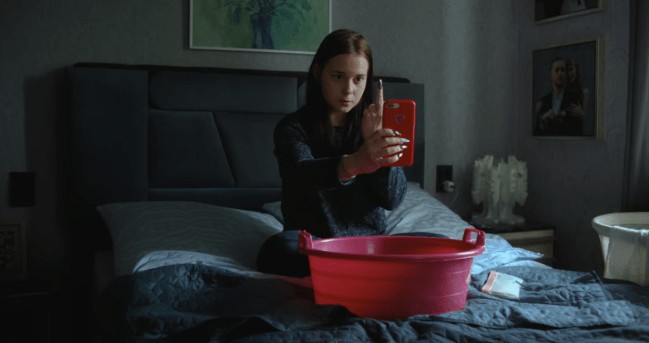

The influx of Ukrainian documentaries on the festival circuit makes it easy to overlook how sparse the country’s fiction film out has become. No wonder: shooting a feature in post-invasion Ukraine is closer to running a military operation with a slate. Daily air raids interrupt the take and take lives; an 11 p.m. curfew comes with the liturgy of bureaucratic supplication required to work past it; the crew is assembled from an industry whose irreplaceable people are in uniform. And then there is a producer fearless enough to cross the minefield, knowing that on the far side waits a festival circuit slightly fatigued by war stories from Ukraine. What survives is a tight spectrum: ultra-low-budget meta-dramas like “To the Victory!” at one end, patriotic war spectacles like “Killhouse” at the other, with the gems in between few enough to count on one hand.


But now, a ray of light arrives in the form of “I Rarely Wake Up Dreaming,” a film by power couple Isabelle Stever and Anna Melikova, who gamely fold the obstacles of wartime reality into a disarmingly tender drama. This German production, predominantly shot in Ukraine, carefully dissects how a gender transition and Russia’s invasion converge on the love between Olya (Tania Myronyshena) and Oleh (Markus Bright).
Their resemblance extends beyond their names to the shared short haircut, the glasses, and matching green-blue eyes that the camera obsesses over at a New Year’s party. But real proximity comes from a distance, through a five-minute unbroken shot that catches their bodies moving slowly in a strip of mirror, talking through traumas old and new as they disassociate from the news of troops massing at the border.
A morning that opens with explosions can hardly get worse. Until it does, with Oleh taking a call from his father and forced to speak of himself in the feminine terms he’s otherwise left behind — a transition he will soon have to conceal from Olya’s parents, who provide refuge in the country’s West. With the radio reporting on Russian troops on Chornobyl, the couple soon after sets course to Berlin. Throughout the evacuation, Olya fixates on the fact that men aged 18 to 60 are barred from leaving, all the while wearing a ridiculous big fluffy hat that seems to protect her more from the societal meltdown around her than from the cold.
Stever keeps company with compromised souls caught in cycles of social and moral precarity, but rarely bothers to rescue them, and so her ascetic form and stiff sarcasm have rarely made empathy an easy passage. Before the poorly received “Grand Jeté,” her story of an ex-ballerina falling into an incestuous bond with the son she once abandoned, the German director had already ventured into wartime diegesis with “The Weather Inside,” in which she aimed her irony at European humanitarianism through a German aid worker holed up in a luxury hotel amid an unnamed civil war.
For all the eclecticism of Stever’s previous work, “I Rarely Wake Up Dreaming” feels almost entirely different in its approach to the material, something that seems to come from Anna Melikova, both Stever’s trusted screenwriter and her Ukrainian wife. A Crimea-born curator and novelist, Melikova is also known as a gifted ex-film critic, the kind who published long, knotty interviews with such deep-cut German directors as Stever. This screenplay, based entirely on her own writing, first came to her before the full-scale invasion, taking inspiration from queer friends as they navigated shifting relationship dynamics after one’s transition. The subsequent war did much of the reshaping. From Melikova’s intimate prose and local industry connections arises an essential sensory texture of national belonging, alongside a moral register sharp enough to carry a critical charge and light enough to keep it wry.
 ‘I Rarely Wake Up Dreaming’
Cinema has lately exhausted the emotional mileage of the Ukraine–EU border, but one wittily choreographed setpiece involving the couple’s border crossing finds in transition an ingenious point of convergence between gender and geography. For Olya and Oleh, there are two patrols to clear, one per gender, in an elegant sequence that starts with a pair of male officers who are so bewildered by their first encounter with transgender documents that they wash their hands of the case, sending the couple further on to the girls who will “figure it out.” There, in a room crowded with women and crying children, we witness Oleh’s grand act of humility as he explains his “psychiatric diagnosis” to two uniformed dragons, aka “the girls,” whose lingering Soviet catechism leaves them outraged that this self-declared man seems to dodge the trench.
Here as elsewhere, Melikova’s script lays bare an intergenerational fault line running straight through morals and social attitudes, while elegantly reinforcing the idea that Ukraine is fighting for European values — as Olya caps the homophobic humiliation: “You’d be jailed for this!” But what awaits the couple, for the time being, is a particular purgatory: Olya’s mother insisting on children, a Kafkaesque maze of exit paperwork, topped with some real existential dread of the mundane.
It is striking how seamlessly Stever’s Berlin School grammar passes through Ukrainian talents, many of whom have honed their eye and ear on some of the country’s finest war documentaries. Take one of the film’s sound artist Mykhailo Zakutskyi, who mastered his sombre soundscape on such celebrated docs as “Intercepted,” “Divia” and “Timestamp“; or virtuoso cinematographer Volodymyr Usyk, one of three to shoot the decorated “Songs of Slow Burning Earth.” Those are some of the striking examples of observational register, one that uses tactical distance, sound, slowness and associative montage to convey pain without resorting to the evidentiary shock of graphic imagery. Here, too, Usyk’s camera renders that echoing dissociation through hypnotic close-ups of mundane gestures: a market woman’s hands fumbling a slick piece of fatty liver, the sharp needle of a manicure drill pressing deep under a cuticle, each image ablaze with a screaming muteness that cannot but drive one insane.
The film’s fragile documentary sensitivity is nowhere more vivid than in its two non-professional leads. Bright is himself transgender and co-founder of The Third Place, an NGO for autistic adults; Myronyshena is a journalist covering the war for The Kyiv Independent. Both bring rawness to the screen with an instinctive precision. This is what gives the film its experiential sincerity — the lived perspective of its Ukrainian crew leaving a nonfictional trace across every level of the fiction, something Stever handles with unusual reverence.
Even if the last stretch hurries itself toward a verdict, it nonetheless reveals something essential about Stever’s career. Having always filmed the collision of personal freedom and convention, she finds in war the ground where that collision is least survivable — a place where gender comes apart in her hands, only to be deftly reassembled on her terms. And so, on one of the grimmest terrains our present has to offer, Stever arrives at her brightest film to date.
Grade: A-
“I Rarely Wake Up Dreaming” premiered at the 2026 Locarno Film Festival. It will also screen in the Main Slate of the 2026 New York Film Festival. It is currently seeking U.S. distribution.
What's Your Reaction?
 Like
0
Like
0
 Dislike
0
Dislike
0
 Love
0
Love
0
 Funny
0
Funny
0
 Wow
0
Wow
0
 Sad
0
Sad
0
 Angry
0
Angry
0







Comments (0)