

I replaced my Sonos home theater with this Sony system - here's why innovation is king

pros and cons
Pros
- Unimposing design
- Exceptional sound
- Expansive software features
Cons
- Expensive
- Limited terminals
Follow ZDNET: Add us as a preferred source on Google.
Sony's been on a roll this year with home theater product releases, expanding its Bravia line with individual devices that let you build a modular system at your own pace. Sony's modular Bravia lineup is more comprehensive than that of Bose, Sonos, Denon, and Samsung, and at the top of the hierarchy lies the Bravia Bar 9, Theater Quad, and the new Trio.
Also: 4 easy tweaks you can make to your TV soundbar for more immersive audio
I previewed the Bravia Theater Trio in April before its official release, and now I've had the opportunity to set one up in my house and see how it stacks up against the industry's best -- including Sony's other products. If you can overlook the Trio's staggering $2,200 price tag, here's what else you should know about it.
Best bluetooth speaker deals of the week
Deals are selected by the CNET Group commerce team, and may be unrelated to this article.
Design matters
Like the Theater Quad, the Bravia Trio is a uniquely packaged home theater system that offers greater performance, convenience, and flexibility than standard soundbars for people who still want a high-end experience. Instead of speakers you place around the room, the Bravia Trio includes three front-facing speakers to be placed directly in front of and on both sides of your TV, which can be mounted or placed flat on an entertainment stand.
Each left and right speaker includes one upfiring speaker for upward sound reflection, and a two-way woofer and tweeter for low and high frequencies. The center channel features rectangular speaker units, which Sony says maximize diaphragm area, maintain sound pressure, limit distortion, and clarify dialogue. With all three speakers, you get a 3.0.2-channel configuration.
Also: How I upgraded my Sonos soundbar's audio quality - 3 easy and free methods
The center channel also features two-way drivers with two woofers and one tweeter. The result is an incredibly powerful sound profile, with exceptional clarity, immersion, and cinema-level dynamism. Though all three speakers in the Trio are front-facing, Sony's proprietary technologies make purchasing surround speakers unnecessary for those with the right room dimensions.
With its large sound presence (and price tag to match), the Trio makes a great high-end home theater for larger rooms and TVs. The center channel should be centered with respect to your TV, but you do have some wiggle room with the left and right speakers. If your space doesn't allow for even placement on either side of your TV, you can place them asymmetrically and let Sony's calibration technologies compensate for the uneven distances. You'll still need to keep them forward-facing.
Also: After testing Bose's $1,100 Ultra soundbar, I'm a little less worried for Sonos
Some people may find home theater products unsightly in their homes, especially when placed in a high-traffic area like a living room. Though Sonos offers a dapper, modern design, you can't avoid the large soundbar, two large rear speakers, and a floor-standing subwoofer that fill a room, creating an adequate sound system for a larger area.
Sony's Trio does a great job at mitigating this aesthetic conundrum, offering consumers a nondescript, unimposing form factor with exceptional sonic performance.
Let's talk about sound
Sony's Bravia Sound Field room calibration technology balances the speakers' output based on your room shape and furniture. At the same time, Sony's 360 Sound Mapping uses that calibration to create a more immersive soundscape by simulating "phantom speakers" around the room. After completing these two calibration sessions, I watched as much Dolby Atmos content as possible to get a sense of the Trio's immersive capabilities.
From the intensity of a burning Pandora in "Avatar: Fire and Ash" on Disney+, to the heartbreak of watching the USMNT lose to Belgium on Peacock, I had plenty to work with. Again, don't let the Trio's solely front-facing speakers fool you. The Trio reproduces exceptional left/right separation, and the left/right speakers' upfiring units are the most audible I've heard in a home theater system, beating the remarkable performance of my beloved Era 300 speakers.
One of the Bravia Trio's left/right speakers.
The Trio's left and right speakers are larger than typical surround speakers, and they get plenty loud with the precision you'd expect from a center channel. Sony developed the Trio alongside audio professionals from its Sony Pictures Entertainment unit, and you can hear the dedication to a cinematic sound experience.
With the Trio's precision and smoothness of conveying the audiority movements of objects in motion across your screen, you can feel the content you're watching as much as you can hear it, which is where the Trio outpaces flagship competitors from Sonos, Samsung, and even itself.
Also: Bose Lifestyle Ultra vs. Sonos Era 100: I compared both smart speakers, and this one wins
When watching immersive content, I noticed that the left and right speakers handled most of the content's moving parts, leaving the center channel to deliver clear audio and musical notes. Still, you can only hear this separation if you put your ear up to the speakers. From your calibrated listening position, the Trio does a great job of blending everything while giving you a sense of spatial awareness inside what you're watching.
In addition to Dolby Atmos, the Trio supports DTS:X spatial audio, Bluetooth connectivity, Apple AirPlay, and Spotify Connect. The Trio has one HDMI Out port for eARC connectivity, one HDMI In port, and an Optical port. The Trio's HDMI ports can accommodate 8K HDR content, 4K/120Hz pass-through, Dolby Vision, PlayStation 5 audio/visual optimization, and IMAX Enhanced.
More speakers, more problems
Despite the Trio's top-end cinematic talents, it's not immune to being elevated by some additional speakers. During my demo of the Trio in April, Sony set the system up with additional Rear 9 speakers and a Sub 9 subwoofer. Though the audio results were phenomenal, this configuration will be overkill if your space isn't big enough.
After lugging several 15-pound boxes from my house to my parents' house, which has much more space, I set up the Trio, a pair of Rear 8 speakers, and one Sub 7 subwoofer. Adding rear speakers and a subwoofer elevates any soundbar, enhancing spatial immersion and taking low-frequency stress off the main speaker.
Also: Forget the soundbar: How I upgraded my TV audio with spare Bluetooth speakers
In the Trio's case, the Rear 8 speakers picked up some slack from the 360 Sound Mapping technology, as placing real speakers behind me reduced relying on Sony's phantom speakers to reach the farthest points of the room. The Rear 8 speakers also helped balance the room's overall calibration. Digital calibration can only do so much, and your listening experience will vary depending on where within the room you're sitting.
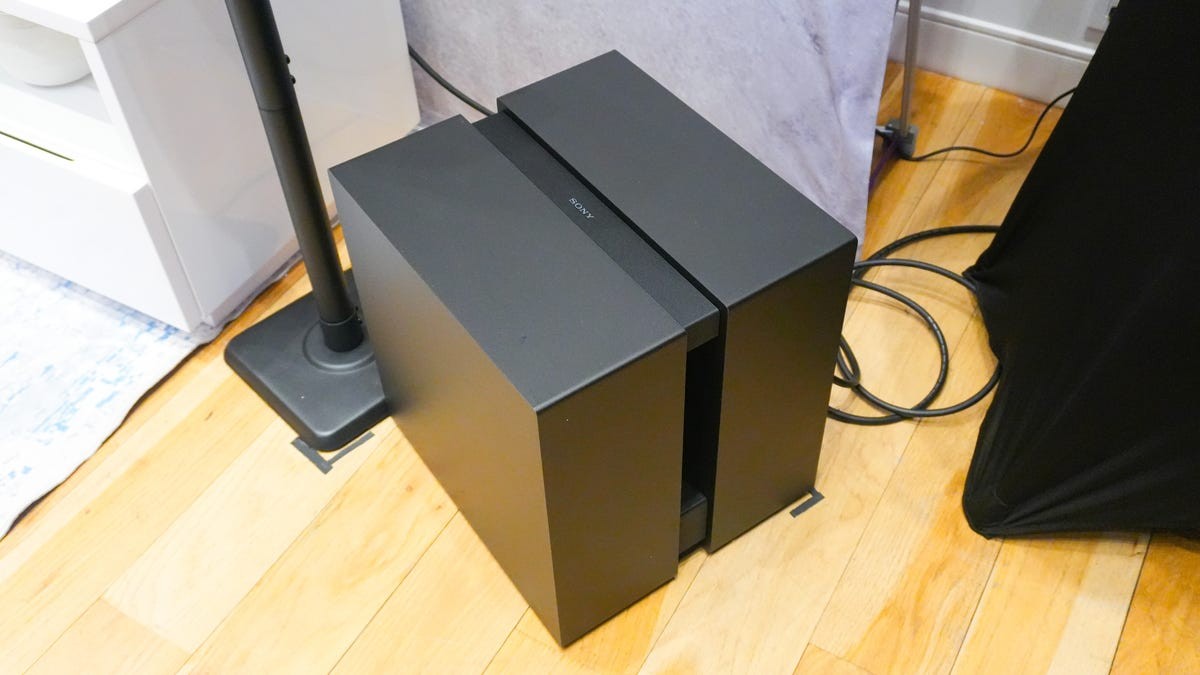
The Sub 7 is Sony's most affordable subwoofer in its new Bravia lineup, featuring a single 130mm driver. On its own, the Trio handles low frequencies very well, but the Sub 7 adds a visceral element to the watching experience, allowing you to feel the bass. When the Sub 7 takes over most of the bass response, the Trio's mid-to-upper-midrange performance becomes even more captivating.
Sony's Bravia Theater Sub 9 is big and boomy enough for the Bravia Trio.
Still, I believe in "go big or go home" with the Trio. If you're going to buy one of Sony's most advanced home theater systems, consider pairing it with one of Sony's beefier subwoofers: Bravia Sub 9, Sub 8, or two Sub 7s. One Sub 7 is great, but its smaller driver doesn't deliver the weighty boom at the very low end that a larger subwoofer or multiple small subwoofers can.
With all of that said, the Trio deserves adequate space to do its system justice. If your viewing room is too small, the Trio's power plus its phantom speaker technologies can become overwhelming very quickly. If you live in close quarters with others, keeping the Trio at low levels does it, and the money you will spend on it, a major disservice.
Also: Why the 'Subwoofer Crawl' is the only way I found the bass sweet spot in my living room
If your viewing space is on the larger side or open-concept, you'll benefit from the Trio's sound projection and phantom speakers, which use the space to envelop viewers. However, if you have vaulted ceilings, adding more Bravia Rear speakers with upfiring drivers may not cut it. In this case, you may need something more advanced, such as in-ceiling speakers.
ZDNET's buying advice
Sony's Bravia Theater Trio is a unique home theater system that offers aesthetically conscious consumers with discerning taste in audio the best of both worlds. Home theater enthusiasts may be skeptical of the Trio's minimal, front-facing design, but it delivers a surprisingly exceptional performance with cutting-edge software that can briefly suspend your belief in physics.
If you have a high-end Sony TV in your large living room or viewing room, the Trio blends in seamlessly, delivering elevated audio performance to match the visuals. However, if you have a complex setup with AVRs and several wired speakers, you'll be limited by the Trio's lack of terminals.
Also: I brought a Bose, Sony, and JBL speaker to the beach - this one's my new outdoor essential
Still, adding rear speakers and an external subwoofer only raises the Trio's bar, but it can be pricey, and I only recommend it if you have the space. If your space is smaller, consider Sony's more compact Bravia offerings, such as the Bravia Bar 7 and Sub 7.
Why the Sony Bravia Theater Trio gets an Editors' Choice award
We awarded Sony's Bravia Theater Trio an Editors' Choice award for its thoughtful and innovative design, exceptional audio performance, and compatibility with Sony's other Bravia Theater-line products. Few features are walled behind Sony's Bravia brand, meaning the Trio can excel with any TV with an eARC port.
Aside from its expected superior audio performance and theater-like sound, the Bravia Theater Trio's design is the most interesting thing about it. Sony implementing its mature 360 Sound Mapping calibration technology allows the Trio to maintain its unimposing, sleek, three-speaker, front-facing configuration without sacrificing immersion. Sony's design choices and technological prowess combine to bridge the gap between home theater enthusiasts and aesthetically-conscious consumers.
What's Your Reaction?
 Like
0
Like
0
 Dislike
0
Dislike
0
 Love
0
Love
0
 Funny
0
Funny
0
 Wow
0
Wow
0
 Sad
0
Sad
0
 Angry
0
Angry
0












Comments (0)