

In the Neon World of ‘Buddy,’ Hints of Fascism Are Everywhere, Even in Talking Trains and Deranged Puppets
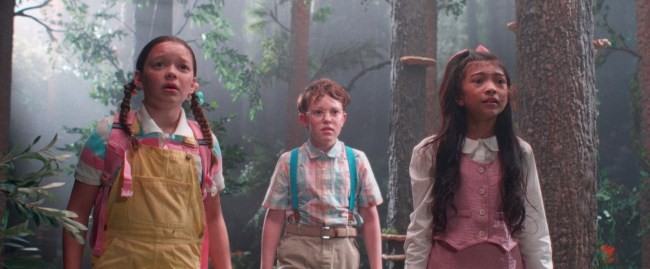
I promise we’re gonna get right back to the demonic orange unicorn thirsting for love/blood in director Casper Kelly’s latest horror smash, “Buddy.” But there is this great Umberto Eco essay about fascism that he starts with his own experience of growing up in Italy in the ‘40s. At age ten, he had to participate in a bunch of Mussolini’s youth programs, including a public speaking contest about whether or not young Italians ought to die for the glory of Il Duce and the immortal destiny of Italy. Eco wrote, “My answer was positive. I was a smart boy.”
On reading the script for “Buddy,” production designer Anna Kathleen immediately responded to it as a story of fascism, and how horrifying it is for smart boys and girls to recognize and need to play along to survive. It is one that uses some very different tools — like googly-eyed sentient trains and a drugged-out cowboy (Clint Horward) and his castoff marionette (Michael Shannon), but still. There’s a vibe.


There is also a masterful visual balance between childish things and the smart survival sense that children have embedded in the world of “Buddy,” especially the TV set for “It’s Buddy!” that Kathleen designed to be under the thrall of Buddy (Sergey Zhuravsky and voice by Keegan Michael Key) himself.
For Kathleen, the more manicured and pristine that set could be, the more things that could have Buddy’s insignia stamped on them and the more objects that could have faces staring out at Freddy (Delaney Quinn) and her friends, the better. Kathleen and her team relished plastering Buddy’s influence everywhere they could within the frame of the “It’s Buddy!” house, from “the patches on the nurse’s uniform, the postman’s hat, there’s a Buddy flag, it creeps in everywhere,” Kathleen said. “I don’t know if we ever saw it, but we made postage stamps on the birthday invitation mail, just a ton of little things. Buddy’s insignia is everywhere.”
 Behind the scenes of ‘Buddy’ Roadside Attractions LLC.
 An innate sense of wrongness comes from all that smothering of Buddy’s mark, but a lot of it slowly builds because of the color palette of the “It’s Buddy!” TV world, as well. Those color choices are hard to articulate but very easy to feel, especially if you’re a smart kid like Freddy. In order to pull off that growing sense of visual unease, however, Kathleen told IndieWire the color palette had to be “extremely tight and regimented.”
The liberal uses of yellows and purples and oranges create kind of a nostalgic, throwback vibe to Millennial kids TV of the ‘80s and 90s. But the space has almost no reds or blues in it — except for the blue of Mr. Mailbox (Eric Bauza) who is a steadfast presence for the kids throughout the film, and except for the red of, well, everybody who Buddy kills.
The exclusions make the space feel slightly warped, at first, though until the blood starts spattering, it’s hard to articulate why.
“ Everything was leaning more cyan or purple or leaning more orange or pink, with the obvious exception of the blood — which we wanted to really make an impact on the palette as it comes into play,” Kathleen said. “Color is always really important to me in any film that I design, and this one is intentionally odd and exceedingly tight and regimented.”
 Behind the scenes of ‘Buddy’ Roadside Attractions LLC.
 The “It’s Buddy!” HQ informed costuming choices as well, as Kathleen worked with costume designer Shawna-Nova Foley to make choices for the core characters that would either pop inside the environment in a special way, or feel almost too lost inside of them. “It was a very close collaboration to understand what the environment was going to be and thread that needle of [the characters] sticking out versus blending in and also feeling practical,” Kathleen said.
In fact, some of the most intense production design work came on the Strange Lands, the places that Freddy, Hannah (Madison Skyy Polan), and Oliver (Tristan Borders) flee towards once they realize that loving Buddy might not be enough to stop him from ripping out their hearts. “We’re a tiny movie with limited resources and limited space, so, how are we going to create this visceral experience for the audience?” Kathleen said.
The answer was that the film segmented one big stage in Cleveland, with the Buddy TV standing for the entire production because shooting had to go in and out of it. But the jungle, swamp, and prairielands the kids journey to had to be designed within a contained space to a much higher degree of realism, although they also still had to have a certain amount of artificiality as still being within Buddy’s reach.
“We had to be really scrappy with what we were doing and also, from the beginning, understand that this was never going to look like ‘The Labyrinth.’ This is not going to be ‘The NeverEnding Story.’ We don’t have these big, fluffy studio budgets. So we have to create this low-budget kids show metaverse where we can see the seams, and we can appreciate the cracks,” Kathleen said.
 Prop bikes from ‘Buddy’ Roadside Attractions LLC.
 But “Buddy” is very deliberate about the cracks that we do get to see and the ones we don’t. Puppet strings, for instance, are hidden or erased with VFX. There are physical seams on the backdrops that Kathleen and her team took great care to make sure wouldn’t be visible in frame. Each setpiece was carefully calibrated in terms of its level of fantasy, in order to draw us further and further into the characters’ emotional journey.
That included building seemingly innocuous details in the main set that could, once things got very dark, be weaponized later.
“We knew [the main set] had to be bright, but we planned wild patterns and practical lights that we knew weren’t going to see any play until the very end. We wanted to bring a little bit more of this ‘80s neo-noir slasher vibe to the party with little pops of color and dramatic practical lighting that would allow for that,” Kathleen said. ““The sets are just the mode of the characters’ emotional journey, and if we can articulate that arc, its peaks and valleys, in there visually, that’s always the goal.”
“Buddy” is now playing in theaters.
What's Your Reaction?
 Like
0
Like
0
 Dislike
0
Dislike
0
 Love
0
Love
0
 Funny
0
Funny
0
 Wow
0
Wow
0
 Sad
0
Sad
0
 Angry
0
Angry
0





Comments (0)