

JPMorgan Urges Investors to Seize Semiconductor Selloff Opportunity

Key Takeaways
- JPMorgan recommends purchasing semiconductor stocks following weakness in early H2 2026
- Semiconductor benchmark SOX declined 5.4% last week before rebounding 2.5% on Monday
- Bank’s investment hierarchy places semiconductors above hyperscalers and AI-vulnerable sectors
- JPMorgan maintains caution on software, business services, and media due to AI disruption concerns
- Analysts anticipate expanded market breadth in second half, favoring small caps and global equities
Semiconductor equities experienced turbulence entering the latter half of 2026. The PHLX Semiconductor Sector Index (SOX) declined 5.4% throughout the abbreviated trading period ahead of Independence Day. This marked the benchmark’s consecutive second week of losses.
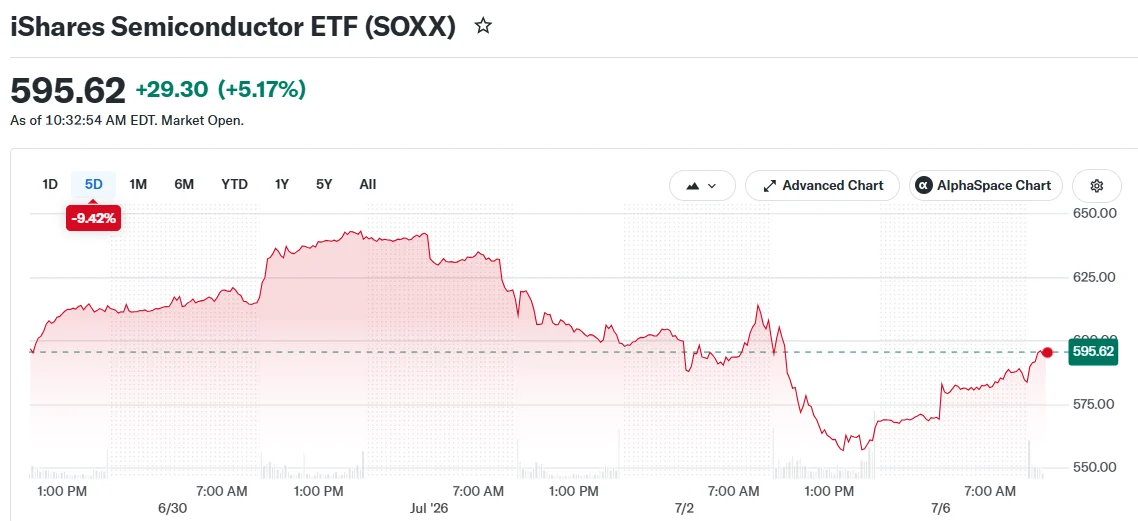 iShares Semiconductor ETF (SOXX)
However, analysts at JPMorgan view this recent downturn as an attractive entry point rather than cause for alarm.
In a client communication released Monday, JPMorgan strategist Mislav Matejka stated that the semiconductor growth cycle is far from reaching its zenith. He emphasized that substantial new production capacity won’t materialize until 2028 at the earliest.
Market action validated this optimistic stance. The SOX jumped 2.5% at Monday’s opening bell. The Nasdaq Composite climbed 0.7% in early trading as investor appetite for AI-linked chip manufacturers returned to Wall Street.
Multiple stocks that underperformed the previous week spearheaded Monday’s recovery. Applied Materials, Marvell, and Broadcom all registered gains. Memory chip manufacturers such as Western Digital, Seagate, and Sandisk also rallied, propelling the Roundhill Memory ETF upward by over 6.1%.
JPMorgan’s Cautionary Notes
Despite its optimistic semiconductor outlook, JPMorgan expresses greater reservation toward other AI-related investments.
According to Matejka, the firm’s investment ranking places “semis over hyperscalers over AI at risk plays.” The Magnificent Seven technology giants are “likely to see derating continuing on monetization fears,” he noted.
JPMorgan maintains a “fundamentally bearish” stance on sectors vulnerable to what it terms AI cannibalization. This category encompasses software, business services, and media companies. While tactical rebounds may occur during oversold conditions, the bank’s overarching perspective remains negative.
The underlying concern is that artificial intelligence applications are eroding revenues for these sectors rather than generating new growth opportunities.
Second Half 2026 Market Perspective
Beyond the semiconductor sector, JPMorgan anticipates global equity markets reaching new peaks during the year’s second half.
The bank cites robust earnings projections, moderating inflation trends, and conservative investor positioning as fundamental support factors.
Matejka also identified the resolution of Iran-related geopolitical tensions as a potential catalyst. He suggested that crude oil prices, inflation expectations, government bond yields, and central bank policy forecasts could all retreat from Q2 levels.
He further noted that artificial intelligence “is unlikely to be the only story in town” through year-end. Small-capitalization stocks, cyclical sectors, and international markets should all gain as market participation expands beyond technology leaders.
Stagflation concerns that dampened investor sentiment in recent months are projected to diminish, the strategist indicated.
JPMorgan’s core thesis is straightforward: Semiconductor stocks represent the optimal vehicle for artificial intelligence exposure currently. Alternative AI-related investments present elevated risk profiles.
✨ Limited Time Offer
Get 3 Free Stock Ebooks
Discover top-performing stocks in AI, Crypto, and Technology with expert analysis.
- Top 10 AI Stocks - Leading AI companies
- Top 10 Crypto Stocks - Blockchain leaders
- Top 10 Tech Stocks - Tech giants


What's Your Reaction?
 Like
0
Like
0
 Dislike
0
Dislike
0
 Love
0
Love
0
 Funny
0
Funny
0
 Wow
0
Wow
0
 Sad
0
Sad
0
 Angry
0
Angry
0












Comments (0)