

‘My Sad Dead’ Review: Pablo Larraín’s Eerie Netflix Ghost Story Just Wants Us to Listen
You hear the whimpers before you see the dying woman making them. Shown from above, the camera steadily encroaching like the angel of death itself, is an elderly woman in a hospital bed. Her gray hair is almost gone. Her breath comes in shallow bursts. Her body bows and twists from the pain she won’t have to live with much longer.
But her cries are what lingers. Moaning, sobbing, pleading, the woman grasps the hand of her daughter, Ema (Mercedes Morán). She pulls Ema’s fingers to her chest. She runs her hands up her arm, driven by an insistent desperation. It’s as if she’s begging Ema… but for what? Ema is a doctor, but her mother is allergic to morphine. There’s nothing that can lessen her suffering. In a matter of seconds, she’ll be gone.


Except, she’s not. Ema’s mother dies with both hands wrapped around her daughter’s limp wrist, but she doesn’t leave. Once director Pablo Larraín’s camera stops its descent, hovering above the woman as she passes from this world to the next, a blurred version of her returns. Ethereal, spiritual, a ghost — but a ghost Ema can see and hear. A ghost still begging, still desperate to be acknowledged by the living.
So much of “My Sad Dead” is wrapped up in the opening sequence, the remaining four hours almost feel like an epilogue. Larraín’s latest ghost story is his first Argentinian production (set in a derelict suburb of Buenos Aires), but the Spanish-language series doesn’t limit its perspective on humanity to a single culture. Instead, it sees a world lending a deaf ear to human suffering with increasing, terrifying regularity, as people prefer living with the residual death rattles to doling out minimum levels of compassion.
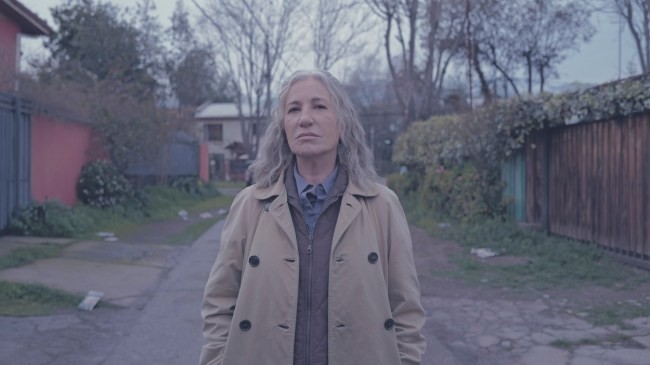
Ema has always seen ghosts. She tells herself (and, more importantly, others) that she knows they’re not real; that it’s just PTSD from hearing too many patients die in agony, or hallucinations sparked by sleep deprivation. But even as a five-year-old, she could hear and see the bodies of the departed, walking around in whatever state they were in when they prematurely passed away, repeating the same moments in their last minutes of life.
Today, living in her mother’s home within an abandoned public housing neighborhood called Piedrabuena, Ema sees ghosts everywhere. Victims of gun violence, police violence, robberies, and addictions walk the streets outside, repeating their last movements, behaviors, and desires. They shout, moan, and scream. They vent their frustrations. They go about their days.
Soon, following an accident that contaminates the local water supply, it’s not just Ema who can hear them. Cries from the living and the dead blend into a cacophonous howl, as if the great beyond is taking issue with how the here and now is treating their shared souls. It would make sense. Community meetings focus on eradicating the homeless and protecting property values rather than supporting neighbors or providing shelter. Ambulances won’t come to the neighborhood anymore, and the city doesn’t respond to complaints about the polluted water for days, maybe weeks.
 Alejandra Flechner in ‘My Sad Dead‘Courtesy of Pablo Larraín / Netflix
All-too-familiar signs of dehumanization pepper “My Sad Dead”: automated customer service agents that keep callers in an endless loop, empty institutions meant to support entire communities, decaying buildings, public panic, and senseless scapegoating. At the root of it all is negligence, which is refuted and embodied by our challenging heroine.
On the one hand, Ema is the only one willing to lend all those wayward souls a moment of her time. She stops and listens. She encourages and offers help. She talks to the ghosts as if they’re really there, because for Ema, they really are. Even if there’s nothing she can do to bring them back, simply acknowledging their presence and their plight goes a long way to improving their situation. At the very least, no one wants to feel invisible, especially when our devolving society keeps finding new ways to instill that impression.
But Ema isn’t a saint. Her sister, Lydia (Alejandra Flechner), accuses her of being a better caregiver to the dying than the living. She may have been there for her mother in her final months, but she spent the preceding years ensconced in work. She may judge her sister for the way she treats her mentally unwell daughter, Julie (Carolina Sanchez Alvarez), but she didn’t keep in contact when the family moved to America. She was even forced out of her job over lawsuits related to medical negligence, even though her medical expertise — and human compassion — guided choices considered to be out of line.
Whether it’s her job, her relationships, or her community, knowing the full story takes time, just as appreciating their complexities requires empathy and understanding. Systems aren’t built to support such things, but humans are, and “My Sad Dead” strives to remind us of our own capacity even as it mourns how often we waste it.
Slow to the point of inertia yet salvaged by consistent curiosity, Larraín captures most of the series in a desaturated daze. Light takes on an ethereal glow and colors blend into murky browns and blacks. Ema’s many long walks through the neighborhood are eerie — the screams echo as if from everywhere and nowhere — but there’s a stark beauty lurking behind the death and decay, as if life could come rushing back if enough people wanted to see it.
Grade: B-
“My Sad Dead” premieres Thursday, September 24 on Netflix. All four episodes will be released at once.
What's Your Reaction?
 Like
0
Like
0
 Dislike
0
Dislike
0
 Love
0
Love
0
 Funny
0
Funny
0
 Wow
0
Wow
0
 Sad
0
Sad
0
 Angry
0
Angry
0







Comments (0)