

One Light, Two Completely Different Portraits
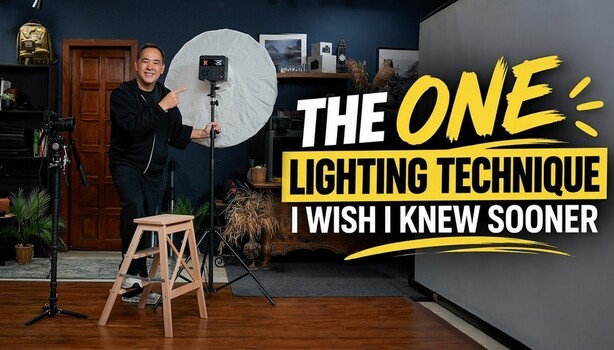
A white wall behind your subject can go pure black in the final frame, even when the light never moves. You can get two completely different portraits from one setup in a room the size of a spare bedroom if you know how to use the light already in the room and how to shut it out.
One flash head, parked in a single spot, produces both a soft, ambient-blended portrait and a dark, dramatic one in a demonstration from Jiggie Alejandrino. He works out of a home studio floor roughly 2.5 meters wide and 4 meters deep. His light is the Neewer Q6, a battery-powered 600 Ws strobe that also has a 30 W bi-color LED modeling lamp, fired through a reflective umbrella with a diffuser. He shoots on a Sony a1 II with the Sony FE 50mm f/1.4 GM for half-body framing. Every image comes straight out of the camera with no editing. He also gives the actual distances: the camera sits about a meter from his subject, the umbrella about 2 feet from her face, and she's roughly 5 feet in front of the backdrop.
The first portrait starts with the lights that were already on. Two video lights in the room weren't hitting her face at all, but one made a gentle fill and the other threw a kicker onto her hair. Alejandrino turns off the flash from the trigger. He uses the Q6's modeling lamp as a continuous main light and shifts its color temperature to match the room's existing sources. Then he turns on the live view exposure effect, so the viewfinder shows what the sensor will actually record. From there, he drops the shutter speed until the scene opens up, landing at 1/50 s and f/1.4. He angles the light slightly downward and moves it until it wraps around her face and gives a hint of Rembrandt lighting. The approach works well in most rooms, because the light already there often has a job it can do if you give it one.
Every flash portrait mixes two exposures in one frame, and you get separate controls for each. Shutter speed, aperture, and ISO set how much ambient light you record. Flash power and the light's distance from the subject set how much strobe light you record. Below your sync speed, a strobe's burst is far shorter than the time the shutter stays open. Changing the shutter speed there shifts the ambient exposure while the flash exposure stays the same. High-speed sync changes that. The flash pulses rapidly while the shutter slit travels across the sensor, so every faster shutter speed costs you usable flash output, which is why a strobe with real power reserves matters above 1/250 s. Distance does the rest through the inverse square law. With the light about 2 feet from the subject and the wall around 7 feet from the light, the wall receives roughly one-twelfth as much light, about 3.6 stops less. In a small room, you can use that falloff to your advantage. The Q6 is also part of a larger shift toward battery heads with strong LED modeling lamps, like the Profoto B10X, which blur the line between strobe and continuous light for anyone who switches between stills and video.
For the second look, the only thing that changes is the camera and flash settings. Alejandrino turns the flash back on and pushes past the roughly 1/250 s sync speed of his camera, trigger, and flash combination into high-speed sync. At 1/4,000 s, the room goes completely black on the camera, so anything that shows up in the frame comes from the strobe. He then turns off the live view exposure effect so he can still see his framing. He starts at 1/64 power and works upward from an underexposed first frame. The Q6 adjusts in 0.1-stop steps from 1/512 to full power, and its 3,000 mAh battery is rated for about 400 full-power pops. It also works with Godox's 2.4 GHz X system, so it fits into a kit that already runs on Godox triggers. He also changes his camera angle and has his subject adjust her pose to suit the moodier light.
The video above shows where the power setting ends up, how the shooting angle changes, and how the black-backdrop frames compare with the ambient portraits.
What's Your Reaction?
 Like
0
Like
0
 Dislike
0
Dislike
0
 Love
0
Love
0
 Funny
0
Funny
0
 Wow
0
Wow
0
 Sad
0
Sad
0
 Angry
0
Angry
0






Comments (0)