

Rebecca Miller on Finding the ‘Perfect Protagonist’ in Martin Scorsese, and the ‘Weird Magic’ That Emerged from Five Years of Conversations with Him
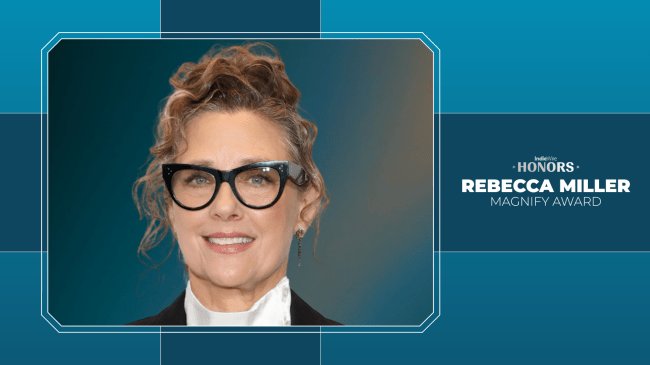

On June 4, the IndieWire Honors Spring 2026 ceremony will celebrate the creators and stars responsible for crafting some of the year’s best television series. Curated and selected by IndieWire’s editorial team, IndieWire Honors is a celebration of the creators, artisans, and performers behind shows well worth toasting. In the days leading up to the Los Angeles event, IndieWire is showcasing their work with new interviews and tributes from their peers.
Rebecca Miller is fascinated by the “weird magic” that must happen with anything involving two people.
“It’s like when you go to the psychiatrist. Some work really well for you, and some don’t. Or love affairs,” Miller, our Magnify Award recipient, said over Zoom ahead of the June 4 IndieWire Honors ceremony. “Or friendship, or even director-actor relationships. All of these deep interpersonal relationships are dependent on some kind of elective affinity.”


Erudite but unpretentious, and also canny and welcoming in her self-aware sense of humor, Miller most recently had the chance to immerse herself in the alchemy between two filmmakers as the director of “Mr. Scorsese.” The intellectually exhilarating and beautifully sculpted five-part Apple TV docuseries serves as an artist’s portrait of the life, the times, and the films of the 83-year-old director of “Taxi Driver,” “Goodfellas,” “The Wolf of Wall Street,” and so many more. A writer and director in the true sense of the term — Miller has directed five narrative features and now two documentaries including “Arthur Miller: Writer,” about her father, the Pulitzer Prize-winning playwright — she sat down with Scorsese for more than 20 hours of interviews across five years.
“Part of my interest in him had to do with his Catholicism in opposition to or existing alongside his fascination with violence, and how do those two things go together?” said Miller, whose own career in filmmaking burst forth in 2002 with “Personal Velocity,” an electrifying adaptation of her own short fiction about women in crisis and at a crossroads. For a storyteller whose works revolve around complicated or slippery romances, life-altering revelations, and fateful everyday encounters, the brutality of the mafia and New York City street vigilantes feels far removed from her own. But nevertheless, she said, questions of violence and religion “were very personal to me as well.”
Miller would’ve been roughly the age of Jodie Foster’s child sex worker in “Taxi Driver” the year that film came out, and her relationship to Scorsese’s work didn’t start to take shape until “Goodfellas” in 1990, when she was still a painter.
“Then the next big movie from me was ‘The Age of Innocence,’ and then I started rewatching and revisiting them all from there on in. By the time I watched ‘The Age of Innocence,’ I was starting to make films,” she said.
 ‘Mr. Scorsese‘Apple TV
Miller got to know Scorsese more personally while living in Italy, outside Cinecittà Studios, where he recreated a version of mid-1800s New York City for the film “Gangs of New York,” starring Miller’s husband, Daniel Day-Lewis. That the three-time Oscar-winning actor submerges himself, Method-style, in every role her plays hardly warrants a push alert. But that meant Miller was all the more absorbed into Scorsese’s storytelling world. This was around the time she was preparing to make “Personal Velocity,” an emotionally frank but delicately told triptych film starring Parker Posey, Faruza Balk, and Kyra Sedgwick.
“I would walk around that set, that incredible set, and you know, Daniel had that immense mustache, terrible road rage,” she said of her time circa the making of “Gangs of New York.” “It was a funny time, and I loved it.”
Around that time, “I became completely fascinated by his films when I made ‘Personal Velocity’ because I needed to use voiceover, and Marty’s such a king of using voiceover. That was how I started to get to know him, asking him about films that use voiceover for ‘Personal Velocity.’ Of course, I’d already been studying his films for that, and he was able to give me some other ideas, too.”
His feedback improved the film in the subtle ways you’d expect from a master obsessive like Scorsese, an artist so fiercely protective of his own work that he once threatened to steal reels from the studio over cuts demanded of “Taxi Driver.”
“His main note for ‘Personal Velocity,’ I remember him saying, ‘My mind wandered here.’ There was a part of the film that was very, kind of, slow, and I cut it down, and I reacted to his note. It was a great note. In general, I would say that his notes weren’t proprietary or invasive; they were his personal feelings about it. Where did the hypnosis fail to work? That’s sort of what he was saying, like, ‘I got disconnected, the ribbon was broken.’ That’s what he was generally telling me… when was he not connected anymore?” Miller said.
Two decades later, their working relationship yielded the interviewer-subject intimacy of “Mr. Scorsese” — but Miller described their dynamic as more of a “conversation” than a sitdown Q&A.
“It was very much a conversation versus an interview because, of course, I had loads of notes, and I had prepared and watched all his films, and all the films I felt he watched at that time that I should have watched,” she said. “But at the same time, it was just a conversation. I tried to say something to start with. I knew I needed to hit certain films, but it was like call-and-response. In a weird way, it helped that I didn’t know very much about his personal life. I knew his films really well, but I didn’t know that much about his past. All the questions are real questions rather than me actually knowing the answer and then trying to get it out of him.”
Miller knew she “had a really strong instinct” to make a generous but clear-eyed portrait of the filmmaker — delving into his cocaine days, and brushes with failure on “The King of Comedy” and controversy on “The Last Temptation of Christ.” That same instinct has driven critically acclaimed and award-winning collaborations throughout her career with actors like Anne Hathaway, Marisa Tomei, Julianne Moore, Ethan Hawke, Greta Gerwig, and Day-Lewis himself. And in a body of work that, through and through, always contains pieces of Miller herself.
“One of the hardest things, honestly, was figuring out how much I’m in [‘Mr. Scorsese’], my voice. I found that if I took it out too much, it’s very disorienting, because he’s obviously talking to someone, and it’s like, ‘Who is that person?’ There’s a lot of interjection and sounds I’m making that I took out so it’s not distracting,” Miller said. “I felt like, by the end, I was in it more than I intended, because you feel me, but that’s good because it’s honest. If you didn’t see the relationship that we have and the humor and all the rest of it, then it would be hard to understand why he’s talking like that.”
 Casting director Ellen Lewis, Martin Scorsese, Rebecca Miller, and Francesca Scorsese attend the ‘Mr. Scorsese’ photo call during the 63rd New York Film Festival at Alice Tully Hall, Lincoln Center on October 04, 2025 in New York City.Getty Images for FLC
In the process, she came upon one of the great leading characters across all her fiction (she’s published five books) and filmmaking. “In some ways, it was a lot like all my work. I’m really fascinated by character … and the anomalies that people contain. If you look at this as just a film, Marty is an incredible protagonist. He’s like the perfect protagonist, actually, in many ways.”
Miller’s pedigree as the daughter of arguably the most famous American playwright of all time unmistakably looms over her work and public profile. But rather than being the daughter of an artist, what she related to most in the parts of “Mr. Scorsese” where his daughters factor in — they all come from different wives — was the “layered family” aspect.
“I do think I also came from a layered family, where my older siblings came from other times, and they had a different father. It’s very similar,” said Miller, who is the youngest of her father Arthur’s four children. “You win in some ways, but then you lose the father, too. I was the last batch of family, so I understood that very well, that dynamic.”
Rebecca Miller has long worked as an independent artist on independent films and projects without heavy studio oversight and interference. But she also could relate to how Scorsese defended his own work and accepted (or didn’t accept) feedback, like when he tangled with Harvey Weinstein over inevitably requested cuts and changes on “Gangs of New York.” There have been times, too, when Miller was asked to conform to someone else’s probably wrong opinion.
“I’ve had to have long conversations where I pretended that something was wrong with the line, and I couldn’t understand the notes, so many things where you have to just have to find a way forward where you’re respectful to people,” she said. “But at the same time, you protect the thing that you’ve given everything to create. It’s not getting any easier, either. I think I’m less tender-hearted than I was. Maybe not tenderhearted, but I have a little bit thicker skin.”
Miller also understands Scorsese’s occasional encounters with failure, or perceived failure, though they’re relatively sparse in the cosmic grandness of his career. The same can be said for Miller’s work, with her proven record of extracting brilliant performances from actors who keep wanting to work with her, and as a critical darling who connects with intelligent audiences.
“I do think it helped that I was a child of artists, who some things worked for and many things didn’t. You wouldn’t be human anymore, and you wouldn’t be a very good artist anymore if you didn’t care at all what or how things work or don’t work,” she said. “I mean, ‘Angela,’ my first film, about 12 people probably went to go see that film in the cinemas, right? It was very minimally distributed, but now has its own life in a funny way. It just amazes me that here we are 30 years later, and the film has a life, and you realize that you can’t predict it, maybe that your successes are not successes later, and it may be that things that don’t work as well now work better later. You can’t control that stuff, and you can’t blame other people. You just have to say, I’m giving you my truth now, and if it works now, then that’s great, and maybe it’ll work better later, that’s great too.”
Miller believes that “Everybody wants people to enjoy their work in the moment, but I think I try to, you know, be a bit zen about it now, I guess is the word. I try.”
“Mr. Scorsese” is now streaming on Apple TV.
What's Your Reaction?
 Like
0
Like
0
 Dislike
0
Dislike
0
 Love
0
Love
0
 Funny
0
Funny
0
 Wow
0
Wow
0
 Sad
0
Sad
0
 Angry
0
Angry
0






Comments (0)