

Researchers create programmable material that can steer heat and remember its state without power — breakthrough could eventually aid AI chip cooling and silicon photonics
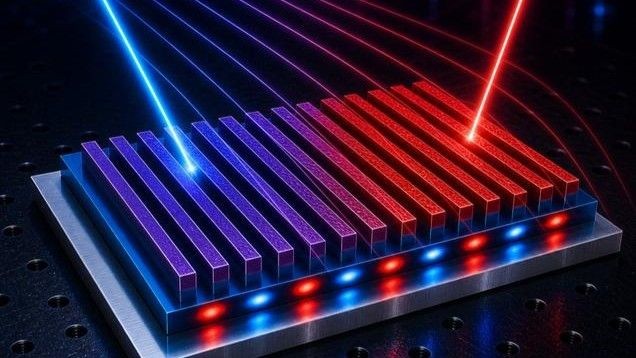
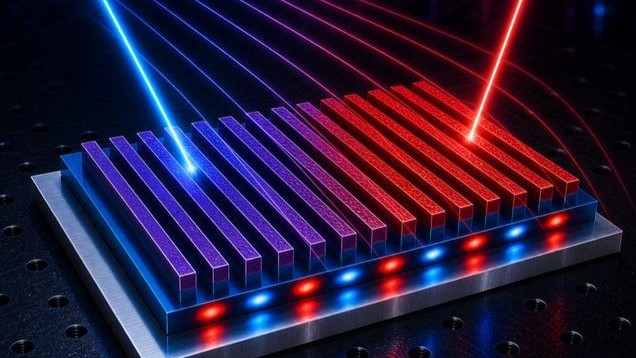 (Image credit: Osaka Metropolitan University)
Researchers from Osaka Metropolitan University have developed a programmable thermal device that can control where heat is radiated while remembering its configuration even after power is removed, a capability that could one day contribute to smarter thermal management in high-performance chips, silicon photonics, infrared sensors, and energy-harvesting systems. The work, published in Laser & Photonics Reviews, overcomes two longstanding obstacles that have prevented the practical realization of nonreciprocal thermal devices.
Go deeper with TH Premium: Chipmaking
The device combines a magneto-optical material — a material that changes its optical properties in the presence of a magnetic field — with a phase-change material known as germanium-antimony-tellurium (GST) to independently control how a surface absorbs and emits infrared radiation. Unlike previous designs that lost their functionality once power was removed or only worked when light struck the surface at extreme angles, the researchers say their device operates almost straight on while retaining its programmed state without continuous energy input.
Under normal circumstances, materials follow a principle stating that if a surface efficiently absorbs heat at a particular wavelength and direction, it must also emit heat equally well under the same conditions. This relationship, defined by Kirchhoff's law of thermal radiation, holds for conventional materials and limits how precisely engineers can manipulate heat. Rather than directing thermal energy where it is most useful, these materials simply emit heat based on how they absorb it.
Circumventing this relationship has become an active area of research, as it could give engineers an entirely new way to control thermal energy. Devices capable of independently steering absorption and emission could improve radiative cooling, thermophotovoltaic systems that convert heat into electricity, infrared sensing, thermal communication, and other photonic technologies where controlling heat is just as important as controlling light.
Researchers have explored several ways to achieve this by breaking Lorentz reciprocity, the physical principle that links incoming and outgoing electromagnetic waves. Most approaches rely on magneto-optical materials, magnetic Weyl semimetals, or actively modulated metasurfaces. However, these designs have generally encountered two major problems. First, they require light to strike the surface at very oblique, or grazing, angles to produce strong directional behavior. While this works experimentally, it significantly reduces the amount of usable thermal radiation and produces broad, inefficient emission patterns. Second, many existing designs are volatile. Their behavior disappears as soon as the magnetic field, electrical signal, or heating source controlling them is removed, making continuous power necessary simply to maintain their operating state.
The Osaka Metropolitan University team tackled both limitations by combining two materials that perform complementary roles. The first is indium arsenide (InAs), a magneto-optical semiconductor whose interaction with infrared light changes in the presence of a magnetic field. Rather than allowing light to behave identically in all directions, the material introduces a directional asymmetry that enables nonreciprocal thermal behavior. The second ingredient is GST, a phase-change material that can reversibly switch between amorphous and crystalline states, dramatically changing its optical properties while retaining whichever state it is written into, even after power is removed.
The researchers patterned GST into a microscopic grating above the InAs layer, forming what they describe as a magneto-optical metagrating. The InAs provides the directional control needed to separate heat absorption from heat emission, while the GST layer acts as a non-volatile switch that stores the device's operating mode. Applying a magnetic field tunes how infrared radiation interacts with the structure, while changing the phase of the GST permanently alters that behavior until it is intentionally rewritten. In effect, the device can be programmed to emit heat differently and retain that configuration without requiring continuous energy.
Get Tom's Hardware's best news and in-depth reviews, straight to your inbox.
According to the researchers, the prototype achieved a nonreciprocity factor approaching 0.9 while operating at an incidence angle of just three degrees, much closer to normal incidence than the steep angles typically required by previous designs. The system also supports continuous tuning via changes in the magnetic field or incident angle, as well as digital on-off switching via the GST phase transition. The team further analyzed why the nonreciprocal effect weakens when GST changes state, concluding that the reduction results from a combination of optical field redistribution and increased damping rather than simple absorption losses alone.
Although the technology remains an early-stage research demonstration, the ability to program thermal radiation could eventually become valuable in computing hardware as processors continue to pack more transistors, chiplets, and photonic components into increasingly compact packages. Future thermal metasurfaces could give engineers another tool for directing heat away from hotspots, reducing thermal interference between neighboring chiplets, or stabilizing silicon photonic devices whose optical characteristics shift with temperature.
Beyond computing, the researchers also envision applications in radiative cooling, thermophotovoltaic energy conversion, infrared emitters, thermal communication systems, and photonic memory technologies. For now, however, the work remains a laboratory demonstration rather than a deployable technology. Considerable engineering challenges remain before programmable thermal emitters find their way into commercial electronics.

Follow Tom's Hardware on Google News, or add us as a preferred source, to get our latest news, analysis, & reviews in your feeds.
Etiido Uko is a news contributor for Tom's Hardware covering the latest updates in big tech and the PC industry. He is a mechanical engineer and senior technical writer with over nine years of experience in documentation and reporting. He is deeply passionate about all things engineering and technology, and is an expert in gadgets, manufacturing, robotics, automotive, and aerospace.
What's Your Reaction?
 Like
0
Like
0
 Dislike
0
Dislike
0
 Love
0
Love
0
 Funny
0
Funny
0
 Wow
0
Wow
0
 Sad
0
Sad
0
 Angry
0
Angry
0










Comments (0)