

Researchers Develop All-New Pixel Type That Can Both Record and Display Light
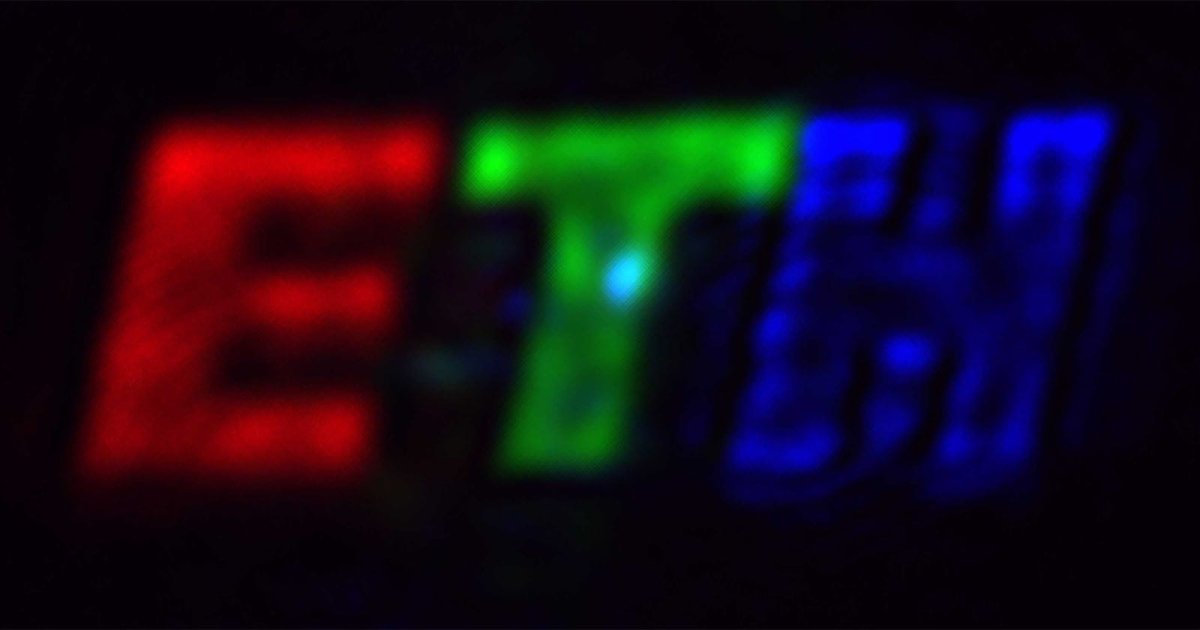
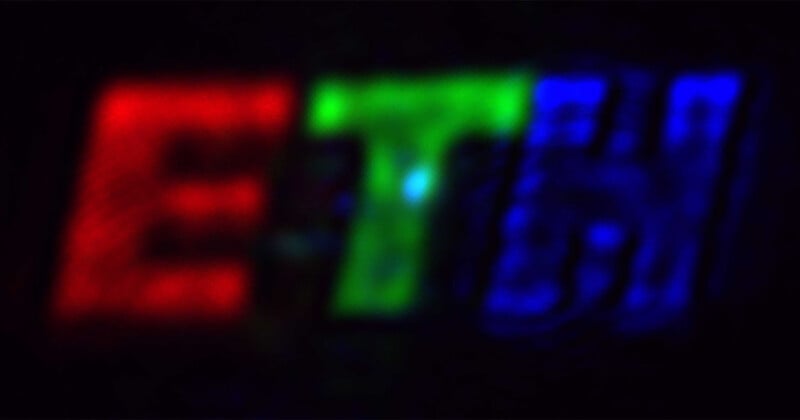 “The colored logo was created using the new ETH researchers‘ Fourier pixels. The letter ‘E’ is roughly 1 millimeter tall on the camera.” | Credit: Glauser YM, Vonk SJW, et al., Nature 2026
Researchers at ETH Zurich have developed a novel type of pixel that can both capture images and display them. In the future, this new pixel could be utilized inside hybrid camera/display devices.
Nearly 100 years ago, the term “picture element,” later shortened to “pixel,” debuted in the American technology publication, Wireless World. As ETH Zurich notes, pixels are everywhere today. On screens, such as phones, computers, and televisions, pixels display light information. In cameras, the pixels instead record light. Pixels could not do both; they could do just one or the other.
A research team led by David Norris, a Professor at the Optical Materials Engineering Laboratory at ETH Zurich, has changed that by developing pixels that can both create and record light. This is a groundbreaking achievement.
“These pixels can both steer light and analyze it. Not only the intensity of the light, but also its oscillation phase and polarization can be controlled and analyzed,” ETH Zurich. “In the future, such so-called bidirectional pixels could lead, for instance, to the development of camera — displays that combine the two functions in a single device.”
The research is outlined in a new paper published in Nature, and relies on the interference of light waves.
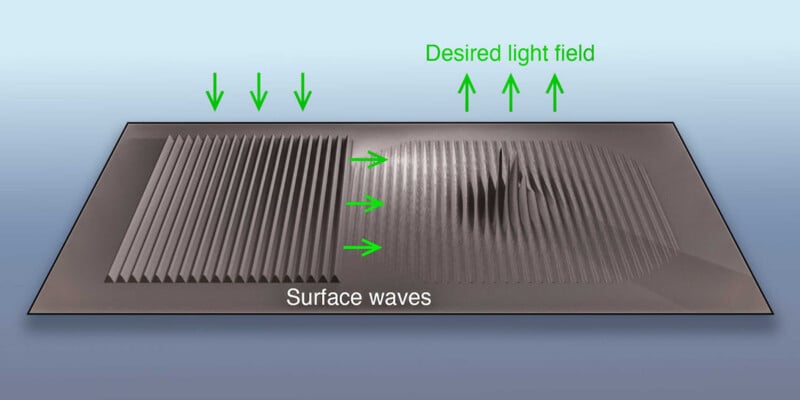 “Fourier pixel use surface waves, which are scattered out as light waves. These light waves interfere with each other and thus create patterns and images. Conversely, the same pixel can be used to analyze the intensity, phase and polarization of incoming light waves.” | Credit: Glauser YM, Vonk SJW, et al., Nature 2026)
“When light is scattered by a surface, the waves originating from different points on the surface overlap. The shape of the surface determines the oscillation phases with which the waves propagate further. If the phases are equal, the light waves reinforce each other, but if they are opposed, the waves cancel out,” ETH Zurich writes.
Norris and the rest of his team used this physical effect to control light using wave-shaped sculpted surfaces. The pixel converts incoming light into a surface wave that propagates across the chip’s surface.
“At a different position within the pixel, the surface wave is scattered back out of the material as a light wave. Through interference of the light waves, patterns and images can be created,” ETH Zurich says.
Using Fourier analysis, the researchers can determine what the images will look like and the specific surface pattern required for a given image.
“Our new pixels for control and analysis could, therefore, become a useful tool in many areas,” Norris says.
As ETH Zurich explains, the team’s new pixels could react to a captured image and, without the use of a computer, produce corresponding light.
In the short term, a more practical goal is creating a matrix of Fourier pixels. This type of matrix could enable complex cameradisplay devices.
This is seriously cutting-edge research that has already led to a patent application and is in the running for this year’s Spark Award.
Image credits: Glauser YM, Vonk SJW, et al.: Fourier pixels for bidirectional light control. Nature, 24 June 2026, DOI: external page 10.1038/s41586-026-10681-7
What's Your Reaction?
 Like
0
Like
0
 Dislike
0
Dislike
0
 Love
0
Love
0
 Funny
0
Funny
0
 Wow
0
Wow
0
 Sad
0
Sad
0
 Angry
0
Angry
0










Comments (0)