

Reviewing The Peak Design Travel Tripod
Today, I wanted to take a break from discussing the cameras that capture our images and look at one of the tools used to make those images better. Let’s have a look at the Peak Design Travel Tripod.
When it comes to camera-related products, it seems as though Peak Design’s company ethos is right there in the title. The products they produce seem engineered to solve common problems in a unique and elegant way.
One specific problem that I always face as a photographer and filmmaker is transporting my gear. The more your career progresses, the larger your traveling kit becomes. The larger your traveling kit becomes, the more likely you are to find yourself spending countless hours trying, and mostly failing, to reduce your footprint and get back to the times when a fun photo trip didn’t also require a trip to the chiropractor.
I was interested in reviewing the Peak Design Travel Tripod specifically for this reason. I have all manner of tripods in my kit, but they all share one very specific logistical challenge. They are huge. That means they either need their own case or, at bare minimum, need to travel separately from my camera gear. That often means multiple trips from my car to set. Of course, when you need sticks, you need sticks. But I won’t lie to you and say that I’ve never forgone sticks just so I wouldn’t have to make another trip back down to the parking lot.
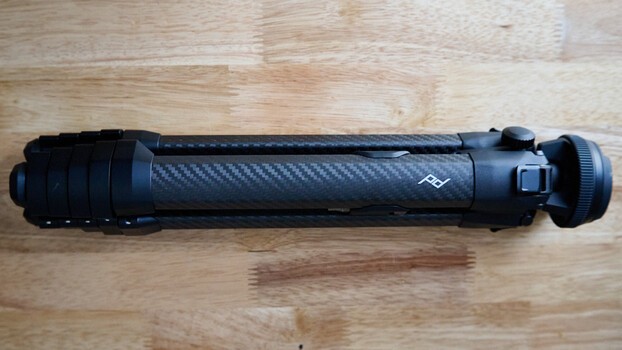
So the primary image in my head that appealed to me about the Peak Design Travel Tripod was the one below.
The tripod collapses down to 15.5 inches when not in use. That number is key to me because it means it can easily fit into my carry-on-sized Pelican case without causing a stir. With a weight capacity of 20 lbs, it may not be my first choice for a fully built Alexa rig, but for the majority of lighter builds, the Travel Tripod can more than handle the necessary payload. This is key because it allows me to pack a full traveling kit, with camera, lens, and tripod, into a case small enough to go on the plane with me under the seat or in the overhead compartment.
Now, the word “traveling” in the previous sentence is key to understanding who this product is made for. Different tripods appeal to different users, but I think the Peak Design Travel Tripod is pretty firmly aimed at travel and landscape photographers. The built-in ball head, while sturdy, isn’t really designed for panning and tilting during a shot. But it’s plenty versatile enough to move a still camera into position in order to get a dynamic landscape shot without motion blur becoming a distraction. Thankfully, the Peak Design Travel Tripod does accept different adapters and configurations. So if you, like me, depend on a third-party fluid head for video, you can also attach a head of your own to the legs and still take advantage of the compact size.
It’s got five leg sections that collapse into one another nicely. So that 15.5-inch collapsed size expands all the way to 60 inches in height with the expandable center column. Conversely, for objects closer to the ground, the legs have a release latch that allows the tripod to get as low as 5.5 inches in “low mode.” This versatility makes this a strong option for the nature photographer out on a hike who is going to want to photograph subjects of all proportions.
The center column comes equipped with a weight-bearing hook at the bottom if you wish to add a sandbag or other weighted object for added stability. And, while the tripod is mostly toolless in operation, I do like that they include a small multitool for making any necessary repairs or adjustments in the field. The tripod comes with a standard Peak Design plate. But the top part is Arca-compatible and can be adjusted by removing two locking screws on either side to make it compatible with more L-mount systems. The model I got came in a nice travel case prefit for the Travel Tripod, which is a nice touch.
The center column is removable and reversible. This means that getting a low-slung composition can be as simple as removing the center column, then replacing it upside down (with the head on the bottom between the tripod legs) for a lower-angle perspective. That center column also hides a phone mount for those of you who wish to mount your mobile device to the tripod instead of a camera body.
From an accessory standpoint, you can opt to purchase things like spiked feet for the tripod or the universal head adapter I mentioned a moment ago.
Pros
Compact size
Collapses to 15.5 inches
Quickly converts to Low Mode
Supports up to 20 lbs
Can be used easily for macro work
Relatively toolless
60 inches max height
Fast to extend legs
Lightweight
Cons
Included head can take a second to figure out
Conclusion
The Peak Design Travel Tripod is definitely a strong addition to my kit. And, by strong, I mean small and portable while still having the payload to handle my everyday build. It comes in two varieties, aluminum ($399.95) and carbon fiber ($599.95), weighing 3.44 lbs and 2.81 lbs, respectively. I think specifically for those of you who are travel photographers, landscape photographers, or just folks like me who are looking to shed as much weight as possible, the Peak Design Travel Tripod is a strong addition to many a kit.
What's Your Reaction?
 Like
0
Like
0
 Dislike
0
Dislike
0
 Love
0
Love
0
 Funny
0
Funny
0
 Wow
0
Wow
0
 Sad
0
Sad
0
 Angry
0
Angry
0







Comments (0)