

Sigma's 85mm f/1.2: Beautiful Bokeh, One Real Weakness
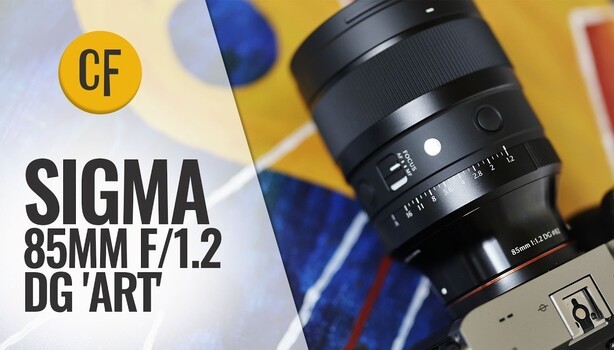
Sigma just released an 85mm f/1.2 DG Art for L-mount and Sony E-mount, and it lands at £1,299 in the UK or $1,599 in the US. That price sits well under Canon's and Nikon's mirrorless 85mm f/1.2 options, and the Sigma is smaller and lighter than both.
Christopher Frost puts the Sigma 85mm f/1.2 DG Art through his usual independent testing, mounting it on a 61-megapixel Sony a7CR with in-camera corrections switched off. The 85mm focal length is a staple for portrait and event work, and wedding shooters lean on it heavily. That f/1.2 aperture pulls in about 30% more light than f/1.4, which buys faster shutter speeds and backgrounds that fall away into a deep blur. Frost notes the optical formula packs three aspherical elements and a floating focus system for cleaner close-up results.
The build gets a lot of attention here, and for good reason. The lens weighs 950 g, just over 2 lb, so it carries some heft, though it still comes in lighter than the Canon and Nikon equivalents. Frost points to a weather-sealing gasket at the rear mount and a stack of physical controls: an aperture ring that clicks in third-stop steps or de-clicks smoothly for video, a lock switch for automatic mode, an autofocus-manual switch, and customizable focus-hold buttons. The autofocus motor stays silent and runs fast in continuous mode, tracking subjects without trouble despite the heavy glass it has to move. Focus breathing is modest, lower than typical for a short telephoto, which makes this a real candidate for video as well as stills.
On image quality, the results hold up under a demanding sensor. At f/1.2 the center already shows excellent sharpness and contrast, and stopping down to f/2 pushes it to razor sharp. The corners look slightly softer and darker wide open, but reach corner-to-corner perfection by f/2.8, even at 61 megapixels. Frost repeats the test in the a7CR's 26-megapixel APS-C crop mode and finds the same pattern. Flare resistance impresses him given how much glass sits inside, and the bokeh renders cleanly with minimal outlining on specular highlights. The one genuine weakness is longitudinal chromatic aberration, which stays strong on bokeh highlights from f/1.2 through f/4 before fading around f/5.6.
The interesting question with any f/1.2 lens is whether the extra third of a stop earns its keep. Optically, an 85mm f/1.4 covers nearly identical ground for portraits and events, often at lower cost and lighter weight, and Sigma already makes strong f/1.4 glass in that range. The case for f/1.2 rests on two things: the extra light for dim receptions and stage work, and the shallower depth of field that separates a subject from a busy background more aggressively. If you shoot weddings in low light or want that specific rendering as part of your style, the gap is meaningful. If you mostly shoot in daylight or stop down for group shots, the f/1.4 route makes more sense and leaves money in your pocket. Sigma's decision to keep this lens lighter than the first-party f/1.2 options also matters for anyone shooting a full day handheld, where every hundred grams adds up across eight hours.
The minimum focus distance sits at 84 cm, average for the class, with excellent close-up sharpness once you clear the purple fringing that shows at f/1.2 and disappears by f/2. Vignetting runs heavy at the widest apertures, and there's a touch of pincushion distortion, both normal for a bright portrait lens and easily corrected. The lens uses an 82 mm filter thread, ships with a lockable hood, and has no image stabilization.
Watch the video above to see Frost's sharpness comparisons and bokeh samples so you can judge whether f/1.2 is the aperture your work actually calls for.
What's Your Reaction?
 Like
0
Like
0
 Dislike
0
Dislike
0
 Love
0
Love
0
 Funny
0
Funny
0
 Wow
0
Wow
0
 Sad
0
Sad
0
 Angry
0
Angry
0










Comments (0)