

Supreme Court forces TV stations to sell more election ads at steep discounts
Legally required discounts
Republican victory means stations must offer lowest ad prices to political parties.
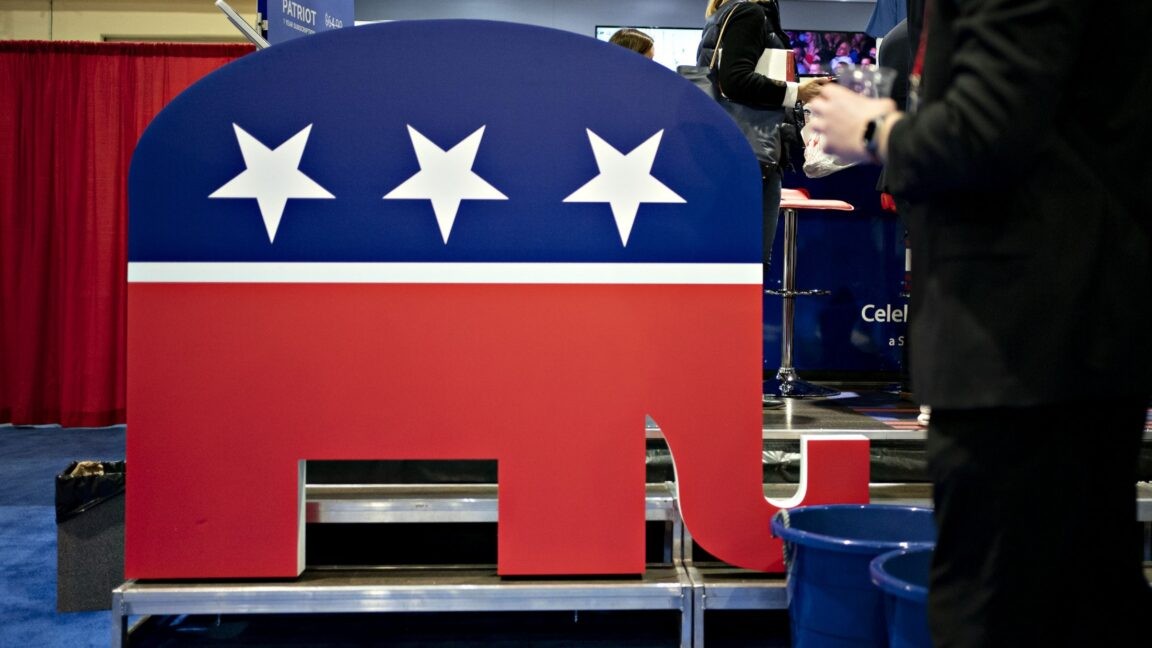
Credit: Getty Images | Bloomberg
In a victory for Republican campaign committees, the Supreme Court issued an order on Friday that forces broadcast TV stations to cut the prices of election ads purchased by political parties and joint fundraising committees. The September 4 ruling came in response to a petition filed by the National Republican Congressional Committee and National Republican Senatorial Committee.
The Supreme Court order was issued just in time for the start of a 60-day period before the election, in which broadcasters are required by US law to offer ad discounts to individual candidates. Because of the top court’s order, TV stations must also give their lowest ad rates to political parties and joint fundraising committees, which face fewer limits on how much money they can raise and spend.
The legally required discount is known as the “lowest unit charge,” or LUC. A US law that applies to any licensed station that airs election ads requires that the lowest price be charged for “the use of any broadcasting station by any person who is a legally qualified candidate for any public office in connection with his campaign.” The main legal question is whether “use… by” a candidate can refer to ad time purchased on a candidate’s behalf by parties and joint fundraising committees.
The Federal Communications Commission this year issued a public notice ordering broadcast TV stations to give the discounts to parties and joint fundraising committees. While both major parties could take advantage of the discounted ads, the Trump administration has pushed for the change, and four Democratic candidates contested it in court. The Democratic candidates won at the US Court of Appeals for the Fourth Circuit, where a judges’ panel found that the FCC public notice contradicts the plain language of US law that limits the discount to individual candidates.
The Republican campaign committees then filed an emergency motion for a stay that would block the Fourth Circuit ruling, and the Supreme Court granted the stay on Friday. The Supreme Court didn’t rule on the merits of the case but said the Fourth Circuit should not have intervened because the FCC hasn’t made a “final” decision on a challenge filed by the Democratic candidates. See this article for a more in-depth description of the legal issues in the dispute.
Coordinated spending
The stay could have a major impact during this election-ad season, in part because of a previous Supreme Court decision that struck down related limits on campaign spending. That case also involved the National Republican Senatorial Committee.
“Just months ago, the Supreme Court lifted all limits on how much political parties can spend in direct coordination with candidates. Now that same money can also buy campaign ads at the lowest price the law requires broadcasters to charge only to individual candidates,” Federal Communications Commission Commissioner Anna Gomez, the commission’s only Democrat, said on Friday.
Gomez was referring to the Friday ruling and a June decision in which the Supreme Court struck down federal limits on how much a political party can spend in coordination with candidates. Gomez said the latest ruling “opens the door to a flood of dark money that will let a handful of wealthy donors pool unlimited contributions,” while broadcasters that are already struggling financially “are the ones absorbing the cost.”
The Supreme Court order on TV ad prices was unsigned, with a dissent from Justice Ketanji Brown Jackson. The ruling was per curiam, meaning at least five of the nine justices agreed, but the court didn’t say how each justice ruled. “For the foregoing reasons, the application for stay presented to the Chief Justice [John Roberts] and by him referred to the Court is granted,” the order said.
The order said, “the Communications Act makes clear that an aggrieved party must wait for the Commission to resolve its application for review by order before filing a petition for judicial review.” The four Democratic candidates did file an application for review with the FCC on April 29, but the commission has not rendered a decision.
SCOTUS says courts must wait for FCC ruling
The Fourth Circuit panel decided in a 2-1 ruling that the FCC’s inaction amounted to a “constructive denial.” The panel also found that the FCC public notice to TV stations constitutes a final order, giving the court jurisdiction to review it.
The Supreme Court disagreed. “Because the candidates’ application for review was pending when they filed their petition for review, the Fourth Circuit likely lacked statutory jurisdiction to address their challenge. Its holding to the contrary splits with every other Circuit to have considered the issue,” the Supreme Court said.
The word “likely” is key, because under the standard to win a stay, the Republican committees had to show “a fair prospect that a majority of the Court will vote to reverse the judgment below” and “a likelihood that irreparable harm will result from the denial of a stay.” It thus appears likely that the Supreme Court will take up the case and issue a more substantial ruling in the Republican committees’ favor.
The court majority also found that Republican Party committees “will likely suffer irreparable harm absent a stay” because having to pay more for advertising space “hamper[s] their efforts to reach the electorate in the critical weeks leading up to the midterms” and “implicates their First Amendment rights to speak and coordinate their political activities freely.” This part of Friday’s decision cited the Supreme Court’s previous ruling that limits on coordinated spending violated the First Amendment.
Jackson’s dissent favorably quoted Fourth Circuit Judge James Wynn’s opinion that “an agency may not reserve to itself the power to defeat judicial review through delay or inaction.” Jackson also quoted a previous Supreme Court ruling, which she herself authored, that said the court “routinely” treats threshold requirements that claimants must complete before filing a lawsuit as “nonjurisdictional” and has “yet to hold that any statutory exhaustion requirement is jurisdictional.”
Ad discount for “ever-expanding number of groups”
The Democrats who challenged the FCC order to TV stations are former senator and current candidate Sherrod Brown (D-Ohio); Sen. Jon Ossoff (D-Ga.); Senate candidate Roy Cooper (D-N.C.), the former governor of North Carolina; and US Rep. Kristen McDonald Rivet (D-Mich.). They told the Supreme Court that “the Fourth Circuit reasonably held that the Commission constructively denied the Candidates’ Application by failing to resolve it despite clearly having decided to reject it, and there is no circuit split on that question.”
The US Justice Department and FCC filed a brief supporting the Republican committees’ case. In addition to saying the Fourth Circuit lacked jurisdiction, the US said the FCC got the law right in its directive to TV stations.
“It makes no difference that the political party helped fund the advertisement,” the US brief said. “Section 315(b) asks whether the candidate is making ‘use’ of a broadcast station, not whether he is ‘funding’ the broadcast. When a candidate works with his party to run an advertisement and announces in the advertisement that he approves it, he uses the broadcast station, even if the party helps him foot the bill.”
The Trump administration’s argument was disputed by the Campaign Legal Center, a nonprofit group founded by Republican Trevor Potter, a former Federal Election Commission chairman. The group filed an amicus brief saying the FCC “interpretation grossly distorts the plain meaning of the Communications Act, as well as Congress’s clearly expressed intent,” and “has no limiting principle.”
“According to applicants, any move by a candidate to include a group in their joint fundraising operation or to otherwise ‘authorize’ or bless an independent committee would potentially entitle this committee to the LUC, stretching the LUC provision—and broadcasters’ financial obligations thereunder—to cover an ever-expanding number of groups,” the Campaign Legal Center said.

Jon is a Senior IT Reporter for Ars Technica. He covers the telecom industry, Federal Communications Commission rulemakings, broadband consumer affairs, court cases, and government regulation of the tech industry.
What's Your Reaction?
 Like
0
Like
0
 Dislike
0
Dislike
0
 Love
0
Love
0
 Funny
0
Funny
0
 Wow
0
Wow
0
 Sad
0
Sad
0
 Angry
0
Angry
0












Comments (0)