

The $1,999 iPhone Duo Is Apple's First Foldable, and It Has Some Clever Camera Tricks
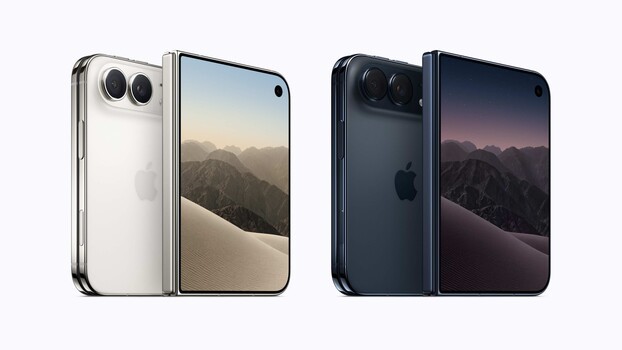
Apple has introduced the iPhone Duo, its first foldable iPhone, pairing a 5.4 in outer display with a 7.6 in folding inner display. Beyond the new form factor, the phone includes dual 48 MP rear cameras, 4K video recording at up to 120 fps, an A20 Pro processor, new photography features that take advantage of the second display, and an updated version of iOS designed around multitasking.
The iPhone Duo starts at $1,999 with 256 GB of storage. Preorders begin October 16, 2026, with availability starting October 23, 2026.
Two Displays and a Foldable Titanium Design
When closed, the iPhone Duo uses a 5.4 in Super Retina XDR outer display. Opening the phone reveals a 7.6 in Super Retina XDR inner display, which Apple says is its largest display yet on an iPhone.
Both displays use the same aspect ratio, allowing content to maintain consistent proportions as users move between them. They also support ProMotion, Always-On functionality, and up to 3,000 nits of peak outdoor brightness.
The inner display has a nano-texture finish intended to reduce glare and reflections while making the crease less noticeable. A FaceTime camera is positioned beneath the inner display and remains hidden when it is not being used.
Apple Pencil support is also planned for later in 2026, allowing the stylus to be used for tasks such as note-taking, drawing, and document markup on either screen.
Apple has moved biometric authentication to Touch ID integrated into the side button rather than using Face ID. The phone can also be unlocked with a compatible Apple Watch.
The enclosure is made from grade 5 titanium and includes a 3D-printed titanium hinge cover. The folding mechanism contains more than 100 components, while internal support ribs and ceramic fiber inserts are used to reinforce the structure.
Ceramic Shield protects the back, while Ceramic Shield 2 is used on the front. Apple rates the iPhone Duo at IP68 for splash, water, and dust resistance.
The folding display itself uses a scratch-resistant coating, polymer cover layer, multiple layers of high-strength glass, and a titanium plate. Apple says the polymer layer has up to 40% greater stiffness than other materials commonly used for similar applications.
Dual 48 MP Cameras
For photographers, the most significant hardware is a dual-camera system consisting of 48 MP Main and 48 MP Ultra Wide cameras.
The 48 MP Fusion Main camera can capture images at up to 48 MP, while the default mode produces 24 MP files. It also provides an optical-quality 2x option for tighter framing.
The Main camera includes sensor-shift optical image stabilization and uses an updated computational imaging pipeline. Apple also specifically notes a large sensor and fast aperture, although the press release does not provide sensor dimensions or an aperture value.
The 48 MP Fusion Ultra Wide camera is the same camera used in the iPhone 18 Pro line, according to Apple, and supports macro photography.
A Center Stage front camera can capture images and video in either orientation without requiring users to physically rotate the phone for landscape framing. A separate FaceTime camera is positioned beneath the folding inner display.
Apple has also updated Photographic Styles with texture and grain controls, giving users additional options for adjusting the appearance of images.
The Foldable Design Adds New Camera Features
The second display gives Apple several ways to change how the cameras can be used.
Duo Preview sends a live camera preview to the outer display while someone is being photographed. A subject can therefore see the framing and adjust their position while the photographer continues to work from the other side of the device.
Users can also take selfies with the higher-resolution rear camera system while using the outer display for composition rather than relying on the front-facing camera.
Smart Take uses on-device AI processing to analyze a scene and automatically capture photographs when subjects appear to be posing. This is intended primarily for group photographs in which the person operating the camera would otherwise be left out of the picture or need to use a timer.
Kid Cue displays Peanuts animations on the outer screen in an attempt to direct a child's attention toward the camera.
Duo FaceTime similarly makes use of both displays, allowing people standing with the user to see and participate in a video call using the outside screen.
These are relatively straightforward applications of having displays on both sides of a camera-equipped device, but they could prove useful in situations such as portraits, interviews, self-recording, and small productions where an external monitoring solution would otherwise be required.
4K at 120 fps and Expanded Video Features
The 48 MP Fusion Main camera supports 4K recording at up to 120 fps in Dolby Vision. Footage recorded at the higher frame rate can subsequently be slowed down for slow-motion playback.
Apple is also expanding its Cinematic tools. Cinematic effects can now be applied after capture at up to 60 fps rather than requiring every decision to be made while recording.
Audio Mix receives updated processing intended to improve voice reproduction, along with the ability to isolate music.
Time-lapse recording can capture 4K footage in Dolby Vision HDR.
The folding body also functions as its own support. The iPhone Duo can be partially folded and placed on a surface, allowing users to shoot longer videos, time-lapses, group photographs, or self-recorded content without necessarily using a tripod.
iOS 27 Is Built Around the Larger Screen
The iPhone Duo runs iOS 27.1 at launch, with iOS 27 adapted specifically for the folding hardware.
Interface elements including Lock Screen controls, the Home Screen Dock, app navigation, and other controls can move toward the sides of the display to preserve more vertical space.
When unfolded, the phone can display two Home Screen pages alongside Today View. The Dynamic Island has also been redesigned for a vertical position on both the inner and outer screens.
More importantly for practical work, Split View brings side-by-side apps to the iPhone. Users can run two applications simultaneously, open two windows from the same application, quickly exchange one app for another, and save commonly used pairs for later.
That could allow a photographer, for example, to keep reference material alongside another application or to work between communications and content without constantly switching full-screen views.
Apps can also respond to the physical position of the phone, changing orientation or moving to the appropriate display as the device is folded, rotated, or flipped.
A20 Pro and Vapor Chamber Cooling
The iPhone Duo uses Apple's A20 Pro processor, the same chip used in the iPhone 18 Pro models.
Apple has paired the processor with a custom vapor chamber thermal management system designed to improve sustained performance during demanding tasks. The company claims up to 35% better sustained performance than the iPhone 17 Pro.
The A20 Pro incorporates a 6-core CPU that Apple rates as up to 20% faster than the A19 Pro, along with a 7-core GPU that it says is up to 40% faster and more efficient.
AI processing is handled by a Dual 16-core Neural Engine offering twice the compute performance of the previous implementation, according to Apple. Unified memory bandwidth has increased by 50%.
The chip is manufactured using a 2 nm process.
A separate display engine handles the inner and outer displays simultaneously.
Apple Intelligence and Siri AI
The iPhone Duo also serves as one of Apple's platforms for its expanded Apple Intelligence features and Siri AI.
Siri AI can use information from supported messages, emails, photographs, and other personal context, while onscreen awareness allows it to respond to information currently being displayed.
For photographers, several of the more relevant AI tools are found in the Photos workflow.
Spatial Reframing can alter an image's composition after capture, while Extend can generate additional content beyond the original frame. Apple has also updated Clean Up for removing unwanted elements.
Image Playground adds support for photorealistic imagery.
Support for SynthID is planned through a software update later in 2026. Apple says this will allow users to identify many images that have been generated or edited using AI, depending on the edits involved.
Battery Life and Charging
The iPhone Duo uses a dual-battery design, with one battery installed on each side of the folding chassis. Software manages the two batteries as a single power system.
Apple rates the phone for up to 31 hours of video playback when using the inner display and up to 44 hours when relying on the outer display.
When both displays are used roughly equally, Apple claims up to 24 hours of typical use per charge.
Wired fast charging can reach approximately 50% in around 20 minutes with appropriate hardware. Wireless charging using MagSafe or Qi2 can reach approximately 50% in around 30 minutes under Apple's test conditions.
Connectivity
The iPhone Duo is eSIM-only worldwide, eliminating the physical SIM tray.
Apple's N1 wireless networking chip provides Wi-Fi 7, Bluetooth 6, and Thread connectivity.
Cellular connectivity is handled by the C2 modem system, which adds support for mmWave in the United States.
iOS 27 also introduces iPhone Handoff, allowing users on supported carriers to switch between two iPhones sharing the same phone number. Apple says the feature will initially be supported by T-Mobile in the United States and Telekom Germany in Germany.
Key Specifications
- Foldable iPhone design
- 7.6 in inner Super Retina XDR display
- 5.4 in outer Super Retina XDR display
- Matching aspect ratios across both displays
- Nano-texture finish on inner display
- ProMotion support
- Always-On displays
- Up to 3,000 nits peak outdoor brightness
- Under-display FaceTime camera
- Apple Pencil support planned for later in 2026
- Touch ID integrated into side button
- Apple Watch unlocking support
- Camera Control button
- Grade 5 titanium construction
- 3D-printed titanium hinge cover
- Hinge mechanism using more than 100 components
- Ceramic Shield rear protection
- Ceramic Shield 2 front protection
- IP68 splash, water, and dust resistance
- Scratch-resistant folding-display coating
- Reinforced polymer inner-display cover layer
- High-strength glass layers around folding display panel
- Titanium reinforcement plate beneath folding display
- 48 MP Fusion Main camera
- Up to 48 MP still-image capture
- 24 MP default image output
- Optical-quality 2x camera option
- Sensor-shift optical image stabilization
- 48 MP Fusion Ultra Wide camera
- Macro photography
- Center Stage front camera
- Under-display FaceTime camera
- Updated Photographic Styles
- Texture and grain controls
- Rear-camera selfies using outer-display preview
- Duo Preview external subject monitoring
- Smart Take automatic AI-assisted capture
- Kid Cue subject-attention animations
- Duo FaceTime dual-display calling
- 4K video at up to 120 fps
- Dolby Vision recording
- Cinematic effects applicable after capture at up to 60 fps
- Updated Audio Mix processing
- Music isolation in Audio Mix
- 4K Dolby Vision HDR time-lapse recording
- Self-supporting folded configuration for tripod-free shooting
- A20 Pro processor
- 2 nm manufacturing process
- 6-core CPU
- 7-core GPU
- Dual 16-core Neural Engine
- 50% greater unified memory bandwidth compared with the preceding architecture, according to Apple
- Custom vapor chamber cooling
- Dedicated dual-display engine
- Up to 31 hours of inner-display video playback
- Up to 44 hours of outer-display video playback
- Up to 24 hours of typical mixed-display use
- Approximately 50% charge in around 20 minutes with compatible wired charging hardware
- Approximately 50% wireless charge in around 30 minutes with compatible MagSafe or Qi2 hardware
- Wi-Fi 7
- Bluetooth 6
- Thread
- C2 cellular modem
- mmWave support in the United States
- Worldwide eSIM-only design
- iOS 27.1 at launch
- Split View multitasking
- Support for two windows from the same app
- Saved app pairs
- Apple Intelligence
- Siri AI
- Spatial Reframing
- Extend
- Updated Clean Up
- Photorealistic Image Playground generation
- Planned SynthID support
- 256 GB, 512 GB, 1 TB, and 2 TB storage options
- Star white and night sky finishes
- Starting price of $1,999
Why It Matters for Photo and Video Creators
For photographers and filmmakers, the significance of the iPhone Duo is less about having a folding screen by itself and more about what Apple is doing with the second display.
An outward-facing live preview could be genuinely useful for portraits, interviews, demonstrations, and creator-led video. Instead of adding an external monitor solely so a subject or presenter can see the composition, the outer display can provide that functionality directly.
Being able to use the rear cameras for selfies and self-recorded work is similarly practical. Smartphone front cameras have traditionally required creators to choose between easy monitoring and using the more capable rear camera system. A second display reduces that compromise.
The folding mechanism has another practical benefit. Because the phone can support itself in partially folded positions, creators may be able to place it on a table or other flat surface for time-lapses, video calls, group shots, and static video without carrying a separate support.
The 4K at 120 fps Dolby Vision mode should also make the phone more flexible for video work where slow motion is useful. Applying Cinematic effects after recording may be more significant still, since it shifts some creative decisions from capture to post-production.
The 7.6 in inner display could also change how useful an iPhone is after the image has been taken. A larger display gives photographers more room for reviewing detail, making edits, managing files, communicating with clients, or running two applications side by side.
Whether that is enough to replace a tablet or other larger device will depend heavily on individual workflows and app support, but the ability to move from shooting to a substantially larger workspace without carrying another screen is an interesting proposition.
There are still important specifications absent from Apple's announcement. The company does not state the physical sensor sizes, exact lens aperture values, video bitrates, recording codecs beyond the mentioned Dolby Vision modes, or the extent of professional manual video controls. Those details will matter when evaluating the phone specifically as an imaging tool rather than simply as a smartphone with capable cameras.
Pricing and Availability
The iPhone Duo will be offered in star white and night sky.
Storage capacities are 256 GB, 512 GB, 1 TB, and 2 TB, with pricing starting at $1,999 in the United States.
Preorders open at 5 a.m. PT on October 16, 2026, in more than 70 countries and regions. General availability begins October 23, 2026. Apple says another 28 countries and regions will receive the phone beginning October 30, 2026.
The device ships with iOS 27.1.
Conclusion
The iPhone Duo represents a substantial change to Apple's smartphone hardware, but its relevance to photographers and video creators will depend on more than the novelty of a folding display. The dual-screen camera modes, rear-camera self-monitoring, 4K at 120 fps recording, improved post-capture video tools, and ability to use the folded phone as its own support all have practical applications.
At the same time, the $1,999 starting price places it well beyond a conventional smartphone purchase for many users, particularly once higher storage capacities are considered. For creators who already use an iPhone as a meaningful part of their shooting and editing workflow, however, the combination of the larger workspace and new camera configurations makes the iPhone Duo one of Apple's more consequential changes to mobile imaging in recent years.
What's Your Reaction?
 Like
0
Like
0
 Dislike
0
Dislike
0
 Love
0
Love
0
 Funny
0
Funny
0
 Wow
0
Wow
0
 Sad
0
Sad
0
 Angry
0
Angry
0











Comments (0)