

The Definitive ’70s Action Blockbuster Is Officially Streaming for Free on YouTube

Published Sep 2, 2026, 10:00 AM EDT
Lee was already reinventing the action movie in 1972
 Image: Golden Harvest
Before CGI sanded the edges off modern blockbusters, the 1970s martial arts boom delivered a completely different kind of cinematic thrill: pure, unadulterated human kinetics. Watching such films today is a masterclass in the anatomy of action. These aren’t just digital avatars colliding, but generational athletes risking their necks in real time. It was a wildly inventive era defined by lightning-fast choreography, wide frames that refused to hide the impact behind quick cuts, and a visceral brutality that permanently rewired global cinema. Every "gun-fu" shootout in John Wick and every bone-crunching sequence in The Raid trace its DNA directly back to these grindhouse marvels — movies that proved action is a language best spoken through unbroken physical perfection.
Nowhere is that raw, pioneering genius more fiercely realized than in 1972’s The Way of the Dragon. Arguably Bruce Lee’s finest hour, the film still serves as the clearest, most unfiltered glimpse into the visionary auteur he was destined to become at the time. Lee crafted a kinetic masterpiece, culminating in what might be the single greatest one-on-one fight ever committed to celluloid. Fortunately, you don't have to hunt down a Blu-ray to experience the impact. The Way of the Dragon is currently streaming for free on YouTube, making it the perfect time to witness the master at the absolute height of his powers.
Rewriting the Martial Arts Template
 Image: Fortune Star Entertainment
For his directorial debut, Lee refused to ease into the driver’s seat. Instead, he hijacked the entire production. Writing, producing, directing, choreographing, and starring in The Way of the Dragon, Lee seized an unprecedented level of creative control. The result is a film that actively defies the established martial arts template. Beyond the blistering combat, Lee injects the narrative with broad fish-out-of-water comedy, genuine romance, and a swaggering personality that previous martial arts movies sorely lacked.
You can see this directorial confidence crystallize early in the film. After dismantling a crew of local thugs, Lee casually perches on the back of a defeated crony as the camera slowly pushes in on him. It’s a deceptively simple framing, but it oozes cinematic slickness. He doesn't look like an actor waiting for his next cue, but like a true visionary who knows exactly how to weaponize the lens. These deliberate stylistic choices elevate The Way of the Dragon from a standard brawler into a directorial flex that perfectly blends noir, action, and comedy.
 Image: Fortune Star Entertainment
Lee’s ambition extends far beyond his camera work. Breaking free from the familiar studio backlots of Hong Kong, Lee relocated the action to the sun-drenched streets of Rome. He utilized landmarks like the Piazza Navona, Piazza del Popolo, and the Villa d'Este. The Way of the Dragon made history as the first Hong Kong feature shot in Europe. It was a massive logistical gamble for a modestly budgeted production ($130,000 that inevitably grossed 10 times as much), but it gives the film an unparalleled sense of global scale.
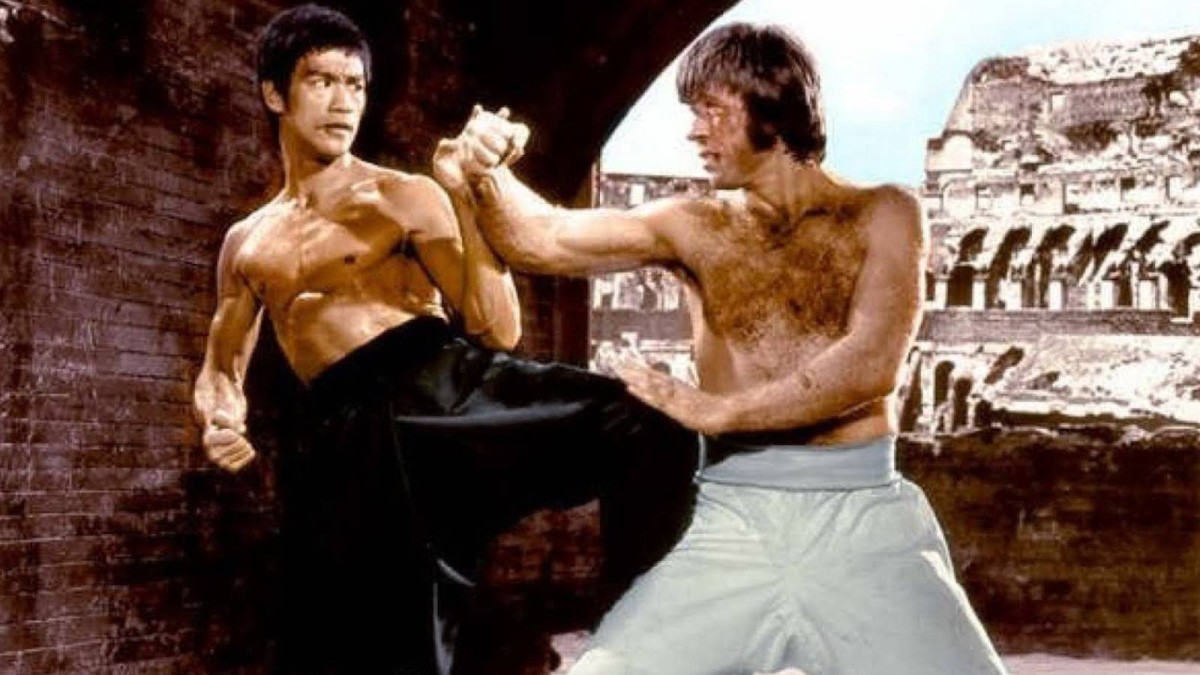
And then there's the fight — the one that was literally filmed illegally. You can’t talk about The Way of the Dragon without bringing up the iconic Colosseum showdown at the movie’s climax, which pits a chest-baring Chuck Norris against Lee in a dance for the ages. What makes it timeless isn't just two legends beating the hell out of each other, but how Lee structures the sequence. The combatants study, adapt, and fundamentally shift their strategies mid-brawl. Leaving behind the rigid, theatrical choreography of older wuxia films, Lee utilizes the gladiatorial space to emphasize tactical intelligence, treating the fight almost like a miniature sports drama.
Arguably one of the greatest showdowns in martial arts history, the sequence unlocks the true legacy of The Way of the Dragon. It’s too often reduced to simply "the movie with the Chuck Norris fight," entirely missing how radically Lee was experimenting with tone, genre, and international scope, all while the martial arts film was still securing its foothold in the West. It’s the kind of boundary-pushing ambition that makes the film feel profoundly bittersweet today. Given it's Lee's first and only completed directorial effort before his tragic death the following year at age 32, the film leaves behind one of cinema's greatest "what ifs."
 Image: Fortune Star Entertainment
One critique: The audio does take some getting used to. The entire film was shot without synchronized sound, with the actors looping their dialogue in post-production. Because of that, The Way of the Dragon exists in a range of different languages, including Mandarin, Cantonese, and English, but some words don’t sync with the actors' lips on-screen. Thus, what can initially sound like an oddity of a dated film is actually part of the production process.
Sure, The Way of the Dragon lacks the sterile polish of modern blockbusters. The dubbing is occasionally jarring, and the humor can veer into slapstick. But beneath the grindhouse grit is an absolute supernova of a talent who wanted to command the camera with the same lethal precision he applied to his fists. Watching such a visionary discover his cinematic voice in real time proves to be every bit as electrifying as watching him land that knockout blow.
The Way of the Dragon is streaming on YouTube.
What's Your Reaction?
 Like
0
Like
0
 Dislike
0
Dislike
0
 Love
0
Love
0
 Funny
0
Funny
0
 Wow
0
Wow
0
 Sad
0
Sad
0
 Angry
0
Angry
0







Comments (0)