

The Sharpest 24mm Lenses You Can Buy Right Now
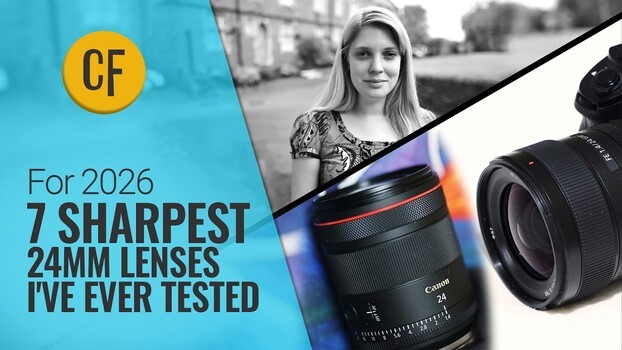
A $200 lens outperforming a Zeiss on corner sharpness is exactly the kind of result that shows how fast optics have moved. The 24mm focal length gives you a wide field of view with just enough drama to hold onto your subject, and paired with a bright aperture, it delivers backgrounds that fall away beautifully.
Four years after his original 24mm roundup, Christopher Frost revisits the category with seven full-frame autofocus lenses, all shot at 24mm except for one 25mm entry. Frost weights his rankings toward brighter maximum apertures, reasoning that an f/1.4 design is harder to pull off than an f/2 or f/2.8, even when they land at similar sharpness stopped down. In seventh place sits the Meike 24mm f/1.4, a genuine surprise at its price, holding reasonable sharpness from center to corner on a high-resolution body despite visible color fringing. Stop it to f/2 and it sharpens up considerably. Above it comes the Zeiss Batis 25mm f/2, an older Sony E-mount favorite that costs more and gathers less light, but rewards you with lower distortion and nicer rendering.
The Samyang AF 24mm f/1.8 takes fifth as the cheapest lens on the list, and Frost found it slightly sharper than the older Zeiss, a small fact that says plenty about the pace of optical progress. Its corners impress, though they carry heavy purple fringing that can turn rough during nighttime shooting. Fourth goes to the Canon RF 24mm f/1.4 L VCM, a hybrid stills-and-video lens Frost calls the sharpest on the list in the center. Its corners soften, and uncorrected files show strong barrel distortion that your camera stretches back into shape at the cost of corner resolution. The top three, and which lens Frost hands the crown to, come down to margins so thin he studied the files for a long stretch before deciding.
The center-versus-corner tension running through this ranking is worth understanding before you spend money on any wide prime. Wide-angle designs almost always resolve their sharpest detail in the middle of the frame, and the corners tell the real story of how hard the lens works. Distortion correction plays into this directly. When a lens like the Canon shows heavy barrel distortion in raw files, the camera or your editing software pulls those corners outward to straighten the image, and that stretch smears fine detail exactly where it was already weakest. If you shoot landscapes, architecture, or astro, where corner performance carries the frame, that behavior changes what "sharp" means for your work. If you shoot environmental portraits or street scenes where the subject lives near the center, a lens with softer corners and a brighter aperture may serve you better. Frost's decision to reward brighter apertures reflects a real engineering truth: light-gathering and edge-to-edge sharpness pull against each other, and a designer chasing f/1.4 accepts compromises that an f/2 designer can sidestep. Reading a ranking like this well means matching the winner to what you actually photograph rather than the raw score.
Third and second place land as a tie between the Nikon Z 24mm f/1.8 S and the Sigma 24mm f/2 DG DN. The Sigma edged the Nikon in corner sharpness, but the Nikon's brighter aperture made it harder to build, and Frost couldn't separate them. He notes a soft spot for the Sigma's build quality. The winner is packed with controls for both video and stills. Its center sharpness ranks among the very best, and while its corners come in a touch behind the Sigma with a little more purple fringing, its aperture is twice as bright, and that difficulty earns it first place. All seven, Frost stresses, are lenses no one would be embarrassed to own.
Watch the full ranking in the video above to see the sharpness scores Frost gave each lens and how close the top finishers really landed.
What's Your Reaction?
 Like
0
Like
0
 Dislike
0
Dislike
0
 Love
0
Love
0
 Funny
0
Funny
0
 Wow
0
Wow
0
 Sad
0
Sad
0
 Angry
0
Angry
0










Comments (0)