

The Uprising review – the peasants are revolting in muddled historical epic

Hollywood loves giving young actors their own historical epic as much as audiences seem to dislike watching them. Timothée Chalamet and Chris Pine’s least remembered roles are in the medieval set films The King and Outlaw King (no relation), Ridley Scott’s The Last Duel made back only a third of its $100m budget and earlier this year, the Saudi-backed seventh-century drama Desert Warrior starring Anthony Mackie and Ben Kingsley quietly became one of the biggest flops of all time. Last week, it was reported that Scott blamed the failure of Gladiator II on Paul Mescal not being “masculine enough” in a logical leap which only makes sense if your barometer for masculinity is a man who throws hotel phones and yells at producers in storage closets.
On paper, The Uprising should be different: it’s a historical epic from a blue-chip director (the Bourne trilogy’s Paul Greengrass), a nuanced, introspective leading man (Andrew Garfield) and a milieu that uncomfortably chimes with the western world’s backslide into repressive authoritarianism (The Peasants’ Revolt of 1381). In reality, it is a disjointed slog through the mud with the emotional depth of a History Channel rerun.
Through Greengrass’s lens, late 14th-century England seems like an utterly wretched place, not only because of the sludge-grey sky, scratchy brown sacks that everyone wears and the fact that no one seems to have had a wash in weeks, but because a despotic king treats the country’s people like scum, gouging them out of what little they have with hefty taxes to advance his own vainglorious agenda. Garfield’s character, who identifies only as Ploughman (“I am what I do,” he grunts), is mourning the loss of his wife and two children after they died from the plague, and will not stand for it any more. When asked for proof of his family’s death, one day he swipes clean the table of the taxman. “We’ve given you enough,” he cries, as the townspeople’s collective rage boils over into a riot.
He’s an unconvincing hero, this gruff Ploughman. The character seems to have been constructed as an everyman figure who unites the common people of England, but without any particular magnetism or spice, he often feels like he could be any man. His troupe soon meets two people who actually were in the Peasants’ Revolt: the priest John Ball and rebel leader Wat Tyler (Jamie Bell and Cosmo Jarvis: both great and, unlike Garfield, both look like they actually could be from the late middle ages). “Join us, Ploughman,” beckons Tyler, as Garfield’s character, his band of brothers and a tomboy named Alyce, Thomasin McKenzie, unite to march on London with an aim to confront the king and restore England to the egalitarian principles of the Domesday Book.
Thus follows a rather hectic-feeling race from one greige setting to the next as the rebels have their run of modern-day Kent, assembling in Maidstone before storming Canterbury cathedral, and then traveling to meet the king and his men in Blackheath. Greengrass’s camerawork can occasionally swoon, with stunning aerial shots of a flotilla on the Thames, but his signature handheld style is a trick that has gone stale: the only uprising I felt during the seasick fight scenes was my breakfast threatening to return on me.
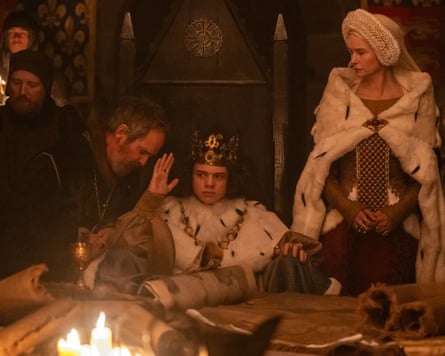
High points briefly come from Katherine Waterston’s satisfyingly icy turn as the king’s mother as well as Tom Hollander and Stephen Dillane as members of the slimy royal counsel, and there is one wickedly gruesome moment in the third act that feels genuinely envelope-pushing. But there are far too many scenes revolving around the Ploughman ominously polishing his scythe or extended debates at Windsor Castle.
Garfield does the best he can with the material, but by the time Ploughman has a righteous and rageful awakening, it is far too late. And the failure of the film to nail the uneasy parallels to today’s political life feels like looking a gift horse in the mouth. There’s certainly a lot of points of identification for a modern audience with downtrodden people who don’t feel heard by the powers that be, but Greengrass barely lets the audience pause for breath, let alone trust them to join those dots.
A couple of weeks before release, the US distributor Focus Features briefly changed the film’s title to The Uprising: The Rise of Robin Hood, suggesting that it would show events “that helped inspire the legend of Robin Hood”, even though the Peasants’ Revolt took place nearly 200 years after the time of the folkloric outlaw and his merry men. Meanwhile, The Uprising makes no mention of Robin Hood: almost as if it was all a last-ditch attempt to drum up buzz for a movie that is about as fun as trench foot.
-
The Uprising is out in the US on 11 September, the UK on 9 October and Australia on 22 October
What's Your Reaction?
 Like
0
Like
0
 Dislike
0
Dislike
0
 Love
0
Love
0
 Funny
0
Funny
0
 Wow
0
Wow
0
 Sad
0
Sad
0
 Angry
0
Angry
0









Comments (0)