

Three Portrait Setups That Work Every Time You Get Stuck
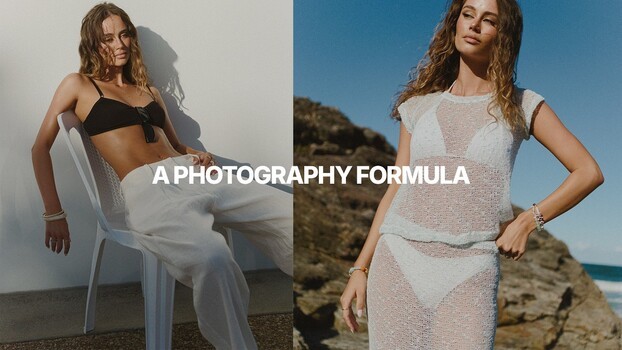
Standing in front of a person with a camera and no plan is one of the fastest ways to freeze up on a shoot. Having a small set of reliable frames to fall back on keeps you moving and gives every session a solid starting point.
That fallback system is exactly what Mitch Lally breaks down, walking through three portrait types that hold up across fashion, editorial, and lifestyle work. He starts with what he calls the contextual full body, a straight up-and-down shot that leaves breathing room around the subject on all four sides. The focus stays on the person and the outfit, with the background blurred enough that you can still read the location without it fighting for attention. Lally shoots this on a 35mm f/0.95 on APS-C, which behaves like a 50mm f/1.4 on full frame, and recommends a 50mm f/1.2 if you're shooting full frame.
The second frame is the compressed close-up, and this is where telephoto glass earns its keep. Lally reaches for an 85mm or longer, with a 70-200mm f/2.8 as his top pick and a vintage 85mm or 135mm as the budget route. Wide apertures like f/2.8 and f/4 do the obvious work, but he points out that lens compression at 135mm and up keeps backgrounds dreamy even at f/5.6 or f/8. He also names distance as a tool: push the background far from your subject and it blows out on its own, forcing the eye onto the detail you care about. This is the shot for outfit textures, faces, unusual angles, and silhouettes, and Lally is blunt that bad lighting will sink it every time.
The third type is the environmental portrait, weighted equally between subject and setting. Here Lally favors wide angle primes between 24mm and 35mm full-frame equivalent, using a 24mm f/2 and a 25mm f/1.7 on his Fuji body. The wider focal length naturally holds more of the scene, so backgrounds read sharper than in the full-body frame. His rule of thumb is to keep the background clean enough that it never competes with the person. He also suggests trying this one in landscape orientation, using elements on the left and right to balance the composition, and cropping creatively when the outfit is the priority.
What makes this approach worth keeping is how it turns gear into intent. Each of the three frames maps to a focal length range for a reason, and once you internalize that map, you stop second-guessing which lens leaves your bag. Wide glass pulls in context, standard glass flatters and isolates, long glass compresses and spies. That's a framework you can apply to street work, product shoots, even real estate, because it's really a lesson in how focal length shapes the relationship between subject and background. The same three-part thinking scales up as your kit grows and stays useful when you're working with a single zoom like the 24-105mm f/4 Lally mentions, zoomed to 105mm for the compressed look.
Watch the full breakdown in the video above to see the reference images and posing notes Lally uses for each of the three setups.
What's Your Reaction?
 Like
0
Like
0
 Dislike
0
Dislike
0
 Love
0
Love
0
 Funny
0
Funny
0
 Wow
0
Wow
0
 Sad
0
Sad
0
 Angry
0
Angry
0





Comments (0)