

Trump’s 100% tariff on drones will be disaster for the US, critics warn
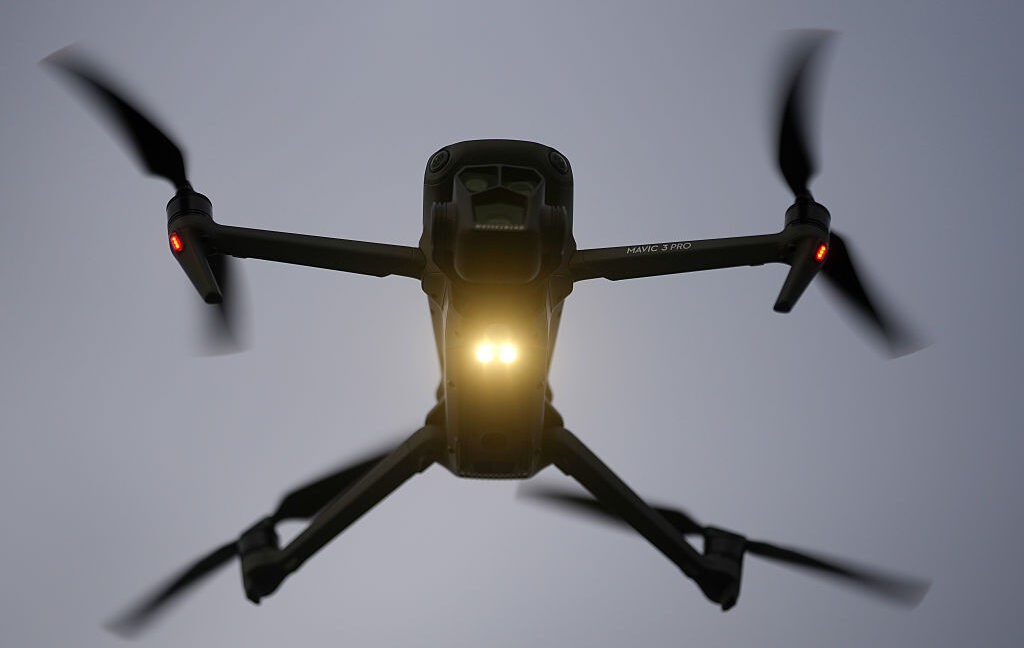
Americans fear there are no cheap alternatives as tariffs suddenly hit drones.
A DJI Mavic Pro 3 camera drone.
On Thursday, the Trump administration imposed a 100 percent tariff on foreign-made drones, alarming critics who warn that high tariffs would harm public safety and devastate thousands of US businesses.
Guidance posted by US Customs and Border Protection says that starting Thursday, a 100 percent tariff will apply to imported drones that use thermal imaging or weigh more than 55 pounds.
Additionally, a 25 percent tariff has been placed on smaller drones, and drones from US allies were hit with smaller but not inconsequential tariffs. There’s now a 10 percent levy on British-made drones and 15 percent levies on drones from the European Union, Japan, Liechtenstein, South Korea, Switzerland, and Taiwan. “Nonsensitive” drones without thermal imaging and their components will carry a 25 percent tariff, starting on February 9, 2027.
While announcing the tariffs, President Donald Trump said that taxing foreign-made drones will strengthen US national security by decreasing reliance on Chinese drones and increasing reliance on domestic drones.
But critics say Trump’s tactics seem short-sighted, citing estimates that “a single Chinese company—Shenzhen-based DJI—manufactures more than 70 percent of the world’s commercial drones,” The New York Times reported.
They fear that Trump’s tariffs will do “more harm than good,” the Times reported, since these drones are considered “essential” for US law enforcement and public safety officials. Thermal drones are regularly used to find missing people, track spreading wildfires, support police and rescue operations in environments with unknown risks, and serve a range of other routine public safety uses. A chief of a large unit comprising police officers and firefighters in the Cleveland area, Scott Mlakar, told the Times that Trump’s tariffs would spike drone costs so much that they would likely “put thermal drones out of reach for communities that needed them the most.”
FCC may effectively ban more drones
Beyond the immediate increase in the cost of drones, even more drones could soon be restricted in the US. The Federal Communications Commission is considering whether to reclassify a range of common drone technologies as “military grade,” a move that many commenters warned would further restrict access to countless drones that serve no military purpose and pose no threat to national security.
Industry experts have warned that the reclassification would amount to a “retroactive ban on drones used by thousands of American businesses and public safety officials,” the Times reported. If passed, it would be an “industry-killing ban,” an aerial photographer, Vic Moss, told the Times. And one official coordinating a city’s drone program, David Hood, urgently alerted the FCC in a comment that the plan to recategorize any drone with Light Detection and Ranging (LiDAR) sensors as military-grade would be particularly disastrous for society.
“LiDAR is a safety and navigation technology, not a military capability,” Hood wrote. His city relies on LiDAR-equipped aircraft to help avoid crashes. That “civilian use—collision avoidance—is a safety function, not a combat function,” Hood wrote.
He recommended that the FCC either remove LiDAR-equipped drones from the list of potential new categories of military-grade technologies or, at a minimum, narrow the “category so that it reaches only equipment genuinely tied to the identified national-security risk.”
“Prohibiting LiDAR would undermine the very safety the proposal seeks to protect,” Hood wrote. “Removing access to these platforms would push operators—including public agencies conducting inspections and public-safety missions over populated areas—toward less capable aircraft with inferior collision avoidance, increasing the risk of crashes over people and property.”
Dale Hylton of Blue Skies Drones suggested in a comment that the FCC “should evaluate the actual risk presented by a system, not classify equipment as military grade simply because it contains a sensor that is widely used in civilian transportation, robotics, surveying, construction, and industrial applications.”
DJI drones irreplaceable, officials say
Cops in red states like Texas and blue states like New York agree that cutting off Chinese drones will impact public safety.
Jason Lee, a Texas police officer, told the FCC that “there is currently no economically viable domestic replacement” for DJI drones. That’s why, he said, “more than 80 percent of state and local law-enforcement drone programs surveyed in 2024 used DJI aircraft.”
“This widespread adoption did not occur because law-enforcement agencies are seeking military equipment,” Lee said. “It occurred because these systems provide dependable capabilities at a price that municipal agencies can actually afford.”
As the manager of his police department’s drone program, Lee explained that he relies “heavily on DJI platforms because they provide a combination of reliability, capability, ease of use, and cost that is difficult, if not impossible, to replicate with currently available domestic alternatives.”
He’s also concerned that tariffs will make it harder to affordably fix minor repairs on drones that public safety officials have already purchased. Right now, he said, US-made drones can’t fill that gap.
“The fact that a domestic product exists does not necessarily mean it is a viable substitute,” Lee said. “A replacement must be operationally comparable, economically obtainable, supported by an adequate supply chain, and accepted by pilots who must rely on it during real-world incidents.”
Both Lee and Hood noted that the impact extends beyond public safety, affecting hobbyists, professional photographers, farmers, construction workers, and many others who rely on affordable access to capable drones. The American Gas Association, which represents energy groups serving 74 million US residences, noted that it relies on 55-pound drones with thermal imaging and LiDAR to “execute a range of operations common to natural gas utilities, including vegetation management, pipeline inspections, security responses, and disaster recovery.”
The AGA argues that the US should give Americans at least two years to transition from Chinese drones or risk disrupting critical infrastructure.
“A prohibition that eliminates the affordable, capable option without a proven equivalent substitute does not have a minor impact; it strands public agencies with aging fleets and no compliant replacement path, forcing either a loss of capability or substantially higher costs borne by local taxpayers,” Hood said.
Trump urged to expand exemptions
New York State Police officer Michael W. Deyo suggested that the US could establish a pathway to exempt state and local police and public safety agencies from paying tariffs or, at the very least, allow them to apply to import components needed for repairs. Hood similarly requested that the FCC extend exemptions for federal authorities to “state, local, and tribal government operators” that use drones to deliver essential public services.
Mlakar told the Times that Trump’s tariffs appear to be more about “protectionism” than national security. He suggested that lobbying by US manufacturers seeking to eliminate foreign competition was a primary factor in Trump’s decision to impose the tariffs. The Times also noted that Trump’s sons, Eric and Donald Trump Jr., have investments in US drone companies. Both are shareholders and advisory board members of Dominari Holdings, which has invested in Florida-based drone maker Powerus. Don Jr. also sits on the advisory board of Unusual Machines, a top US manufacturer of drone components. On Thursday, Unusual Machines was among the US drone stocks reportedly rallying after the tariffs took effect.
Hood warned that the plan to restrict access to drones with LiDAR sensors would achieve the “opposite” of Trump’s goal to “protect the safety and security of United States persons.”
And the 100 percent tariffs on drones with thermal imaging will likely shift how communities respond to disasters and other scenarios where drones help protect civilians. If public safety officials lose access to DJI drones due to budget constraints, they’ll lose valuable advanced thermal imaging technology that “assist officers and the public in situations where speed, accuracy, and reliable aerial information can directly affect safety,” Lee wrote.
“A thermal-equipped drone can locate a person who cannot otherwise be seen, assist officers searching large or wooded areas, provide information during dangerous incidents, identify heat sources, and support operations where sending an officer into an unknown environment would create unnecessary risk,” he wrote. “These are not military missions. They are routine public-safety applications intended to protect American citizens.”

Ashley is a senior policy reporter for Ars Technica, dedicated to tracking social impacts of emerging policies and new technologies. She is a Chicago-based journalist with 20 years of experience.
What's Your Reaction?
 Like
0
Like
0
 Dislike
0
Dislike
0
 Love
0
Love
0
 Funny
0
Funny
0
 Wow
0
Wow
0
 Sad
0
Sad
0
 Angry
0
Angry
0








Comments (0)