

Using Rhino Linux's new Lomiri snapshot took me back to the glory days of Unity

Follow ZDNET: Add us as a preferred source on Google.
ZDNET's key takeaways
- Rhino Linux is about to undergo a dramatic change.
- The distribution will soon have a new UI that's focused on convergence.
- You can download a snapshot of the new build, but it's not ready for everyday use.
I've been a fan of Rhino Linux for some time. I've called it a Swiss Army knife of Linux distributions and believe it offers the best take on the Xfce desktop. It's a beautiful distribution that anyone could use, no matter the skill level.
But there are big changes afoot with the distribution, changes that could help elevate to new heights, should things work out.
Those changes involve convergence.
Yep, we're back to the concept of bridging desktop and mobile devices together.
Let's take a trip down memory lane.
Years ago, Canonical (the company behind Ubuntu) had a dream of bringing desktop and mobile devices together. They called that dream "convergence," and they were the first to bring it to light.
Also: This Linux distro has a smart feature that vastly improved my workflow
The idea was simple: You plug your phone into a monitor/keyboard/mouse, and the mobile UI would be presented on the connected monitor, only in desktop form. It was genius. To that end, they migrated Ubuntu from the GNOME desktop to the in-house Unity desktop. It was beautiful, and it offered some of the most forward-thinking features I'd ever seen on a desktop.
Unfortunately, it wasn't meant to be. I believe the biggest hurdle Canonical faced was hardware. The only OEMs willing to bet on Unity and convergence were unknown companies creating low-end devices. I was one of the few who received a test device and found it to be just awful. It was slow, buggy, and the mobile take on Unity failed miserably.
Not long after that, Canonical dropped the idea of convergence, went back to the GNOME desktop, and continued on its previous path of least resistance.
Fast forward to the here and now, and several companies have taken on the idea of convergence. Both Samsung and Google have created outstanding takes on the melding of mobile/desktop, and it's going to be hard to beat them.
But where there's a will, there's a way, and the developers of Rhino Linux think they have both.
Ergo… Lomiri.
What is Lomiri?
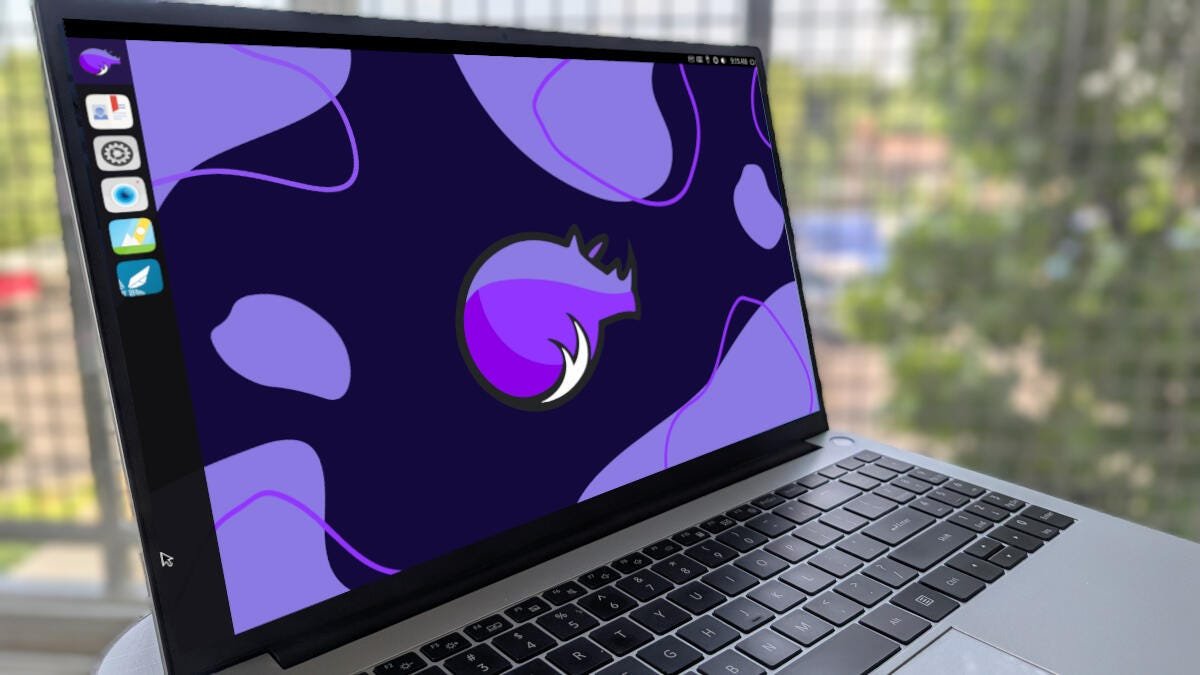
Lomiri is Rhino Linux's take on Unity. Essentially, what the developers have done is refashion the Rhino Linux desktop after Unity. They are planning on picking up where Canonical left off.
Also: The best old-school Linux window managers that still hold up
Recently, the developers released a snapshot of the latest iteration of Rhino Linux with the Lomiri desktop, and as soon as I booted it into the live instance, I was immediately taken back to those days of Unity. I installed the distribution to see how it fared, and here's my reaction.
Lomiri: The good, the bad, and the ugly
It's Ubuntu Unity, Rhino style.
First, this is a snapshot, so it's unfinished and buggy. I knew this going in, so I had no pretension that this version would be usable. That assumption of unuseability was spot on, as the Lomiri desktop is far from a finished product.
Apps would open, but then resize themselves until I couldn't access or use them. I was unable to access the titlebars to move apps, so they were essentially small black boxes that didn't function.
I was able to access and use some apps (such as System Settings and Mugshot), and apps like LibreOffice Writer opened, but a portion of the toolbars was missing, which rendered the app unusable. App menus also barely functioned.
When you examine the System Settings app, you can see that the focus is on mobile devices, as there's an Airplane Mode and Rotation Lock front and center. On a desktop, those two things are irrelevant.
Again, this is a snapshot, so it's very early on in the development process.
As far as the good is concerned, the Lomiri desktop is very much in line with Unity. What you see looks like what's on the Ubuntu desktop, with the side panel and top bar. The Lomiri menu is fairly basic and reminds me more of a mobile App Drawer than an actual desktop menu. Unlike the Unity menu (which was highly configurable and had one of the most powerful search features on the market), the Lomiri menu has no options. You open it, you locate your app, and you launch your app.
It falls a bit short of the Unity menu, but it's still nicely done.
Also: The new COSMIC Linux desktop from System76 is out of this world
Although that's somewhat disappointing, it also might be the right direction, as the original Unity menu was far too advanced for the average user. The Lomiri take on this is as simple as it gets.
Although I do find Rhino Linux's take on Xfce to be gorgeous, the Lomiri desktop does show signs that the developers are serious about bringing that same aesthetic to the new iteration. It's not as elegant, but it could be.
You can disable the dark mode in System Settings > Background & Appearance, which I much prefer. The only issue with the light mode is that the overview icon (top left) doesn't switch, so it's a bit out of place.
Light mode is almost there.
A long way to go
As I've said, what I tested was a snapshot, so problems were to be expected. Even so, it's apparent that Lomiri has a long way to go before it's ready for general release. There's no obvious way to set up peripherals (such as printers), there's little in the way of customization, and certain actions (such as right-clicking on the desktop) do nothing.
With that being said, what the Rhino Linux developers are doing is commendable. I would love to see them achieve what Canonical failed to do, but that success will depend on whether they can get the mobile version of Rhino Linux (and the Lomiri UI) functioning on viable hardware. If they fall into the same trap as did Canonical (with only low-end mobile hardware as an option), the Rhino Linux convergence experiment will not succeed. If, on the other hand, they are able to get the OS running on modern, mid-to-high-end mobile devices (such as Pixel or Samsung phones), they could have a massive hit on their hands.
I would only recommend that you give the Lomiri version of Rhino Linux a test if you understand that it's not a working product at the moment. If you're okay with that, download an ISO, create a live USB drive with it, boot it, and see what there is to see.
What's Your Reaction?
 Like
0
Like
0
 Dislike
0
Dislike
0
 Love
0
Love
0
 Funny
0
Funny
0
 Wow
0
Wow
0
 Sad
0
Sad
0
 Angry
0
Angry
0







Comments (0)