

Venice Prizes Elevate John Malkovich, ‘Possible Love,’ and ‘NAZA’ to Oscar Frontrunners
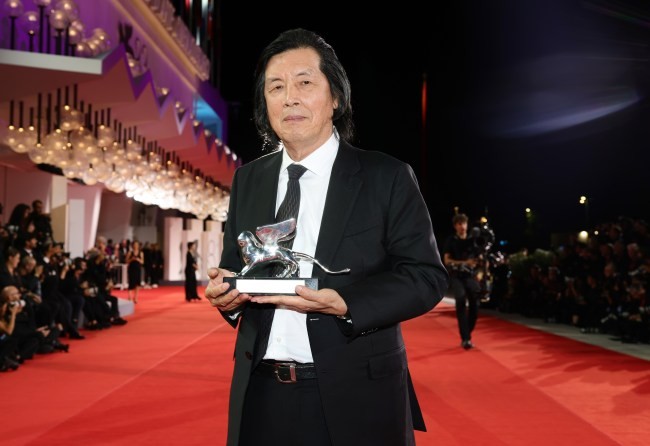
If Venice has illuminated anything about the Oscar race, it’s that “Wild Horse Nine” star John Malkovich is the current frontrunner for Best Actor. The two-time Oscar nominee (“In the Line of Fire,” “Places in the Heart”) received the Volpi Cup for Best Actor from a competition jury led by Maggie Gyllenhaal. Recent Oscar nominees like “At Eternity’s Gate” lead Willem Dafoe and “The Banshees of Inisherin” star Colin Farrell also won the Venice acting prize. “Banshees” was “Wild Horse Nine” director McDonagh’s last film to premiere at the Italian festival.
The recognition is also great news for Searchlight Pictures, which had both critical darling “The Testament of Ann Lee” (another Venice premiere) and fall festival favorite “Rental Family” on its awards slate last year, yet last season still yielded zero Oscar nominations for the first time in the distribution shingle’s history. “Wild Horse Nine” is already well on track to bring it redemption as one of the best-received titles at Telluride this year as well.


Even while scaling back the number of films it brought to the festival, Netflix still made a significant impact on Venice, with its film “Possible Love” from auteur Lee Chang-dong winning the Grand Jury Prize. The drama has received the best reviews of all the narrative films in competition and has already been submitted by South Korea to represent the country in the Best International Feature category.
While it’s easy to say “Wild Horse Nine” will be a Best Picture nominee based on its reception and director Martin McDonagh’s Oscar track record alone, it is a lot harder to say whether or not “Possible Love” in particular will make the cut as the other major studio film to win a jury prize. While there have been major strides in the past decade toward inclusivity of films in languages other than English in categories outside Best International Feature, the nominations still often end up very Eurocentric. Even within Netflix, with the top priority already seemingly being Cannes-winning Spanish saga “La Bola Negra,” “Possible Love” could be put on even more of a back burner should “The Further Mis-Adventures of Cliff Booth,” David Fincher’s follow-up to Best Picture nominee “Once Upon a Time in Hollywood,” finally hit theaters in a timely fashion.
That said, the last two East Asian films to be nominated for Best Picture are “Parasite” and “Drive My Car,” both of which won Oscars — they just didn’t receive any acting nominations. There’s certainly a world in which director Lee breaks into the Best Director race. Both Bong Joon-ho and Ryusuke Hamaguchi, who helmed the two aforementioned films, did — but it would be way more of an uphill battle and triumph for Lee’s frequent collaborator Jeon Do-yeon to be nominated for Best Actress, for example. Director Lee is beloved for films including “Burning,” “Secret Sunshine,” and “Poetry,” which never made it to the Oscars but regularly appear on lists of the best films of the 21st century.
As for the film that actually won the festival’s top prize, the Golden Lion, “Woman Unknown,” from Danish-Egyptian director May el-Toukhy, is now automatically eligible for Best International Feature under the new rules for the category without having been submitted by any countries. So the conversation about whether Denmark submits the film on its behalf is mostly irrelevant (though we have still seen countries like Romania submit a film like “Fjord” despite it automatically being eligible for Best International Feature via its Cannes Palme d’Or win).
 Mathilde Arcel and May el-Toukhy pose with the Volpi Cup for Best Actress Award and with the Golden Lion for the Best Film Award for ‘Woman Unknown’ and at the Winners Photocall during the 83rd Venice International Film Festival at Sala Grande on September 12, 2026 in Venice, Italy.Benjamin Cremel/Getty Images
In terms of Oscar potential for “Woman Unknown” following its two jury prizes, there’s a bit of good news, bad news. Not having a U.S. distributor yet means it’s now a very hot acquisition, likely to be picked up by a distributor because of how much the Golden Lion brings to its Best International Feature campaign. But the downside of not yet having a U.S. distributor is that there will be too much catch-up to do to mount a Best Actress campaign for the film’s star, Mathilde Arcel, winner of the Volpi Cup for Best Actress. It’s already a challenge for studios to convince the Actors Branch to consider performances not in English. She is also less well known than fellow European actress Sandra Hüller, for example, who has starred in the Oscar-winning films “The Zone of Interest” and “Anatomy of a Fall,” plus Best International Feature nominee “Toni Erdmann.”
With respect to the other main jury competition winners like “DAU,” “A Good Little Soldier,” and “A Place to Heal,” all acquisition titles that will have a harder time finding an American audience, the last prize winner sure to enter the Oscar conversation is “NAZA,” the Special Jury Prize winner from two of the Best Documentary Feature-winning directors behind “No Other Land.”
While “No Other Land” was set before the Nova music festival massacre on October 7, 2023, it was released in the United States a year after the fact, helping audiences have much more context on the relationship between Israelis and Palestinians in the lead-up to the war in Gaza. Directed by Yuval Abraham and Rachel Szor, the Israeli half of the four “No Other Land” helmers, “NAZA” is explicitly about the war in Gaza, with IDF soldiers going on the record about war crimes they have committed.
Even well before the current war in Iran, the Academy has had a rich history of recognizing dissident filmmakers from that country, like “The Seed of the Sacred Fig” director Mohammad Rasoulof and “It Was Just an Accident” director Jafar Panahi, so there are immediate parallels to the work Abraham and Szor are doing exposing the ills of their government. The Documentary Branch is also one part of the Academy willing to engage with films that directly address world events.
So, even if Israel and Palestine are still taboo subjects among Academy members, the relevance of “NAZA” coming off the Oscar win for “No Other Land” makes the Venice prize winner a top contender for voters seeking films that speak to the moment we are in globally. “NAZA” doesn’t right now have a U.S. distributor, but “No Other Land” similarly made its way to the Oscars without a backer, and through self-releasing.
What's Your Reaction?
 Like
0
Like
0
 Dislike
0
Dislike
0
 Love
0
Love
0
 Funny
0
Funny
0
 Wow
0
Wow
0
 Sad
0
Sad
0
 Angry
0
Angry
0












Comments (0)