

Viltrox’ New Nifty-Fifty(-Five) Is Done Being Just a Budget Option: We Review the Viltrox 55mm f/1.8 EVO APO Prime
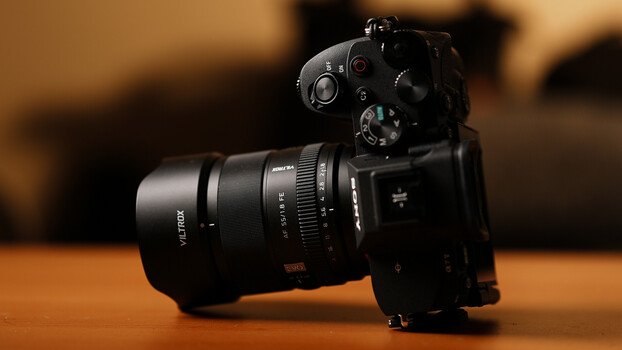
This lens is the perfect example of why one should not judge a lens by its cover. While it may seem like any other budget fast prime, it offers a real, visible difference for your images.
There's no doubt that Viltrox has been on a fast trajectory in developing lenses beyond the budget options they're known for. Last year they launched their LAB line, headlined by the 35mm f/1.2 LAB, which has proven to be a one-of-a-kind option. While Viltrox still has their AIR line to make autofocus primes available for those on a limited budget, the EVO line hits the sweet spot between quality and affordability. This new addition, the Viltrox 55mm f/1.8 EVO, clearly raises the bar.
The Viltrox 55mm f/1.8 EVO
The Viltrox 55mm f/1.8 EVO comes in a similar form to the recently announced 35mm f/1.8 EVO. It has an all-metal build, including the focus and aperture rings. It comes in at 69 x 76 mm and has a 58mm filter thread, similar to the other EVO lenses, and it weighs 365 grams.
Closest to the distal end is the textured metal focus ring, followed by a central layer of the barrel that has the autofocus switch, the aperture click switch, the programmable button, and the silver EVO badge. Right below this is the metal aperture ring, with a range of f/1.8 all the way to f/16, plus an extra setting for "A."
Just like other Viltrox lenses, this one comes with a USB-C port at the bottom for firmware updates. However, what's even more impressive on this part of the lens is a rubber seal layer that gives additional protection from the elements. While we're unsure of the extent of weather sealing that this lens has, it is quite pleasant to know that such lenses can have improved durability.
Image Quality and Focusing
Of course, the biggest yet most subtle physical feature of this lens would have to be the glass design. It's made up of 13 glass elements in 9 groups, designed to minimize chromatic aberration and thereby result in sharper and cleaner output, especially in high-contrast situations. Not too many lenses on the market have APO markings, and this might be one of the most affordable ones. Evidently, shooting in high-contrast situations yielded some very impressive, clean images, and this can have implications for almost any kind of photography this lens is applicable to.
Autofocus was quite impressive too. It comes with an internal focusing mechanism that uses an STM motor that provides quick and quiet focusing even with shallow depth of field, and can focus from as close as 0.43 m away from the subject. While it's probably not a lens you would use for shooting sports and action, it seems to keep up quite well with AF tracking on the Sony a7 V, even for moving subjects that had just popped into the frame. Add to that the fact that this is in the context of shooting at f/1.8, and the fact that the accuracy is closely matched by the speed is impressive for a lens that is less than $400.
Application and User Experience
A 55mm, much like a 50mm, is one of the most versatile primes around, and that is precisely why 50mm lenses are the most commonly available budget primes across any lens and camera brand. It has a perspective that isn't wide but isn't too tight either, and that makes it a lens that can be used for photographing portraits with or without a surrounding environment.
While there is a 5mm difference in focal length, the feel and the perspective are pretty much the same. Even in this context, the biggest difference would still be the fact that this lens produces significantly cleaner images than a lot of the lenses in this price range. This image quality contributes a lot to the perceivable effect that shooting at f/1.8 would have, especially when there are lots of layers in the foreground and background. Given the capabilities of the focusing motor when paired with a camera that maximizes it, this lens can also be very helpful in low-light situations, whether for shooting stills or even video.
With a range that isn't wide but also not too tight, 55mm is a good focal length that can be paired with moving closer to or farther from the subject to get the right perspective. Being able to shoot wide open at f/1.8 allows the user to create better emphasis on the subject through isolation from the background and foreground. This can come in handy when shooting outdoors, especially in a busy scene, or in emphasizing certain objects individually when shooting products and/or still life.
As a content creator, my go-to lens is a 50mm f/1.4, and because of the close resemblance of the perspective despite the 1/3-stop difference, I can definitely see this lens being a good companion for similar use cases. A 55mm offers a natural-looking perspective when photographing or filming people, but it can easily be used as well for photographing products or close-ups of certain objects for B-roll. Not to mention that, even when used wide open, it gives a nice background blur that doesn't totally take away the context of the background, especially when filming from a healthy distance.
There's really not much more to say about this lens, because it offers precisely what it is: an update on a very well-known and well-loved lens model that offers fast autofocus, good low-light capabilities, and clean images that are rid of any visible chromatic aberration. While it is a lens model that is very common on the market, those who pay attention to details and look at their images closely will appreciate what a $370 lens has to offer.
What I Liked
- Compact and lightweight
- Remarkable optical performance
- Fast adaptive autofocus
- Apochromatic lens design
What Can Be Improved
- Currently only available for Sony FE and Nikon Z
What's Your Reaction?
 Like
0
Like
0
 Dislike
0
Dislike
0
 Love
0
Love
0
 Funny
0
Funny
0
 Wow
0
Wow
0
 Sad
0
Sad
0
 Angry
0
Angry
0









Comments (0)