

What Happens When a Cryptocurrency Reaches Its Maximum Supply?
When a cryptocurrency reaches its maximum supply, no new coins can be created under its current rules. The blockchain does not stop. Existing coins keep trading, and miners or validators can still earn rewards from transaction fees or other methods.
Bitcoin is the best-known case. Its supply is capped at about 21 million coins. The last fractions are expected to be mined around 2140.
Other networks work differently. Cardano (ADA) has a cap of 45 billion tokens, and XRP created all 100 billion of its coins at launch. Ethereum (ETH) has no fixed cap, but it burns some ETH to reduce supply.
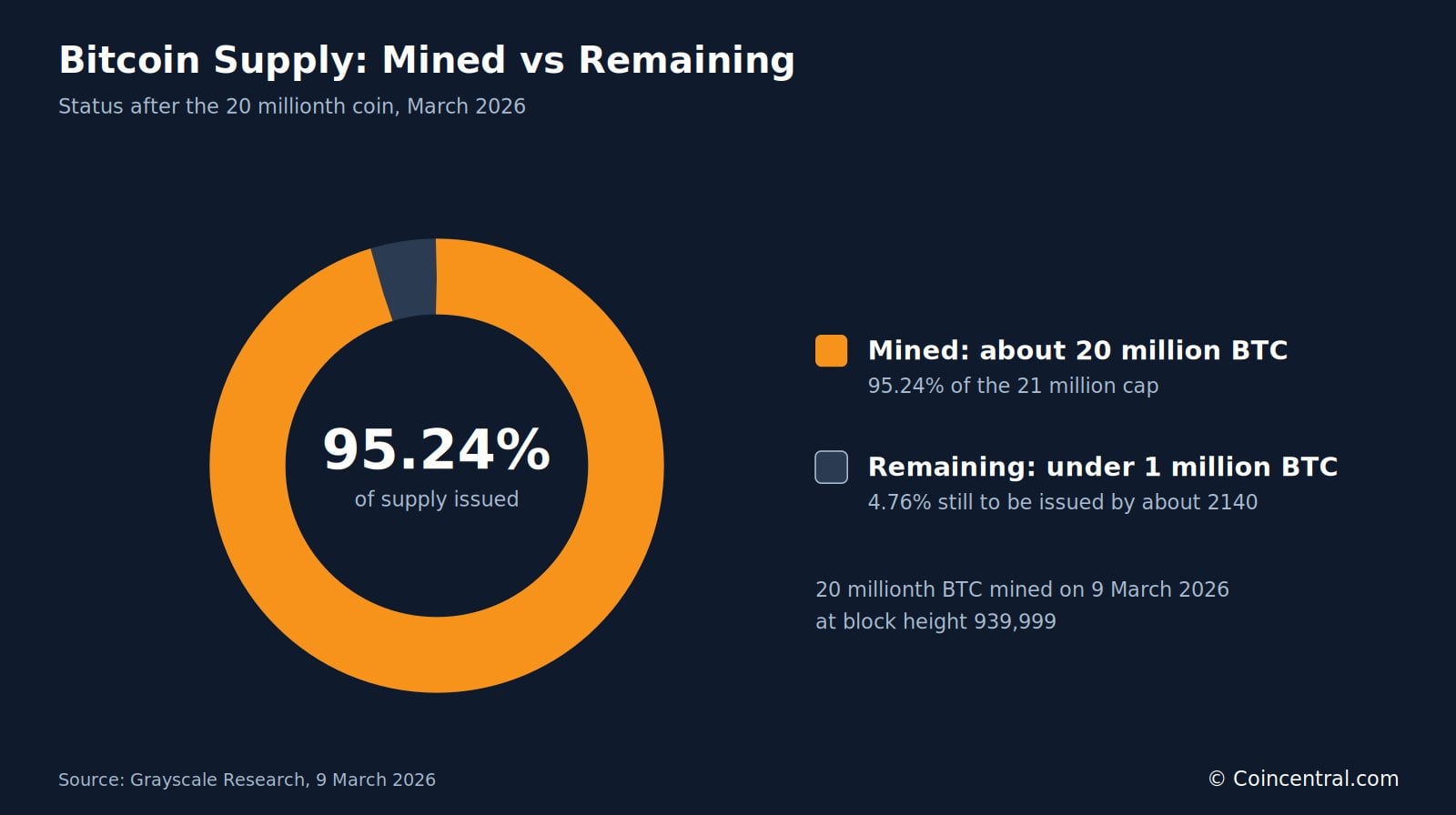
In March 2026, Bitcoin’s 20 millionth coin was mined. That leaves fewer than one million BTC to be issued over roughly the next 114 years.
This article looks at the numbers behind supply caps. It covers what happens to miners, validators, prices and network security when issuance slows or stops.
Key Statistics at a Glance
Bitcoin is the main example of a hard supply cap, so its numbers set the scene. The table below shows where the network stands today.
| Bitcoin maximum supply | About 21 million BTC |
| 20 millionth BTC mined | 9 March 2026 |
| Share of supply issued | About 95.24% |
| BTC left to issue | Fewer than 1 million |
| Current block reward | 3.125 BTC |
| Final coins expected | Around 2140 |
| Ethereum maximum supply | No fixed cap |
Figure 1: Share of Bitcoin’s maximum supply issued as of March 2026. Source: Grayscale.What Does Maximum Supply Mean?
Maximum supply is the largest number of coins that can exist under a cryptocurrency’s rules. For coins with a fixed cap, the protocol limits how many units can be created. Bitcoin’s cap is about 21 million BTC, Litecoin’s is 84 million LTC, and Cardano’s is 45 billion ADA.
People often mix up maximum supply with total supply and circulating supply. These numbers describe different things.
| Maximum supply | The most coins allowed under the supply rules |
| Total supply | Existing coins, usually excluding burned tokens |
| Circulating supply | Coins estimated to be available in the market |
| Available supply | Coins holders are willing and able to sell or move |
| Fully diluted valuation | Price multiplied by maximum or another full supply figure |
Take a made-up coin with a maximum supply of 100 million tokens. Suppose 80 million have been created, but only 60 million are circulating.
The other 20 million existing tokens may sit in team allocations, treasuries or vesting contracts. Another 20 million could still be issued under the rules.
So the cap is 100 million, but buyers only have access to 60 million. This gap matters when judging future dilution.
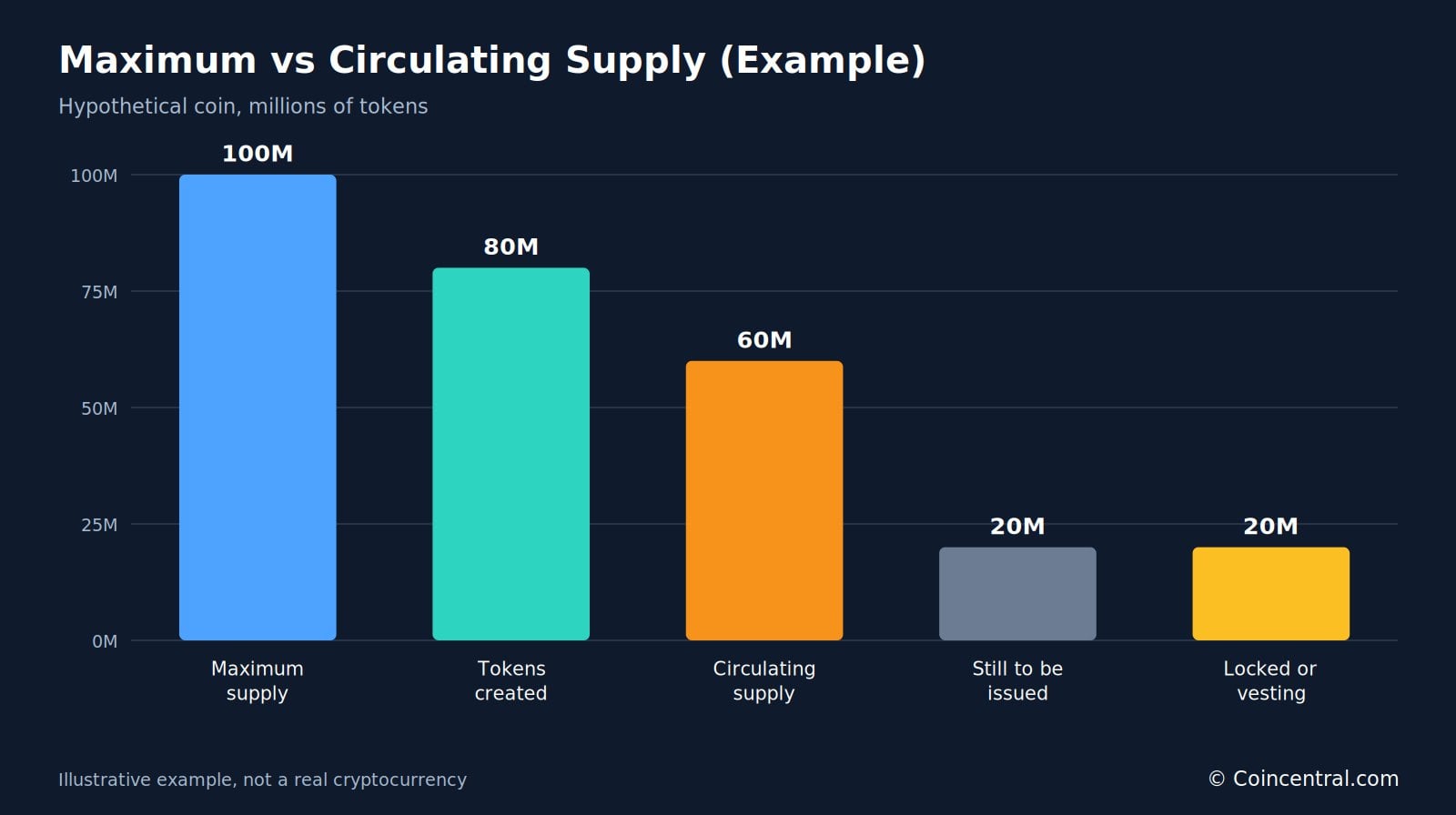 Figure 2: Hypothetical coin with a 100 million token cap. Only 60 million tokens are circulating.
Which Cryptocurrencies Have a Maximum Supply?
Not every coin has a fixed cap. Some follow set issuance schedules, others create tokens all the time, and some burn tokens to offset new supply.
| Bitcoin (BTC) | About 21 million | Mining rewards halve until issuance ends |
| Litecoin (LTC) | 84 million | Mining rewards fall through halvings |
| XRP | Originally 100 billion | All tokens created at launch; fees burn XRP |
| Cardano (ADA) | 45 billion | Staking rewards partly funded from finite reserves |
| Avalanche (AVAX) | 720 million issuance cap | Staking rewards minted; fees burned |
| BNB | Target of 100 million | Supply reduced through token burns |
| Ethereum (ETH) | No fixed cap | Issuance offset partly or fully by burning |
| Dogecoin (DOGE) | No fixed cap | Ongoing issuance rewards miners |
These figures show protocol rules or stated targets, not current circulating balances. A capped coin is not automatically a better investment than an uncapped one.
Value also depends on adoption, utility, demand, liquidity and network security.
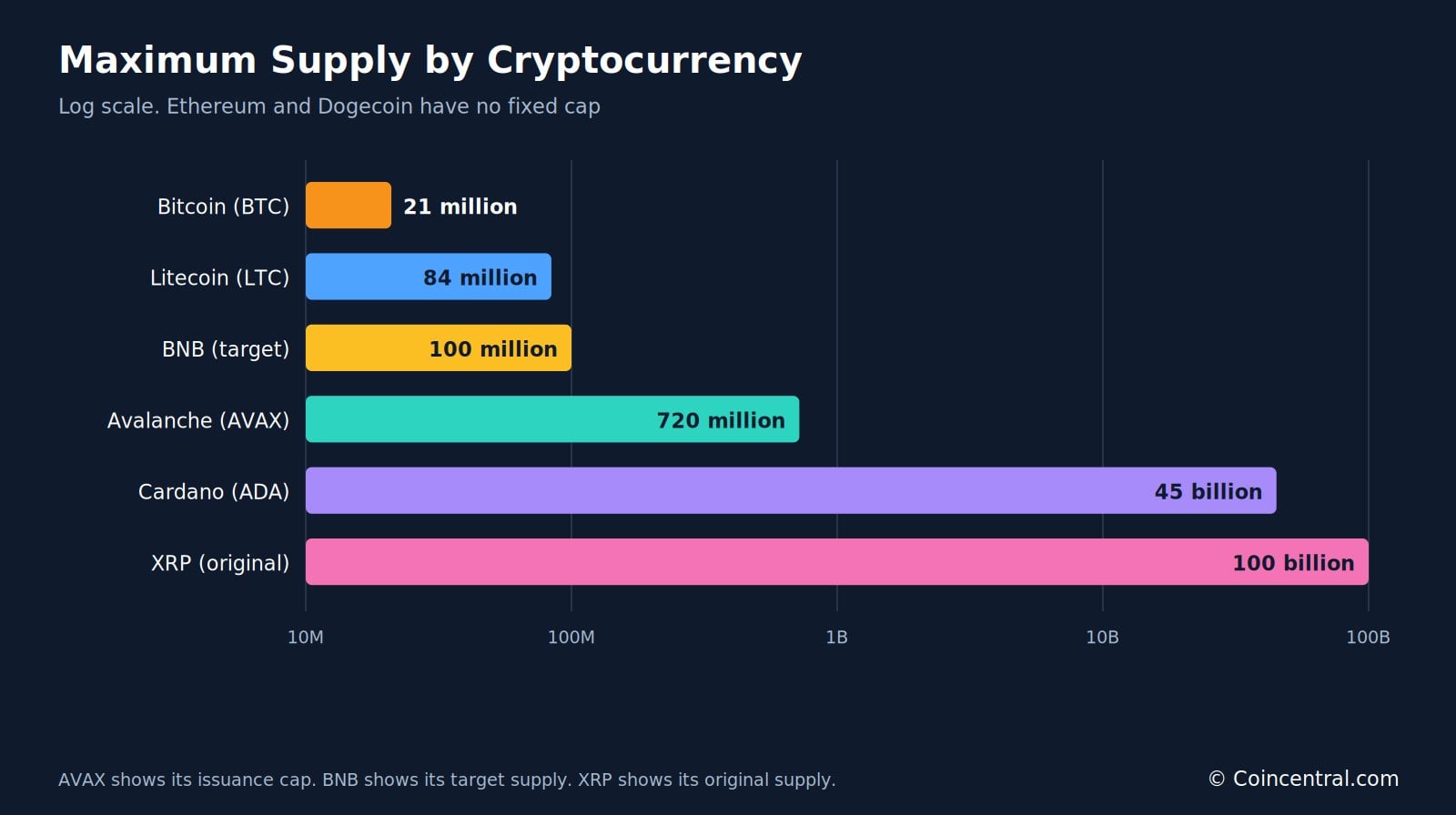 Figure 3: Maximum supply or supply target for six cryptocurrencies, shown on a log scale.
The Bitcoin Halving Schedule
Bitcoin releases new coins at a set pace that slows over time. When it launched in January 2009, miners received 50 BTC for each block. About every four years, that reward is cut in half. This event is called the halving.
| 2009 | 50 BTC | 7,200 |
| 2012 | 25 BTC | 3,600 |
| 2016 | 12.5 BTC | 1,800 |
| 2020 | 6.25 BTC | 900 |
| 2024 | 3.125 BTC | 450 |
| 2028 (estimated) | 1.5625 BTC | 225 |
| 2032 (estimated) | 0.78125 BTC | 112.5 |
| Around 2140 | 0 BTC | 0 |
Daily figures assume an average of 144 blocks per day. Actual production varies.
The latest halving took place on 20 April 2024. It cut the block subsidy from 6.25 BTC to 3.125 BTC. The next is expected in 2028.
By about 2140, the subsidy should reach zero. After that, no new Bitcoin will be created through regular mining rewards.
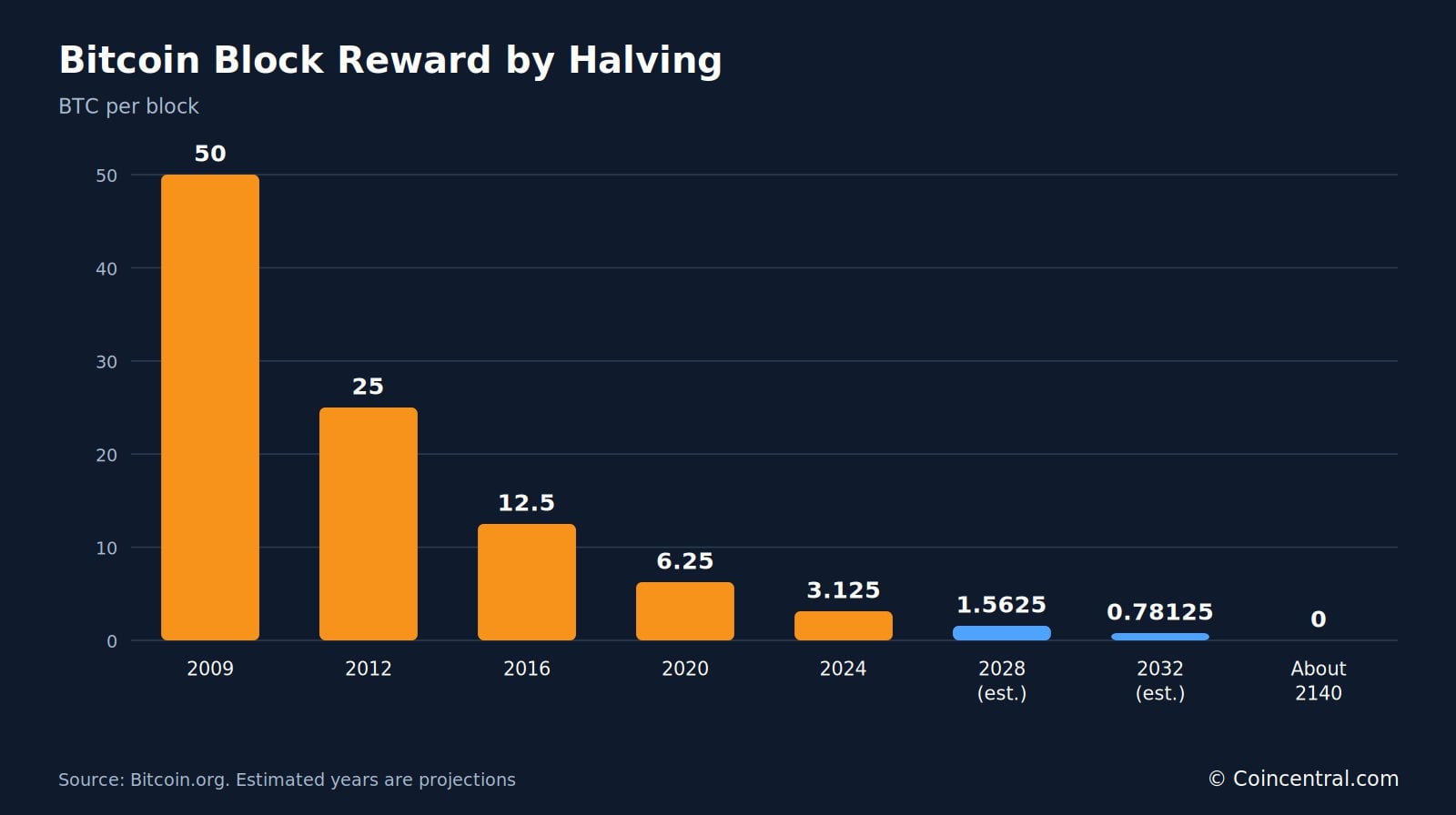 Figure 4: Bitcoin block reward after each halving, in BTC. Source: Bitcoin.org.
How Much Bitcoin Has Been Mined in 2026?
Grayscale reported that the 20 millionth Bitcoin was mined on 9 March 2026, at block height 939,999. The Foundry USA mining pool produced the block.
That means about 95.24% of the maximum supply had been issued. Fewer than one million BTC remain.
Even so, the last coins will take more than a century to arrive. Each halving cuts new issuance, so the pace keeps slowing.
Grayscale calculated that total issuance will reach about 20,999,999.9769 BTC. That is slightly below the 21 million figure often quoted, because of rounding in the protocol.
The schedule is highly predictable. Future demand, prices and investor returns are not.
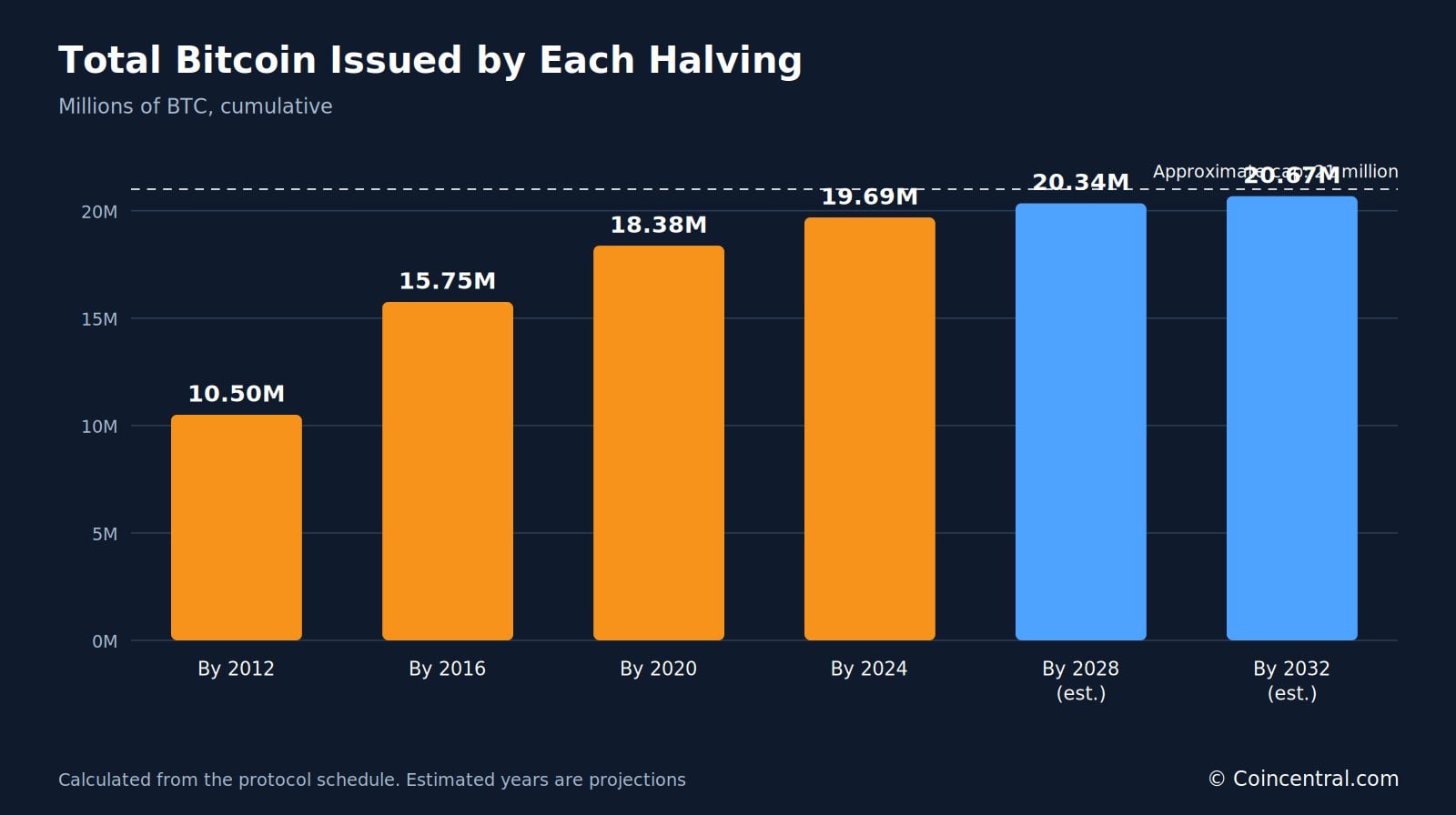 Figure 5: Total BTC issued by each halving, calculated from 210,000-block halving periods.
Will Bitcoin Mining Stop at Maximum Supply?
No. Mining is expected to continue after the last new coins are issued. What changes is how miners get paid.
Today, miners earn two things. The first is the block subsidy, which is newly created Bitcoin. The second is transaction fees paid by users who want their transactions included in blocks.
Once the cap is reached, the subsidy ends. Transaction fees become the only direct Bitcoin revenue miners earn from each block. Bitcoin’s original white paper expected this shift from new coins to fees.
Picture a block with 0.25 BTC in fees. At an example price of $100,000, that is worth $25,000. Whether that covers costs depends on electricity prices, hardware efficiency, competition and Bitcoin’s future value.
If fees are too low, some miners could shut down. Mining difficulty would then adjust, making blocks easier to produce for the miners who remain. But less total mining power could also lower the network’s resistance to certain attacks.
Could Fees Rise After 2140?
Possibly, but it is not guaranteed. Bitcoin has limited block space, so users compete when demand is high. If Bitcoin becomes a major settlement network, users may pay more for reliable transactions.
Demand could also stay low. Second-layer payment networks and exchange internal transfers can reduce how many transactions need direct settlement on the blockchain.
Here is an example. Suppose miners needed $10 million per day in fees. The average fee would depend on how many transactions are processed.
| 200,000 | $50 |
| 400,000 | $25 |
| 500,000 | $20 |
| 1 million | $10 |
These figures are hypothetical. They do not reflect current volume, mining costs or future block capacity. They show that a network can raise fee income through many cheap transactions or through fewer high-value ones.
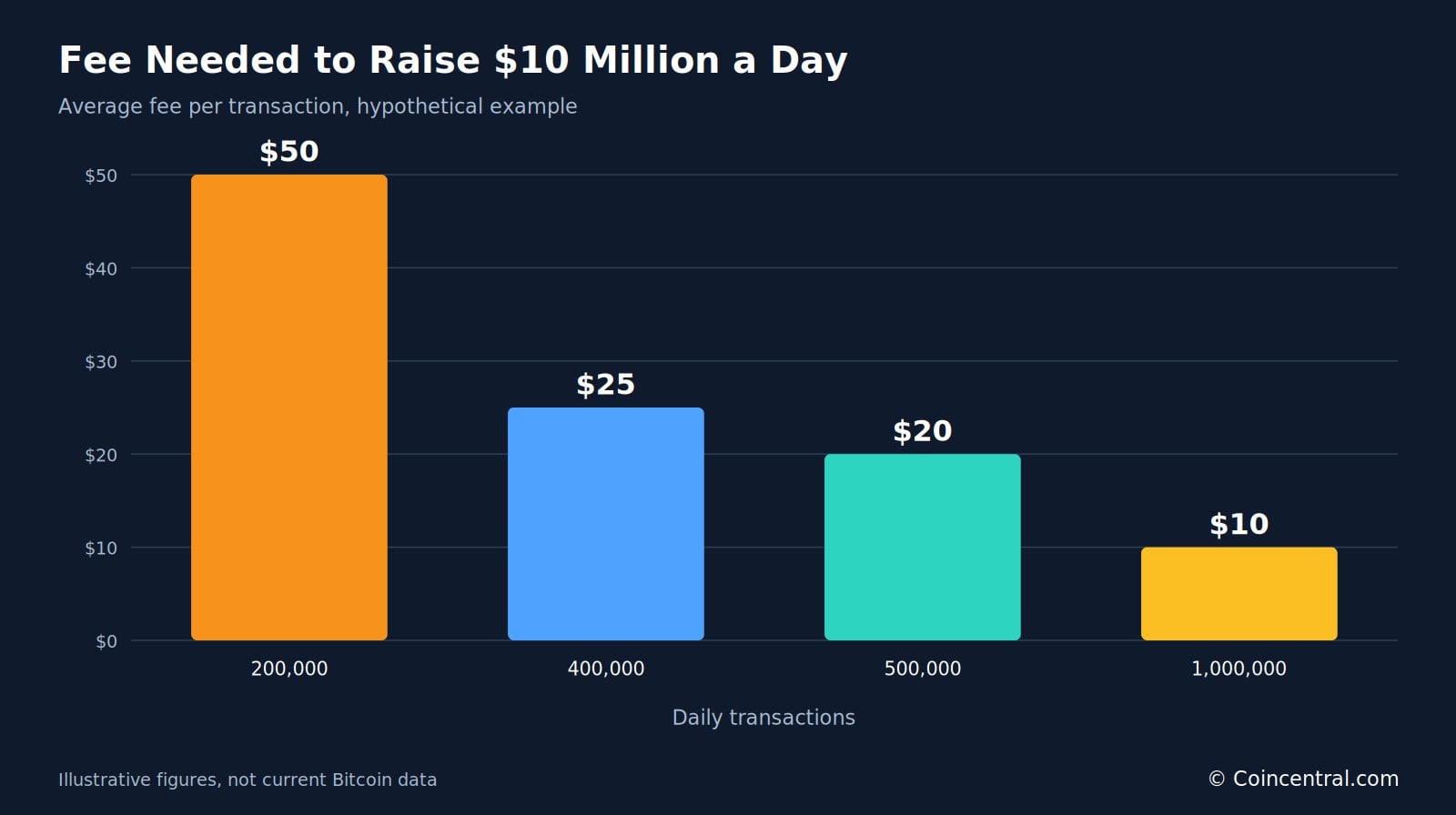 Figure 6: Average fee needed to raise $10 million per day (hypothetical).
Could Bitcoin Become Less Secure Without Mining Rewards?
This is one of the main concerns about Bitcoin’s supply cap. Proof-of-work security rests partly on the cost of trying to manipulate the chain. Mining needs specialized hardware and a lot of electricity.
The more mining power on the network, the more expensive certain attacks tend to be. If mining revenue falls sharply, some participants may leave. That could lower the cost of attacks that rely on large mining power.
What the Research Says
A 2016 Princeton University paper, On the Instability of Bitcoin Without the Block Reward, studied miners who rely only on fees. The authors found incentives that could push miners to reorganize recent blocks when fee income varies widely from block to block.
Their theory suggested a fee-only system could create security and performance problems that are less pronounced when subsidies give steadier pay.
The paper does not prove that Bitcoin will become insecure in 2140. Future demand, mining technology, fee systems and user behavior are unknown. The takeaway is that a supply cap raises a long-term security question. It does not cause an automatic failure.
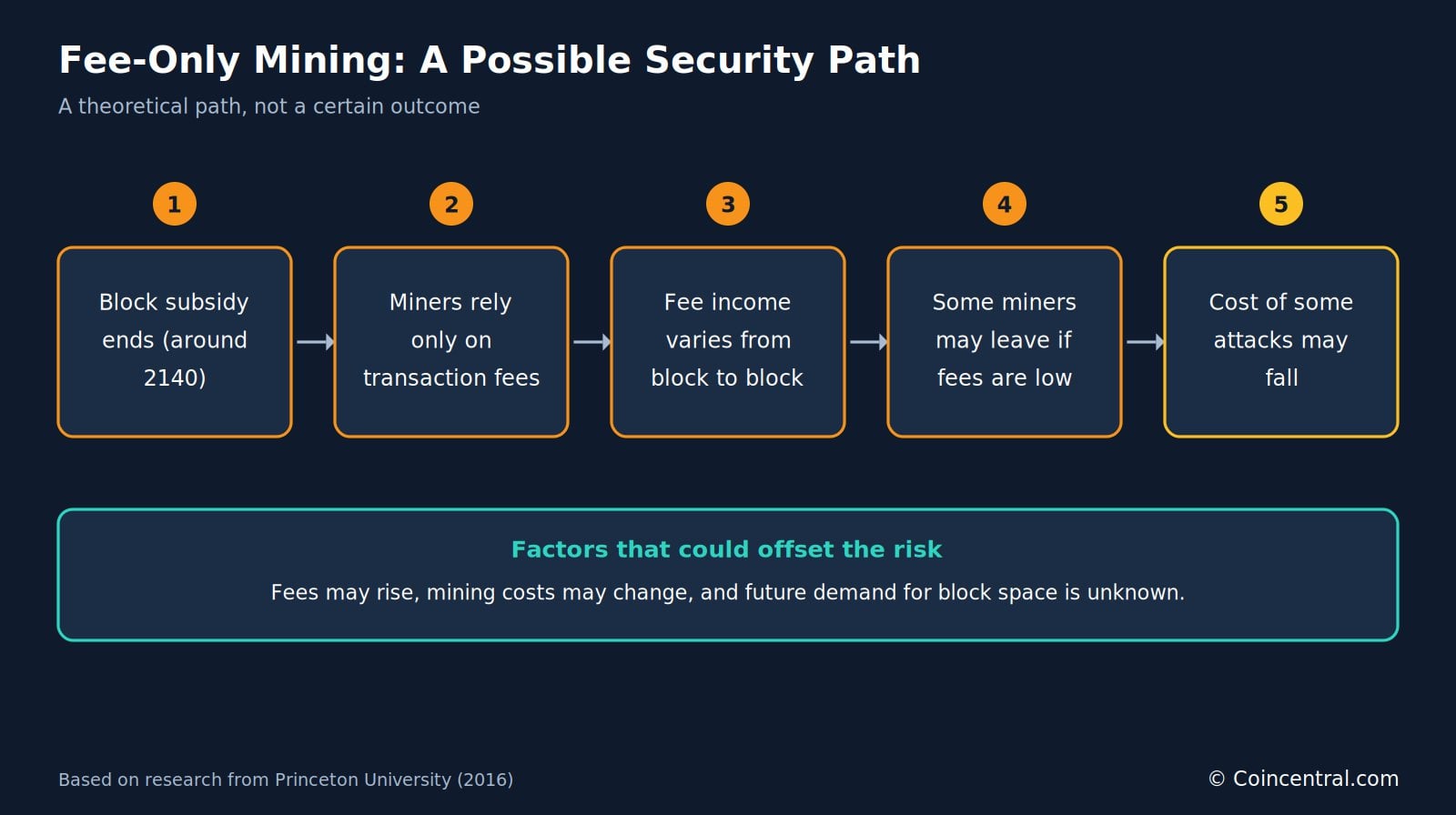 Figure 7: One possible path from fee-only mining to security concerns. It is not a certain outcome.
Does Maximum Supply Make a Cryptocurrency More Valuable?
Not necessarily. A fixed cap creates scarcity in the number of coins. But scarcity alone does not create value, because a coin needs enough demand to support a market price.
Compare two example coins. Coin A has a cap of one million tokens but almost no users. Coin B has a cap of one billion tokens and a widely used payment network. Coin B could still be worth far more.
How Supply and Demand Affect Price
Say a coin has 100 million tokens in circulation and a market cap of $200 million. The price is $200 million divided by 100 million tokens, or $2 per token.
If supply becomes permanently fixed at 100 million and demand stays the same, the price stays at $2. The cap alone does not cause a rise.
| $100 million | 100 million | $1 |
| $200 million | 100 million | $2 |
| $400 million | 100 million | $4 |
If demand grows while supply stays fixed, the price may rise. If demand falls, the price can still drop sharply. A fixed supply can strengthen scarcity, but it does not protect investors from losses.
Bitcoin’s cap has been public since launch, so it is already part of how investors view the coin. Future prices will depend on demand, liquidity, adoption and wider market conditions.
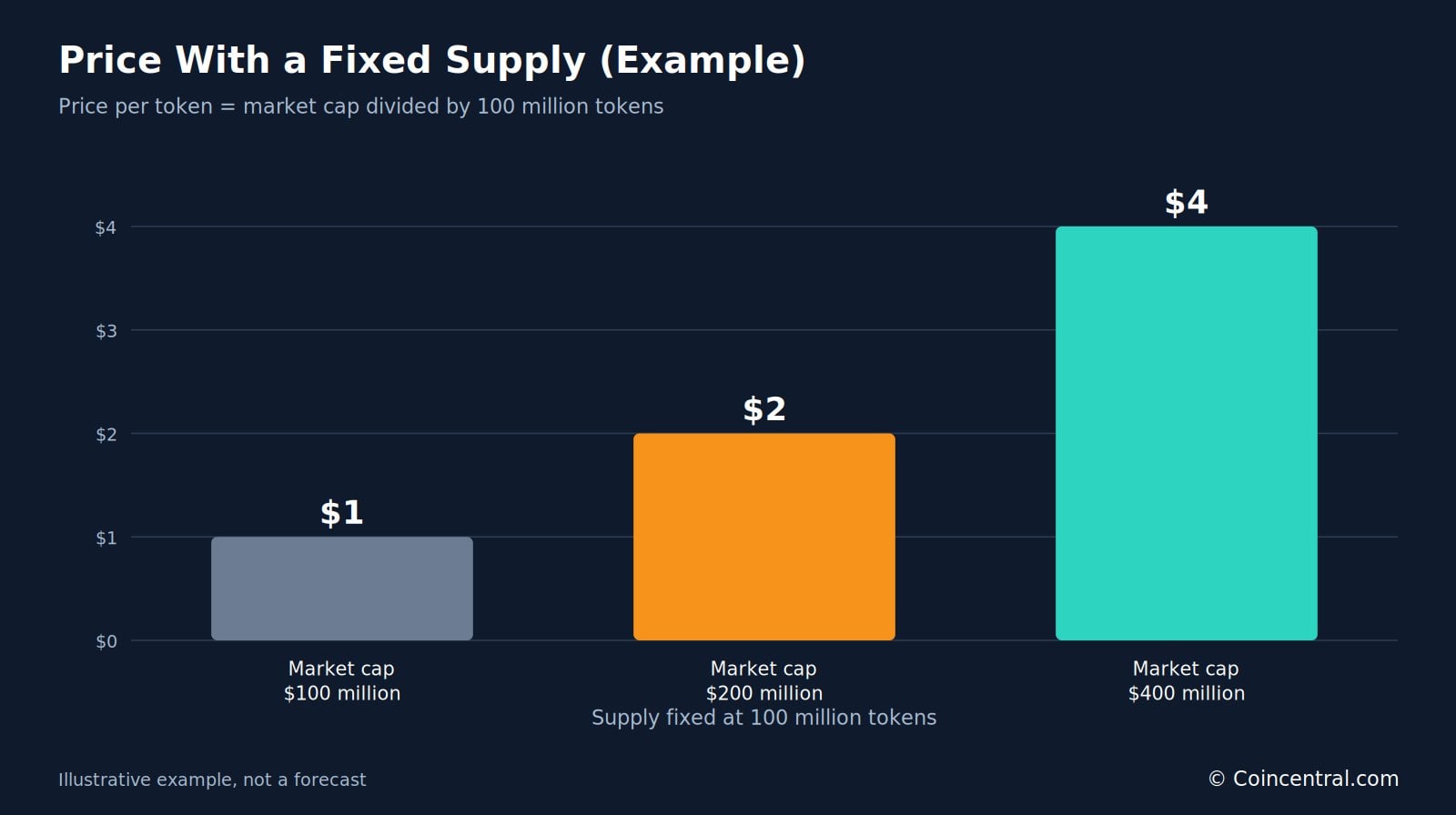 Figure 8: With supply fixed, price depends on market value. Hypothetical example.
What Happens to Staking Rewards at Maximum Supply?
Proof-of-stake networks work differently from Bitcoin. Instead of mining, validators lock up coins to help secure the chain. They can earn rewards from new tokens, transaction fees or other rules set by the protocol.
So reaching a cap does not mean staking rewards disappear.
Cardano
Cardano limits total ADA to 45 billion. According to its documentation, staking rewards come from monetary expansion out of reserves, plus collected transaction fees. As reserves shrink, they contribute less to rewards.
Over time, fees would need to cover more of the rewards. Whether they can depends on how much people use the network. Cardano’s constitution also states that total ADA supply must not exceed 45 billion.
Avalanche
Avalanche has an issuance cap of 720 million AVAX. Validators earn newly minted AVAX for securing the network, while transaction fees are burned. Reward rates fall as supply nears the cap, and fee burning lowers the amount in circulation.
As a result, the network may approach its cap without ever reaching 720 million coins in circulation. A maximum supply does not always mean a set number will circulate on a set date.
Ethereum
Ethereum has no fixed cap. Since moving to proof-of-stake in September 2022, it creates new ETH through validator rewards. Its EIP-1559 mechanism burns part of transaction fees.
If issuance exceeds burning, supply rises. If burning exceeds issuance, supply falls. ETH can be deflationary at times, but that is not guaranteed to continue.
Ethereum’s documentation confirms that ETH has no fixed maximum supply. The claim that it has a 120 million ETH cap is incorrect.
| Bitcoin | About 21 million cap | Subsidy, then fees | Paid to miners |
| Cardano | 45 billion cap | Reserves plus fees | Collected for rewards |
| Avalanche | 720 million issuance cap | Newly minted AVAX | Burned |
| Ethereum | No fixed cap | New ETH issuance | Partly burned |
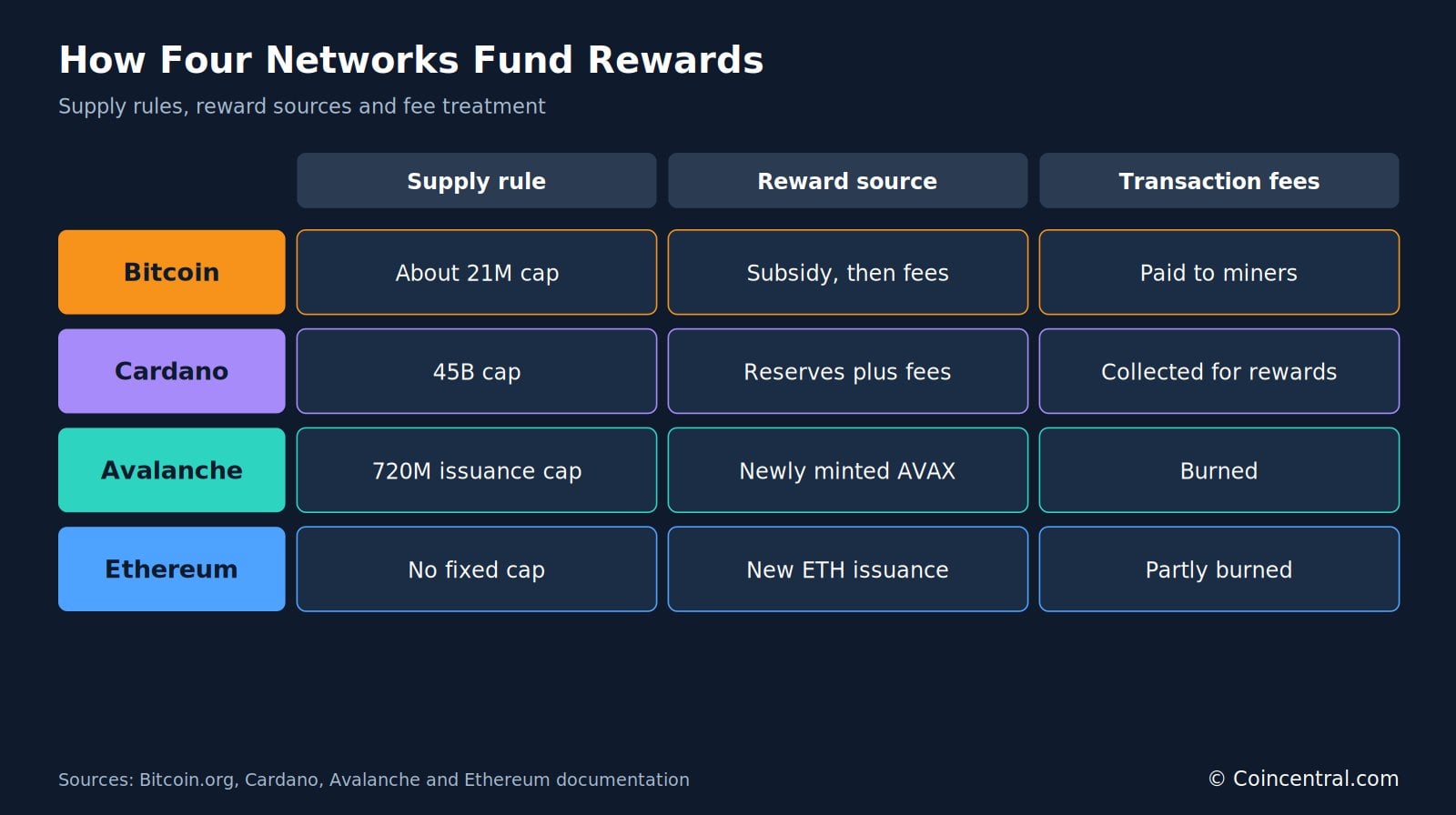 Figure 9: How four networks fund rewards and treat transaction fees.
XRP, BNB Burns and Lost Coins
A coin can have a fixed cap while its real supply still shrinks. This happens through burning or permanent loss of access.
XRP Created Its Supply at Launch
XRP does not rely on mining. When the XRP Ledger launched in 2012, all 100 billion XRP were created. No more can be minted under the network’s current rules.
That does not mean all XRP was free to trade at once. Ripple received a large share, and large amounts went into escrow. Tokens released from escrow can reach the market without raising the total ever created.
The ledger also destroys small amounts of XRP through fees. The standard minimum transaction cost is generally 0.00001 XRP, though fees can rise when the network is busy. These fees are burned, not paid to validators.
Normal burns are tiny next to 100 billion XRP. They are not a reliable source of large price moves.
BNB Burns Toward 100 Million
BNB Chain runs an Auto-Burn program that aims to reduce supply toward 100 million BNB. On 19 October 2026, the BNB Foundation announced its 37th quarterly burn.
| Burn number | 37th quarterly burn |
| Announced | 19 October 2026 |
| BNB destroyed | About 1.65 million |
| Reported value | Roughly $1.2 billion |
| Supply after burn | About 131.5 million |
| Target supply | 100 million |
After the burn, total supply stood near 131.5 million BNB. That is about 31.5 million above the target. Burning does not automatically raise a price, since the effect depends on demand and on what investors already expected.
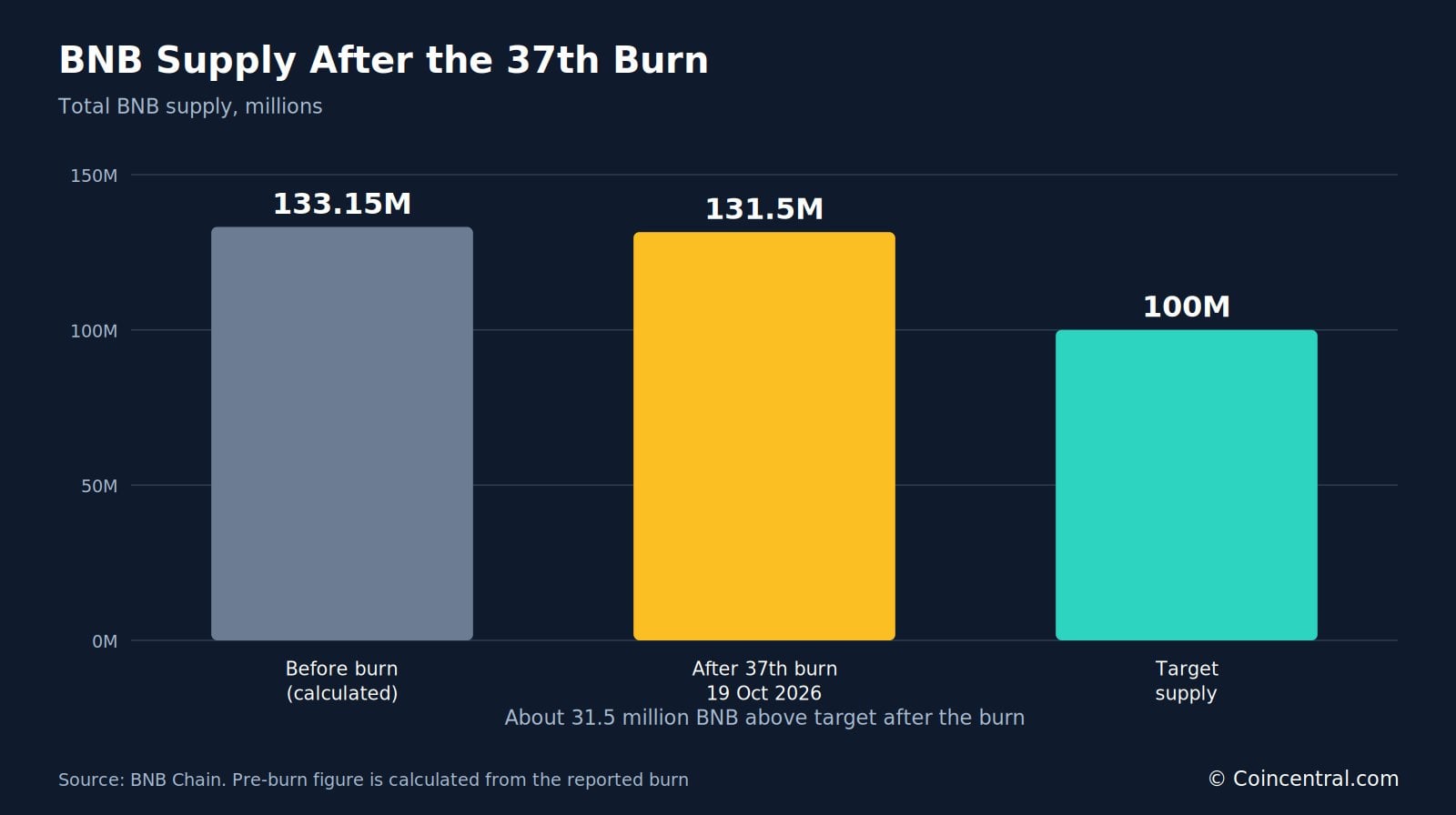 Figure 10: BNB total supply before and after the 37th quarterly burn, against the 100 million target.
What Happens to Lost Coins?
Coins can also be lost forever when owners lose their private keys. Bitcoin in a wallet with destroyed recovery information may never move again. Those coins stay on the ledger, but nobody may be able to spend them.
Researchers have estimated that millions of Bitcoin could be lost. These estimates are uncertain, because an inactive wallet is not always a lost one. A wallet idle for ten years may belong to a long-term holder.
Lost coins are not replaced. The supply investors can actually reach may be well below the cap.
Can the Cap Change, and What Are the Risks?
It depends on governance and design. Bitcoin’s cap is enforced by consensus rules that network nodes check on their own. A developer cannot publish new software and force everyone to accept a higher limit.
Raising it would need network participants to adopt new monetary rules. People who reject the change could keep using the old rules. That could split the blockchain into two networks with different supply policies.
Because the fixed supply is central to Bitcoin’s identity, such a change would likely face strong opposition. Still, it would be wrong to call it physically impossible. Other coins may have looser governance, and some token contracts let authorized parties mint more tokens.
Investors should tell apart a cap enforced by decentralized consensus from one that rests mainly on a project’s promises.
Risks of Fixed-Supply Coins
A fixed supply can limit future dilution, but it does not guarantee success. A capped coin can still face falling demand, regulation, technical flaws and weak liquidity.
Ownership concentration is another issue. If a few wallets hold much of the supply, large holders can move prices with big trades.
Token unlock schedules also matter. A coin can have a fixed cap while large amounts sit in treasury or team allocations. When those tokens become tradable, selling pressure can rise even though the cap has not changed.
Network security matters too. Proof-of-work coins depend more on fees as rewards shrink. Proof-of-stake networks face a similar shift when reward reserves run down.
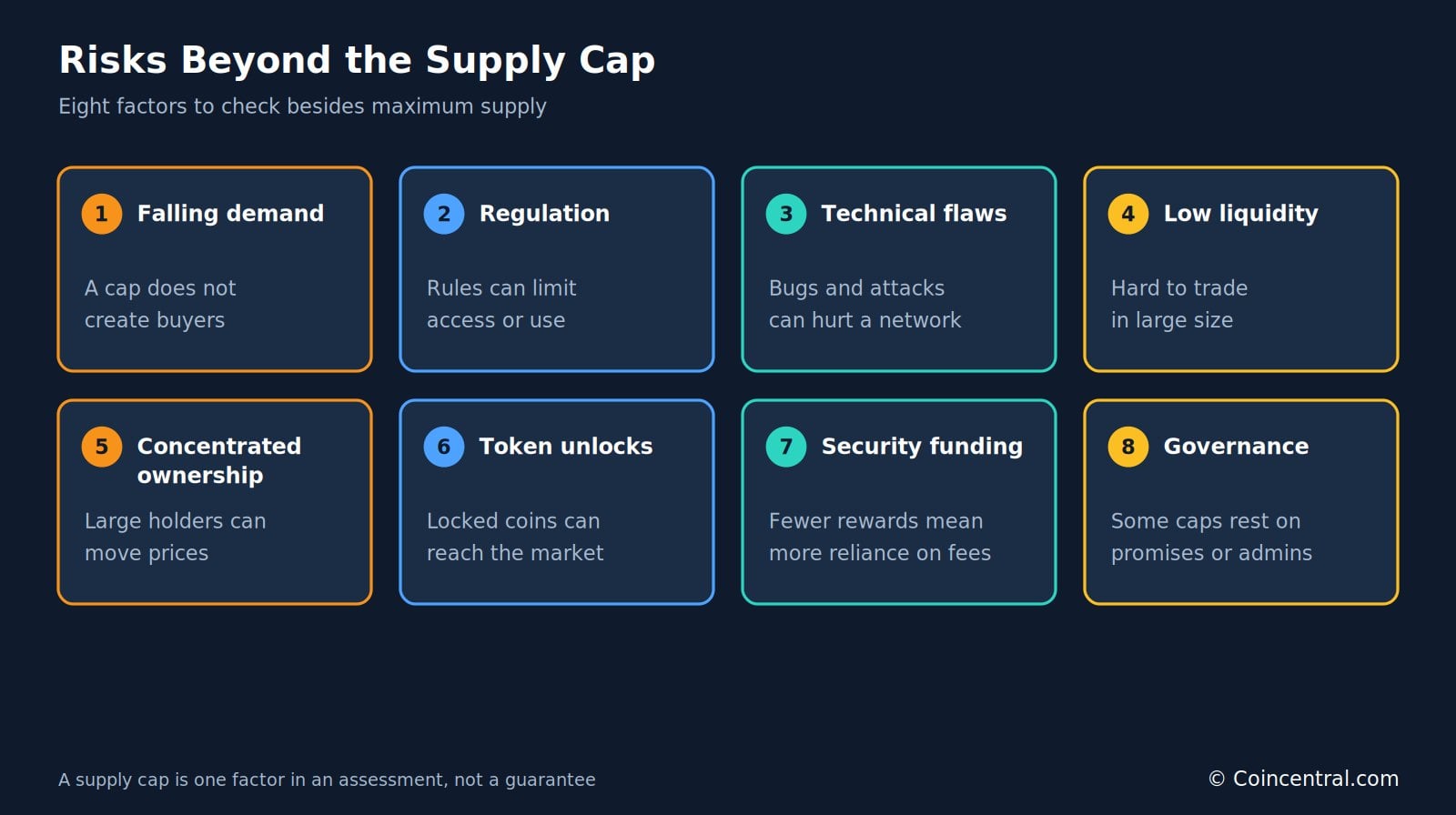 Figure 11: Eight factors that can affect a fixed-supply cryptocurrency beyond its cap.
Bottom Line
When a cryptocurrency reaches its maximum supply, new issuance stops under its current rules. The blockchain does not have to stop.
Bitcoin is the clearest case. About 95% of its supply was mined by March 2026, yet the rest will arrive slowly until around 2140. After that, miners will rely on transaction fees.
Whether fees can keep the network secure is an open question. Other coins take other paths. Cardano pays rewards partly from finite reserves, Avalanche pairs a cap with burning, XRP created all its coins at launch, and Ethereum has no cap and balances issuance against burning.
For investors, maximum supply is one feature among many. A limited supply can reduce future dilution. It cannot promise higher prices, strong demand or a secure network.
The key question is not only how many coins can exist. It is whether the coin stays useful and secure once new issuance slows or stops.
Sources
- Bitcoin Halving Schedule and Maximum Supply (Bitcoin.org)
- Bitcoin: A Peer-to-Peer Electronic Cash System (Satoshi Nakamoto)
- The Final Million: Bitcoin’s Remaining Supply (Grayscale Research, 9 March 2026)
- Why Is Bitcoin’s Supply Limited? (Blockstream)
- On the Instability of Bitcoin Without the Block Reward (Princeton University)
- The Cardano Constitution (Cardano)
- Staking Rewards, Monetary Expansion and Reserves (Cardano Documentation)
- AVAX Tokenomics and Supply Rules (Avalanche)
- XRP Supply and Original Distribution (XRP Ledger)
- Transaction Costs and XRP Burning (XRP Ledger)
- ETH Supply and Issuance Explained (Ethereum Foundation)
- Litecoin Supply and Halving Mechanism (Litecoin)
- 37th Quarterly BNB Token Burn (BNB Chain, 19 October 2026)
- Why Dogecoin Has No Fixed Maximum Supply (Dogecoin Foundation)
Disclaimer: This article is for educational and informational purposes only and does not constitute financial or investment advice. Cryptocurrency supply rules, governance arrangements and market conditions can change. Hypothetical examples are illustrative and should not be interpreted as price forecasts.
The post What Happens When a Cryptocurrency Reaches Its Maximum Supply? appeared first on Blockonomi.
What's Your Reaction?
 Like
0
 Dislike
0
 Love
0
 Funny
0
 Wow
0
 Sad
0
 Angry
0











Comments (0)