

Wide Angle vs. Telephoto in Fiordland: How This Photographer Made Both Work
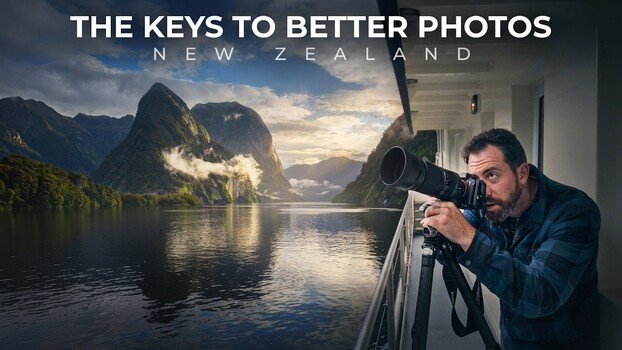
Shooting in Fiordland National Park, New Zealand, is a test of patience, adaptability, and a willingness to get soaked. Shainblum's time there produced some striking results across two very different focal lengths, and the decisions he made in the field are worth paying attention to.
Coming to you from Michael Shainblum, this visually rich video follows Shainblum through the remote terrain of Fiordland, shooting at locations like Milford Sound and Doubtful Sound with the Sony a1 paired with both a Sony 12-24mm wide angle lens and a Sigma 100-400mm telephoto. The variety in focal lengths isn't just aesthetic preference; Shainblum uses each one to solve a specific compositional problem. At Milford Sound, he wades into the wake left by passing boats to build a two-thirds foreground of churning water, shooting at f/16 with a two-stop neutral density filter and exposures around a third of a second to get a soft lead-in to the moody peaks behind. When a wide angle composition near a river didn't come together the way he hoped, he switched to the telephoto and found abstract, almost painterly water patterns instead.
The telephoto work on the boat cruise through Doubtful Sound is where things get particularly interesting. Shainblum shoots handheld and on a tripod at around 400mm while the boat moves, bumping ISO to 500 and keeping his aperture wide since everything is focused at infinity. The fog lifting off massive cliff faces gives him shapes to isolate, including one that forms what he describes as a skull-like figure in the frame. He also uses the mist to separate a glowing tree line from the background, applying the same dodging and burning technique he used on the waterfall images earlier to control contrast and direct the viewer's eye. The black and white treatment runs through much of the edit, and it works especially well when color information is minimal and the light is flat.
What Shainblum keeps returning to throughout the video is the mindset behind the images. He's explicit that two things drove the results on this trip: persistence through difficult conditions and going in without fixed ideas about what he was trying to capture. Standing in streams, waiting out rain, shooting through a rainstorm while managing autofocus on falling water instead of background rocks, getting completely drenched near a waterfall on a Milford Sound boat tour. These aren't incidental details. They're the actual method. He also gets into specific technique decisions that don't always make it into landscape photography discussions, like bracketing shutter speeds to compare how motion texture changes the emotional feel of a shot, and manually focusing in rain to keep the camera locked onto the subject rather than the precipitation.
Check out the video above for the full rundown from Shainblum, including the best morning of the entire trip, which he saved for the end.
What's Your Reaction?
 Like
0
Like
0
 Dislike
0
Dislike
0
 Love
0
Love
0
 Funny
0
Funny
0
 Wow
0
Wow
0
 Sad
0
Sad
0
 Angry
0
Angry
0










Comments (0)