

8 Reasons to Upgrade Your Gear, and Whether Each One Calls for a New Camera or Lens
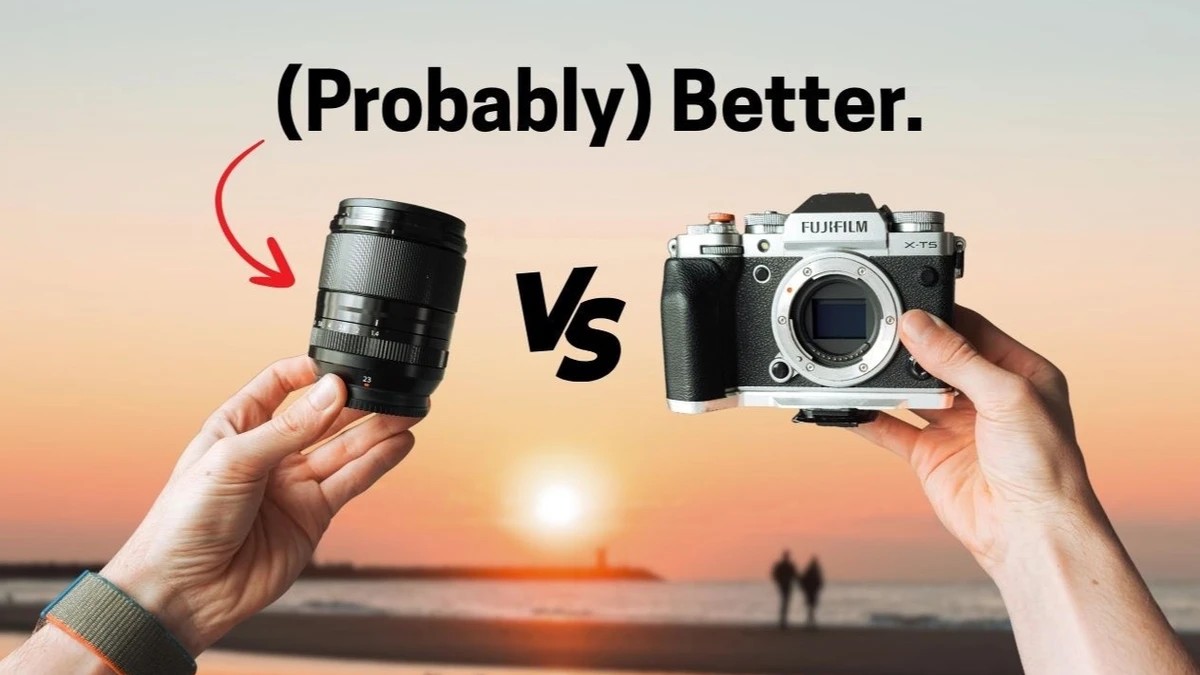
Your photos come out soft, noisy, or flatter than you hoped, and a new camera body looks like the obvious fix. A body and a lens solve different problems, and spending on the wrong one can leave the original issue sitting right where it was.
Pit Haupert breaks the upgrade question down by the reason you want to upgrade, starting with background blur. A larger sensor does give you more blur when the field of view and aperture are the same, so full frame beats APS-C and Micro Four Thirds on that front. The lens pulls just as hard, though. Tighter focal lengths make the background look blurrier, and a wide maximum aperture adds to it. On his Fujifilm APS-C bodies, the Viltrox AF 56mm f/1.7 behaves like an 85mm full frame lens and melts backgrounds without any change of sensor. It sells for about $180. Jumping to a bigger sensor usually means a new mount too, so you'd be buying lenses either way.
Sharpness follows a similar pattern. Plenty of beginners chase megapixels and start browsing 40, 60, and 100-megapixel bodies, and resolution does decide how far you can crop. Most current cameras already sit above 20 megapixels, though. If your images still look soft at that resolution, the lens is the likely culprit, especially a bundled 18-55mm or 16-50mm kit zoom. Haupert found the same inexpensive Viltrox crisp even on one of his lower-resolution bodies. Noise is less one-sided. A bigger, newer sensor produces cleaner files at ISO 3,200 than his Fujifilm X-T5 does at the same setting. A brighter lens lets you throw more light at a smaller sensor, though, whether that's f/2, f/1.4, or f/1.2, and Haupert leans toward primes because they're generally smaller and let in far more light than a typical zoom.
Camera bodies turn over fast, and lenses tend to stick around. Fujifilm's X-T line went from the Fujifilm X-T2 in 2016 to the X-T5 in 2022, roughly a new model every two years. A good lens on the same mount moves with you through each of those bodies. That makes a lens purchase a longer investment than most body upgrades. The pool of affordable glass has also grown. Viltrox has made autofocus lenses for X mount for years, Tamron and Sigma joined with X-mount lenses in 2021 and 2022, and fast primes that once meant a premium price now show up in the $200 range. Before you spend, list the specific flaw you keep seeing in your files. Then ask whether a sensor or a piece of glass produces that flaw. Field of view is the clearest case: an ultra-wide or a long telephoto changes your framing far more than any sensor swap, and nearly every manufacturer sells the full range.
Some upgrades need both halves of the kit. Haupert's first camera was a Fujifilm X-T30, and he moved to the older X-T2 specifically because it was weather-sealed. A sealed body alone won't protect you in the rain, though. The Viltrox 56mm has no internal seals and no gasket at the mount, so a fully weather-sealed setup means a sealed lens as well. Stabilization has been moving into camera bodies, and none of his Fujifilm XF primes are stabilized, so in-body stabilization is what steadies them. Lens stabilization still earns its place on bodies without it and at long focal lengths, where it's generally considered more effective. For Haupert, though, in-body stabilization alone justified his move from the X-T2 to the X-T5, because it lets him choose lenses without checking which ones are stabilized. Autofocus splits the work between the camera's algorithms and the lens' motor. Linear motors are generally quicker than stepper or DC coreless designs. To isolate the camera's role, Haupert ran the Viltrox in its X-mount version on Fujifilm and in its E-mount version on a Sony a6700, with identical lens hardware on both bodies. The Sony focused far better, and in his experience, the camera accounts for most of the difference in autofocus hit rate, with only a few percentage points down to the lens motor. If autofocus is your reason for upgrading, the body is where to spend.
Handling is the most personal reason of all. A small prime can make a setup more enjoyable simply because you take the camera out more often, while a comfortable grip, plenty of custom buttons, a joystick, or a large, high-resolution viewfinder are all fair reasons to buy a new body instead. Tactile, good-looking cameras that are fun to use are a big part of why he shoots Fujifilm.
Haupert works through all eight reasons in the video above.
What's Your Reaction?
 Like
0
 Dislike
0
 Love
0
 Funny
0
 Wow
0
 Sad
0
 Angry
0









Comments (0)