

A Full-Frame Fisheye With Autofocus for $449
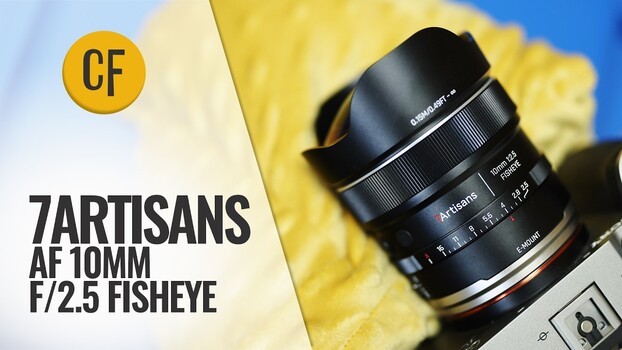
Fisheye lenses that cover full frame sensors, not just APS-C, are surprisingly hard to find, which makes any new release worth a close look. The 7Artisans AF 10mm f/2.5 Fisheye adds autofocus and a bright aperture to that short list, landing at $449.
In his hands-on test, Christopher Frost walks through what a 10mm fisheye actually gives you, and the answer is a lot. The 7Artisans AF 10mm f/2.5 Fisheye throws a 185-degree diagonal field of view into your camera, wide enough that composing a shot becomes a real challenge since almost everything reads as background. The 10mm focal length gives a slightly less bulbous projection than the common 14mm or 15mm fisheyes, but a wider horizontal field of view. Frost points out that you can't fake this effect well in editing, so the optic earns its place if you want the look. The lens comes in Sony E, Nikon Z, and L mount, all full frame.
Build quality has stepped up for 7Artisans. Frost tests it on a Sony a7CR with its 61-megapixel sensor, and the lens itself is solid metal, weighing 504 grams, a bit over a pound. There's a weather-sealing gasket at the metal mount, a USB-C port for firmware updates, and an aperture ring that clicks at every third of a stop. Two customizable focus-hold buttons sit on the side alongside an auto/manual focus switch, and the manual focus ring is electronically coupled to the motor. The front element is a non-removable metal hood over bulbous glass, so filters aren't an option and there's no image stabilization. Autofocus runs silently and accurately, though at only average speed, which the deep depth of field of any fisheye hides in practice.
Sharpness in the center starts excellent right at f/2.5, with strong contrast. The corners tell a different story at the brightest apertures, showing darkness and softness, but they clean up as you stop down. By f/5.6, f/8, and f/11, that sharpness reaches the far corners, and chromatic aberration stays low throughout. Close focusing gets you to 15 cm, where center detail holds up well and the bokeh turns genuinely wild. Coma smearing in the corners at the widest aperture will frustrate anyone shooting stars, though Frost shows how it improves as you close down. For the full breakdown on flaring, sun stars, and how the corners behave across the aperture range, the video above lays it out shot by shot.
A 10mm full frame fisheye with autofocus at this price sits at an interesting point in the market. Most fisheye options have historically been manual-focus specialty glass, priced either very cheap and rough or very expensive from the major brands. An autofocus fisheye matters less for locking onto a subject and more for close-up work, where you can push the front element within centimeters of something and let the lens handle the tiny margin of focus at f/2.5. That close-focus fisheye technique, foreground object huge and exaggerated against a curved horizon, is a look worth practicing if you shoot skateboarding, interiors, real estate, or event work where you want energy and distortion baked into the frame. The 185-degree coverage also gives astrophotographers a near-total view of the sky in a single frame, which is why the coma performance is worth weighing before you commit.
Frost calls it a very good lens rather than a perfect one, with the corner softness and coma being the trade-offs you accept for the price. Watch the full review above to see the sample images and decide whether the fisheye look fits how you shoot.
What's Your Reaction?
 Like
0
Like
0
 Dislike
0
Dislike
0
 Love
0
Love
0
 Funny
0
Funny
0
 Wow
0
Wow
0
 Sad
0
Sad
0
 Angry
0
Angry
0










Comments (0)