

‘East of Eden’ Review: Zoe Kazan’s Magnificent Netflix Epic Will Knock You Over

“There is a beauty in the truth, even if it is a dreadful beauty.”
In “East of Eden,” Zoe Kazan‘s aching, radiant adaptation of John Steinbeck’s 1952 classic, there is ample beauty, dreadful and otherwise. The period drama follows a doomed couple and their distressed family across five decades, from Adam Trask’s (Christopher Abbott) cruel upbringing under his oppressive, ex-military father (Tracy Letts), through his own pained parenting of twin boys, Aaron (Joe Anders) and Caleb (Joseph Zada). His brother Charles (Mike Faist) is his partner in youth, a 19th century lonely boy unjustly dismissed by his dad and abandoned, fairly or not, by everyone he loves.


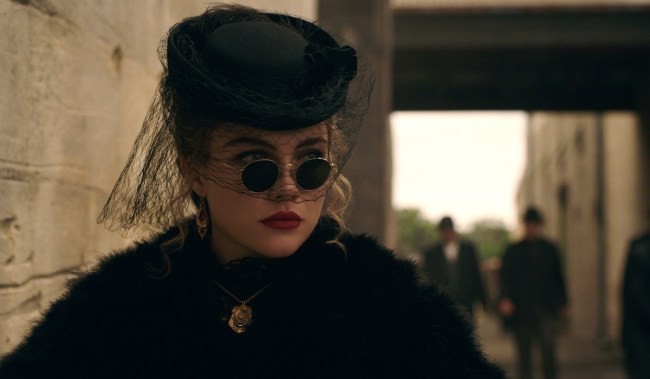
At the core of the siblings’ relationship, there’s a love that’s still clean and pure. But it’s Cathy (Florence Pugh), Adam’s eventual wife, who gives “East of Eden” its prickly, piqued edge. Introduced crawling through the Trask family’s field, her black blood spattering their rich soil like a human pesticide, Cathy personifies the series’ potent blend of dread and beauty.
Transfixing once she’s no longer bruised beyond recognition, it’s easy to see her as Adam does: a fallen angel, delivered to his doorstep, ready to be remedied with a little love and care. But he doesn’t notice what she so carefully guards — her tenacious individualism in pursuit of freedom and safety — and that blind spot allows Cathy to cut through Trasks like a serrated blade. The marks she leaves on Adam (and, to a lesser extent, Charles) don’t heal easily, if at all.
The same can be said for her effect on audiences. As a character, Cathy is a richly realized provocateur; a self-described monster whose rejection of conventional values is sure to earn her a villainous label from certain viewers. But it’s how Kazan — the co-showrunner who writes every episode — informs Cathy’s unimaginable choices, both broadly and in minute detail, that round her out.
Cathy’s treatment of Adam isn’t rooted in innate wickedness, as in Steinbeck’s novel, but personal experience. She feels society’s misogynistic boot on her throat from a young age, and she does not submit. She does not keep still. She fights back, and even when her tactics prove nasty, her desperation stays honest. It’s a brutal honesty, to be sure, but such severity — sustained by Pugh’s vigilant, commanding performance — also makes her remarkable and, at times, cogent.
 Mike Faist, Christopher Abbott, and Florence Pugh in ‘East of Eden’Courtesy of Netflix
Directed by Garth Davis (Episodes 1-4) and Laure de Clermont-Tonnerre (5-7), with Stuart Dryburgh and Sam Chiplin as cinematographers, “East of Eden” relishes the staples of its origin as an American epic. Big emotional moments are punctuated by striking shots of fiery, mountainside sunsets and comforting, homestead greenery.
The Trasks encounter a wide swath of citizens, haggling with sneaky cheats, exploiting innocent fools, and befriending big-hearted neighbors. They traverse the country, fight in wars, and marvel over industrial innovations, and yet it can feel like nothing has changed in the months and years that pass. The combination of spectacle and intimacy is well balanced, in part because Kazan and her co-showrunner Jeb Stuart are so dialed into their characters.
Two invaluable bright spots amid the Trasks’ roiling turmoil are Lee (Hoon Lee), Adam’s code-switching, Chinese-American housekeeper, and Samuel (Ciarán Hinds), a good-humored Irish immigrant who becomes a family friend. Neither is reduced to sainthood, but they carry a light, welcoming pragmatism that rebukes the prejudices they’ve faced, while juxtaposing Adam’s naive romanticism and Cathy’s cynical rebelliousness. (Abbott’s gentle melancholy, in heartache and joy, has rarely been so nuanced or utilized so effectively.)
Lee is a repository of knowledge. His studiousness applies to books (reading the principles of psychology, among others in his collection, while brushing his teeth) as well as lived experience. As an outcast, he clocks who expects him to speak in Pidgin English and who he can trust with his refined natural dialect. Samuel is among the trusted. A beloved family man and jack of all trades, Samuel is like the father Adam never had, and Hinds plays him with an even warmth that’s part comforting show, part assumed reality. Lee, meanwhile, is magnificent in a role requiring similar kindness, only laced with loneliness and loss.
It’s no surprise Samuel and Lee articulate the series’ guiding ethos, pulled straight from the novel (more or less): “Timshel,” Lee says, is a Hebrew word from the Book of Genesis that translates to “thou mayest.” It means people aren’t bound to their past or fated to a set future. They have a choice in what they do and who they are. “Timshel” allows for the opportunity to change while acknowledging the forces greater than ourselves influencing our ability to do so, like lineage, laws, customs, and identity. Possibility and realism. Hope and understanding. Beauty and truth.
“East of Eden” tracks changes in a developing world with a shrewd disdain for systemic failures just as it traces change in its characters with the utmost compassion for human fallibility. It sees how the greatest growth comes from recognizing our darkest shame, not hiding from it, and convincingly marries contradictions within individuals that should tarnish their verisimilitude. Instead, it hints at how we can embrace the imperfect reality in front of us — and keep crawling toward a state of grace.
Grade: A-
“East of Eden” premieres Thursday, October 1 on Netflix. All seven episodes will be released at once.
What's Your Reaction?
 Like
0
Like
0
 Dislike
0
Dislike
0
 Love
0
Love
0
 Funny
0
Funny
0
 Wow
0
Wow
0
 Sad
0
Sad
0
 Angry
0
Angry
0








Comments (0)