

Knife: The Attempted Murder of Salman Rushdie review – terrifying and inspiring story of survival
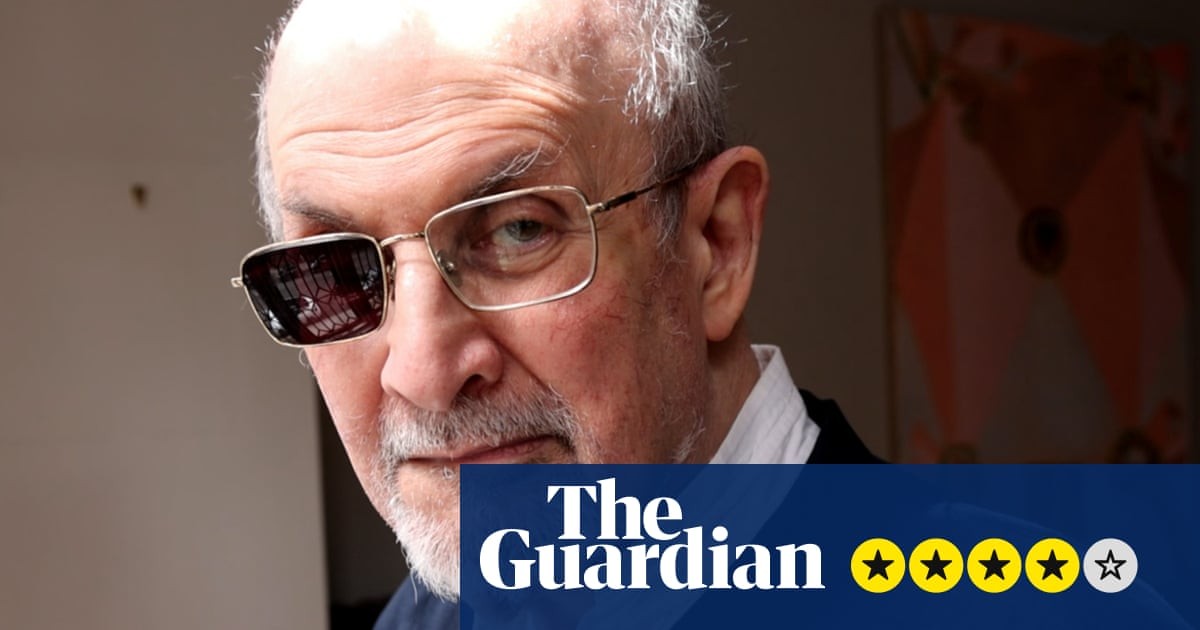
The terrifying, inspiring story of how Salman Rushdie survived and thrived after the assassination attempt on him in New York in 2022 is the subject of this excellent documentary from Alex Gibney. It is based on Rushdie’s own memoir, narrated extensively by the author himself, and using the intimate hospital-bedside video footage shot by his wife, the poet Rachel Eliza Griffiths. There are stomach-turningly explicit shots of Rushdie’s damaged eye and also, finally, horrendous scenes of the attack itself. What emerges is Rushdie’s courage and his remarkably level-headed, calm and unafraid writerly voice insisting on the primacy of literature, freedom of expression and the life of the imagination.
The film itself takes us from Rushdie’s childhood in Mumbai (with a certain unselfconscious locution of his class and background, Rushdie still calls it “Bombay”), to the years of bullying and unhappiness at an English public school, then Cambridge, London, his day job in advertising (he is cheerfully delighted by his successful campaign for Aero chocolate). Then there is writing fiction and the big breakthrough with his magic-realist creation myth Midnight’s Children. We get a lot of footage of him in black-tie at awards, which is how he appeared in the media: a crude jihadi placard actually shows him in a bow tie.
The 1989 fatwah for The Satanic Verses was a shocking event, a death threat by a foreign power on a British national; Rushdie here gives us his theory that his book was seized upon by the Iranian theocracy as a diversionary tactic after the wearisome war with Iraq. In a sense, it was part of the prehistory of the modern culture wars and cancellation, but at a time when literary authors had more prestige than they have now and were not told to stay in their lane. Or not until that spectacular moment. Many British and American cultural figures, to their shame, airily sided against him at the time (and even in 2022 it was depressing to see how many declined to offer their unambiguous support). Christopher Hitchens and Edward Said emerge with distinction here for defending him.
The film takes us through the years of internal exile, under guard by special branch in safe houses, then after a decade an emergence into public life – a defiant amplification of normality in his adopted city of New York. Eventually Rushdie had let his guard down sufficiently for his would-be murderous attacker to make his move.
Considerations of privacy mean that the film can’t or won’t go into much detail about the author’s private life, though there is something a little airily detached about his phrase: “There were marriages, divorce, children …” And he doesn’t mention claiming to have embraced Islam in 1990, reportedly terrified by threats to his children, in an attempt to appease the extremists, a statement he later retracted.
Rather amazingly Rushdie has recovered so much that his deportment does not seem to be that of an old or injured man – just that of the stately figure he always was. He visits the outside of the prison where his assailant is detained and goes back to the scene of the crime. Doubtless he has revised his security precautions – and no one would begrudge him this cautious victory dance.
What's Your Reaction?
 Like
0
Like
0
 Dislike
0
Dislike
0
 Love
0
Love
0
 Funny
0
Funny
0
 Wow
0
Wow
0
 Sad
0
Sad
0
 Angry
0
Angry
0





Comments (0)