

First-of-Its-Kind Footage Captures Humpback Whale Mourning Her Dead Newborn Calf
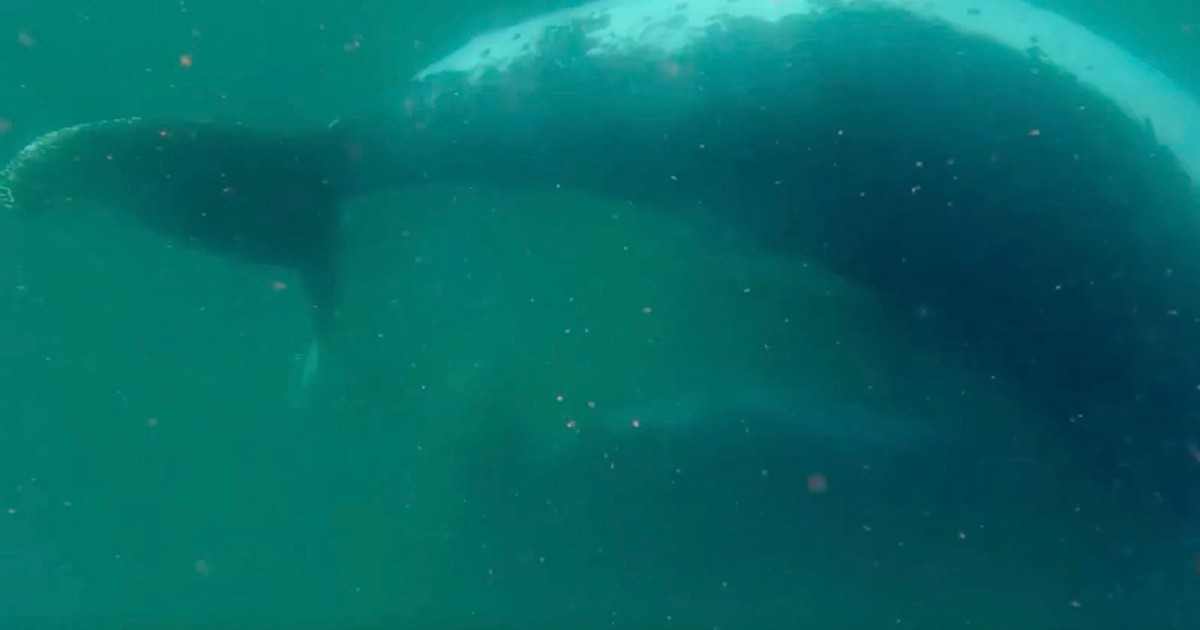
Researchers captured footage of a female humpback whale mourning her dead newborn calf, in what a new study describes as a first-of-its-kind behavior.
Scientists filmed an extraordinary underwater video off Australia’s Gold Coast in July 2025, which showed a mother humpback whale remaining beside her stillborn calf for hours, possibly days.
The footage shows a female humpback whale repeatedly returning to her stillborn calf for more than an hour. She stays above the motionless body on the seafloor and appears to look directly at the newborn, seemingly checking for any sign that it is still alive.
While similar behaviors have been documented in pilot whales, dolphins and killer whales, a study published this week in the journal Discover Animals suggests that this is the first described case of a toothless baleen whale mother caring for her deceased newborn calf.
Scientists have mostly documented whales showing this kind of “grieving” behavior toward dead calves among toothed whales, such as dolphins and orcas, while there is much less evidence of it among toothless baleen whales such as humpback whales. This may be because dead newborn baleen whales often sink quickly, making it difficult for researchers to witness and record what happens afterward.
According to a report by Live Science, study co-author Andrew Mulville was on a private boat when he noticed two adult humpback whales near the surface. One suddenly moved into a vertical position, with its tail pointing upward, and Mulville then spotted part of the membrane that surrounds a fetus floating in the water, suggesting the whale had just given birth.
But there was no calf in sight, so Mulville and others on the boat followed the female underwater with a GoPro camera. They found her newborn calf lying dead on the seafloor, while the mother remained nearby in what the researchers described as “postmortem attentive behavior.”
“The encounter offers a rare window into one of the least understood aspects of whale behavior: how these highly social animals respond to death,” Olaf Meynecke, a marine ecologist at Griffith University in Australia and study co-author writes in an article for The Guardian. “And it raises the question: do whales, and other highly social animals such as elephants, grieve?”
Meynecke writes that humpback whales are known for their unusual responses when other animals are in distress. They have been observed protecting their calves from killer whales, as well as staying alongside injured or entangled whales, sometimes circling them, resting nearby, or appearing to help. They have also been seen intervening when killer whales attack seals, sea lions, and gray whale calves.
Affiliate Disclosure PetaPixel articles may include affiliate links; we may earn a commission if you buy through one.
What's Your Reaction?
 Like
0
Like
0
 Dislike
0
Dislike
0
 Love
0
Love
0
 Funny
0
Funny
0
 Wow
0
Wow
0
 Sad
0
Sad
0
 Angry
0
Angry
0










Comments (0)