

Gaze Into a Cosmic Crystal Ball Unlike Anything Else In the Universe
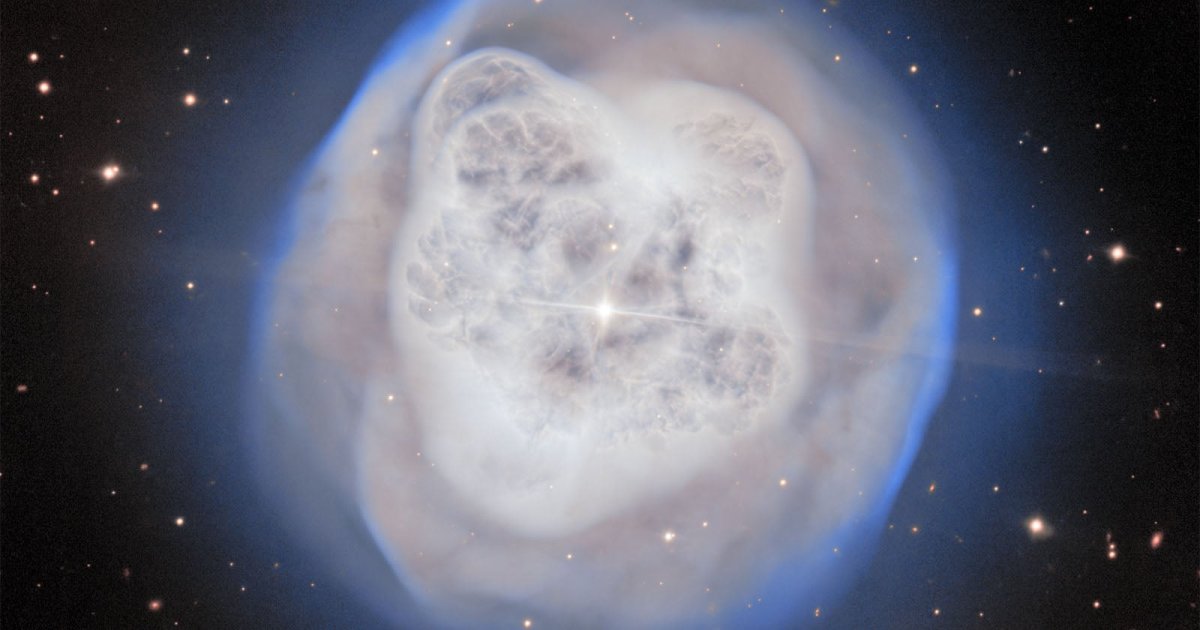
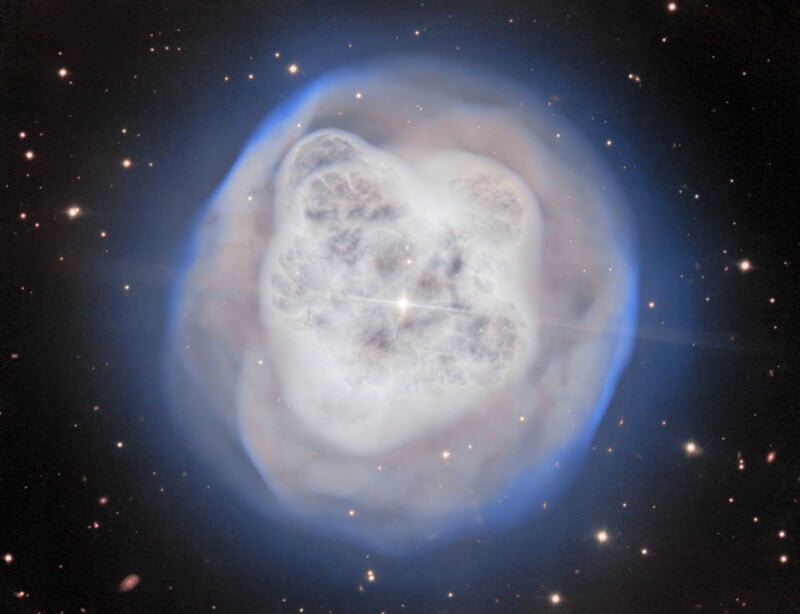
NOIRLab and the National Science Foundation’s Gemini North telescope, located on Maunakea in Hawai’i, captured a mesmerizing photo of NGC 1514, nicknamed the Crystal Ball Nebula. It looks a lot different than the photo the James Webb Space Telescope captured last year, and frankly, unlike nearly any other space photo.
The Gemini Multi-Object Spectrograph (GMOS) on the Gemini North telescope captured this photo of the Crystal Ball Nebula in May, revealing it in exceptional detail.
Compare it to the photo captured by the Mid-Infrared Instrument (MIRI) on the James Webb Space Telescope (JWST) last year, shown below. In that mid-infrared image, the nebula’s rings are clearly captured, and a visible pink central region is present.
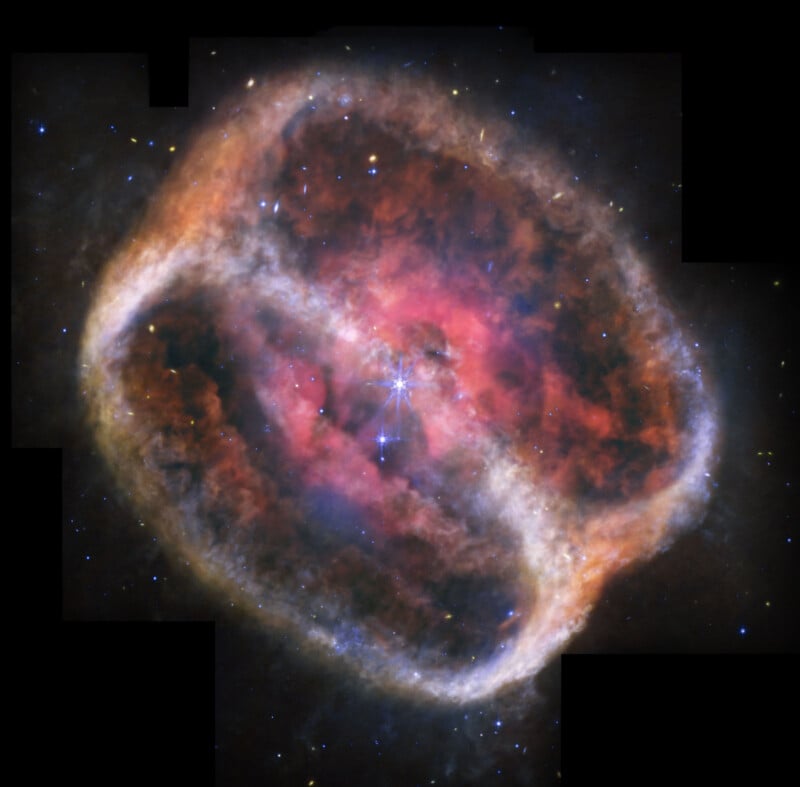 NGC 1514 — Webb (MIRI) | NASA, ESA, CSA, STScI, Michael Ressler (NASA-JPL), David Jones (IAC)
These same rings that Webb photographed are not really visible in Gemini’s new photo at all. The colors are entirely different because the GMOS operates at different wavelengths of light than JWST’s MIRI. Further, the interstellar material, cosmic dust, and gas that MIRI could see through, Gemini cannot.
What both images capture, although in different ways, is the Crystal Ball Nebula’s once-mysterious core. When German-British astronomer William Herschel discovered NGC 1514 way back in 1790, it just looked like a bright sphere, or planet, hence why he called these cosmic objects “planetary nebulae.” As NOIRLab notes, planetary nebulae and planets are entirely unrelated.
Before he discovered NGC 1514, Herschel, limited by the instruments and astrophysics of the day, believed that nebulae were collections of stars too far away to see distinctly. That’s not true, as he realized the following year. He noted that the distinctly bright point at the heart of NGC 1514 suggested it was instead a single star, not a distant group.
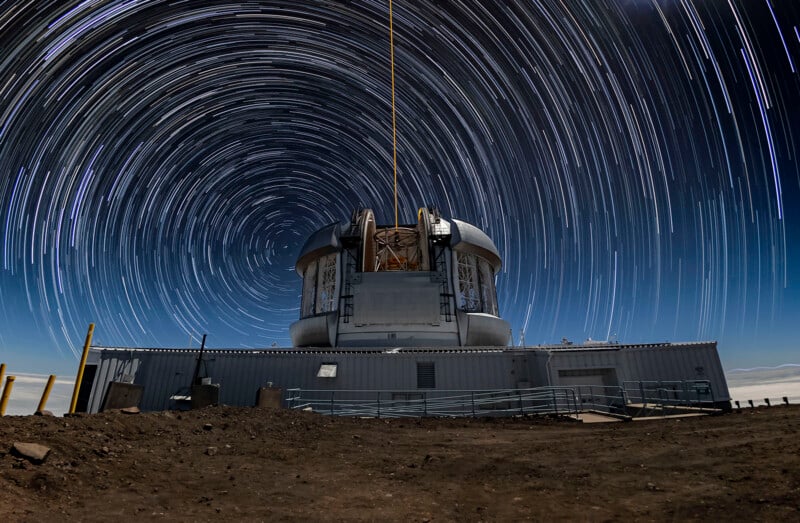 Gemini North | Image credits: International Gemini Observatory/NOIRLab/NSF/AURA/T. Matsopoulos
However, although planetary nebulae result from low- or intermediate-mass stars ejecting their outer layers as they approach death, NGC 1514 actually contains two stars. Herschel couldn’t see it in the 18th century, limited by the optics of the day, but NGC 1514’s core features a pair of stars that orbit each other every nine years. This is the longest known orbital period for binary stars within any known planetary nebulae in the Universe.
That’s not the only special thing about NGC 1514. Not only does it have uniquely long-orbiting binary stars, but it is also lumpy. Planetary nebulae are typically smooth and spherical, not asymmetrical and clumpy.
“Scientists believe that one of these stars, which was once several times more massive than our Sun, released its outer layers while in the throes of death. As the progenitor star and its binary companion orbit each other, they mold the expanding shell of gas with their strong, asymmetrical winds, forming the lumpy layers we see today,” NOIRLab explains.
Image credits: International Gemini Observatory/NOIRLab/NSF/AURA | Image Processing: J. Miller & M. Rodriguez (International Gemini Observatory/NSF NOIRLab), T.A. Rector (University of Alaska Anchorage/NSF NOIRLab), D. de Martin & M. Zamani (NSF NOIRLab)
What's Your Reaction?
 Like
0
Like
0
 Dislike
0
Dislike
0
 Love
0
Love
0
 Funny
0
Funny
0
 Wow
0
Wow
0
 Sad
0
Sad
0
 Angry
0
Angry
0











Comments (0)