

Hasselblad's Best Feature Isn't the Camera, It's This App
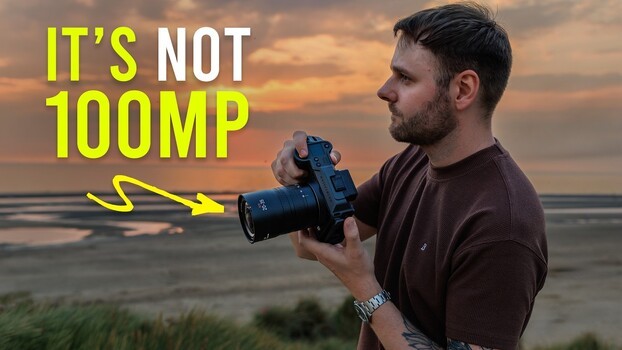
Most camera companion apps are an afterthought, slow, clunky, and quick to disconnect the moment signal drops. Hasselblad's Focus Mobile is the rare exception, and it finally runs on Android after living on iPhone alone.
Following a full day of shooting across landscapes, a solar eclipse, portraits, and low-light cityscapes, James Reader shows how the app slots into real work with the X2D II and a range of prime lenses. He starts at a coastal lighthouse with the sun burning behind it, a scene with dynamic range wide enough to bury the subject in shadow. This is where the app earns its keep. Focus carries the in-camera HDR workflow straight into your phone, so you send the file over and edit fully in HDR, pulling back highlight glow that gets flattened in a standard SDR file. Reader raises the shadows, warms the image, and drops in a radial gradient around the lighthouse, all before ever touching a laptop.
The eclipse sequence is where the stakes get real. Working the west coast of England with the 90mm prime and no proper solar filter on hand, Reader rigs film meant for telescopes onto a variable step-up ring so it fits every lens he owns. The window to capture both a filtered exposure of the sun and a clean frame of his model Rachel lasts only minutes. Two features do the heavy lifting here. Remote control lets him trigger the camera on a tripod without shaking it, and fast, reliable raw transfer lets him check exposures on his phone despite having zero phone signal and no internet for miles. That offline reliability is the part worth paying attention to, since most transfer tools fall apart the second they lose a connection.
Focus Mobile lands at a moment when phone screens and processors have gotten good enough to make serious editing on location a genuine option rather than a compromise. The broader shift is toward closing the gap between capture and delivery, and this workflow is a clean example of it. Reader hands his model Jade the phone at a portrait shoot, she scrolls through the frames and picks a favorite, and he exports and sends the finished image to her before anyone leaves the botanical garden. Batch editing pushes one set of adjustments across 50 or 60 files shot in the same light, which is the kind of speed that turns a same-day turnaround from a scramble into a routine. If you shoot events, portraits, or travel where clients expect something fast, that loop is the whole point.
The York leg closes the day with low-light work in front of the Minster, shot handheld at ISO 6,400 from the middle of a quiet street. Raising the shadows drags out noise across the sky and the stonework, and Focus answers with Hasselblad's own natural noise reduction built into the app. One click, roughly 15 to 20 seconds of processing, and a new file comes back cleaned up. Reader runs detail mode to protect the intricate stonework, and the before-and-after shows the sky and brickwork cleared without smearing the fine detail. For getting low-light shots ready to post on the move, that's a fast path from raw to something usable.
Watch the video above to see how the eclipse composite came together and how each edit held up across a full 24 hours of shooting.
What's Your Reaction?
 Like
0
Like
0
 Dislike
0
Dislike
0
 Love
0
Love
0
 Funny
0
Funny
0
 Wow
0
Wow
0
 Sad
0
Sad
0
 Angry
0
Angry
0











Comments (0)