

How Boston Dynamics Got Its Atlas Humanoid Robot Fit for the World Cup
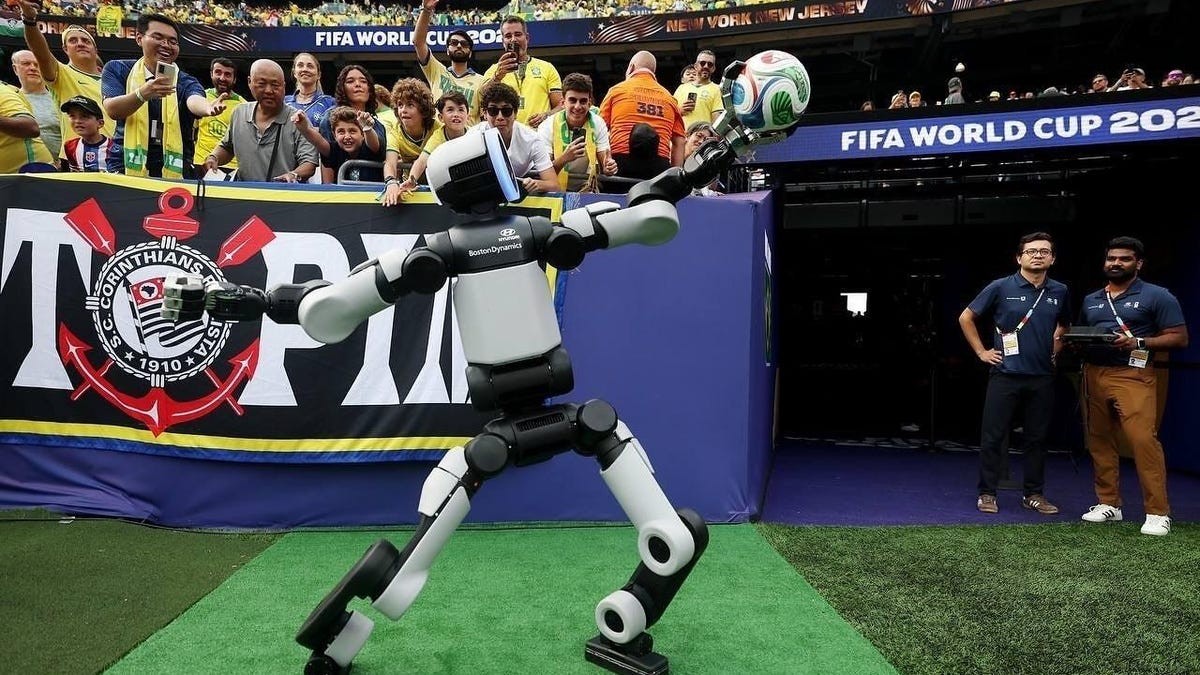
Before Atlas the humanoid robot strode onto the pitch to hand the ball to the referee during Norway and Brazil's World Cup match on Sunday, it hinted at its own soccer skills on the sidelines.
At the end of halftime, Atlas emerged from the players' tunnel and replicated a series of iconic goal celebrations before passing the ball. But it seems the robot was being shy, because it's actually capable of far more.
In a series of videos published to YouTube, Boston Dynamics shows how it trained the humanoid robot to perform a number of soccer tricks, including its own version of the rabona -- a complex move in which the kicking leg crosses behind the standing leg to strike the ball -- that the company calls the ghost rabona.
When I met the latest version of Atlas at CES back in January, I had no idea that by summer it would be capable of World Cup-worthy moves. But I shouldn't have underestimated it -- after all, this robot, and many like it, are designed to constantly learn new things.
These humanoid robots will first be deployed in industry before moving into service and entertainment settings, and eventually into our homes. That's still a way off, but the learning they do along the way is crucial to getting there.
In the interim, it's important for Boston Dynamics to share Atlas' skills with the world -- and not just for entertainment purposes, says the company's director of robot behavior Alberto Rodriguez.
"It's a public service to show that the technology is getting to a certain level of capability," he says.
Not only does it spark debate of how this technology will fit into society, but it also raises public awareness of how close we are to humanoid robots becoming commonplace.
Getting Atlas World Cup-ready
I'm curious about why, of all the things Atlas could learn, Boston Dynamics wanted to teach the robot soccer skills.
"We've always taken inspiration from high-strength or high agility-physical behavior," says Rodriguez. "It motivates us to squeeze more performance that we know is possible out of the robots we build."
Training Atlas to be World Cup-ready started by using motion capture to record the moves and skills that Boston Dynamics wanted the robot to perform. These were then put into a simulation, and "through massive trial and error," Atlas then learned to imitate these moves as much as it could within its physical constraints, explains Rodriguez.
There were two levels to the robot mastering the skills, he adds. The first part of this involved the robot's limbic system -- its balancing and counterbalancing, agility and movement. It needed to develop lightning-fast muscle memory, which is also what it needs for athletic performances in the fields of dance or gymnastics.
The second level was trickier, going beyond athleticism. It involved the robot's manipulation of objects and its ability to exert the appropriate amount of force to engage with the world around it.
Teaching Atlas to spontaneously adapt to friction and slip, as well as being precise with how close it stepped to the ball, really pushed the robot out of its comfort zone. It was much trickier to model than, say, a backflip, says Rodriguez. "All of that is in the air, where the dynamics are much more well understood and much easier to represent in simulation."
Atlas might not boast an exact replica of the human physiology, but it was designed in a way that made it capable of replicating human "fluidity and dynamism." But that doesn't mean its soccer schooling was without growing pains.
In Boston Dynamics' School of Football video series, it's clear that Atlas took a whole bunch of tumbles on its way to mastering skills. It's especially challenging to teach Atlas athletic skills because that process inevitably involves contorting its body into positions that put it at risk of "catastrophic falls," says Rodriguez.
In spite of this, breaking and repairing is all part of training the robots, and there's a "well-oiled process" for fixing them up, he adds. By the time we see them -- stepping out onto a soccer pitch, for example -- it's highly unlikely we'll see them fall.
"When we deploy robots, they tend to do things that have already been well tested, and we're confident that they're not going to get into awkward situations," says Rodriguez.
When will Atlas make its professional soccer debut?
Atlas is already more adept than many of us less athletic, creaky-boned humans when it comes to soccer, but I asked Rodriguez whether there are any skills he wishes Atlas could learn that he hadn't been able to teach the robot by the World Cup.
"Kicking a ball is not hard to learn, and we've definitely done that," he says. "But kicking it really well, that's really hard to do." He referenced the way legendary soccer players such as David Beckham and Roberto Carlos were capable of dramatically bending the ball towards their intended targets.
"That's the kind of thing that you probably have to end up learning by practicing in the real world. That's just very, very hard to learn in simulation," he says. "You probably have to learn through practice and error with a real soccer ball."
Will Atlas make the squad in 2030?
Hyundai/Boston DynamicsFortunately, Atlas has another four years to master the skill before the next World Cup. Should we expect that by the time the 2030 tournament rolls around, Atlas might have been recruited by one of the teams?
In spite of its fast-evolving soccer skills, it's unlikely that we'll see humanoid robots play on human-robot teams, says Rodriguez. What's more likely is seeing teams of robots play against one another.
Robots can move in ways that human players can't -- rotating their joints or inverting their limbs, allowing them to turn without having to take any steps, for example. This wouldn't make them better players, but would undoubtedly change how the game is played in a way that would be tricky for a mixed group of robots and humans to navigate.
In the meantime, Atlas has learned an enormous amount from its foray into the world of soccer. Its newfound footwork, precision and speed might not see it taking home a World Cup trophy anytime soon, but the robot has leveled up overall.
"Forcing ourselves to go through those behaviors had this indirect effect of improving, just in general, the way that Atlas works," says Rodriguez.
What's Your Reaction?
 Like
0
Like
0
 Dislike
0
Dislike
0
 Love
0
Love
0
 Funny
0
Funny
0
 Wow
0
Wow
0
 Sad
0
Sad
0
 Angry
0
Angry
0








Comments (0)