

How to Find a Photo Anywhere, Even When Nothing Looks Interesting
Finding a great photo isn't always about being in a great location. The ability to see a story or a feeling in whatever's in front of you is one of the most practical skills you can build as someone with a camera.
Coming to you from Andrew Banner, this thoughtful video opens with a challenge: look around wherever you are right now and ask whether anything in your immediate surroundings would make a great photograph. It sounds simple, but Banner uses this exercise to expose a real gap in how most people approach making images. He argues that struggling to find a story isn't about lacking creativity; it's about not yet knowing how to look. One reframe he offers is to stop searching for a "story" entirely and instead look for a feeling. A comfy pair of slippers under warm light, or a train carriage full of people buried in their phones, each carries a feeling, and that feeling is where the image starts.
Banner then walks through several of his own photographs to show how this works in practice. One is a beach scene with no people in it, just a windbreak, a blanket, buckets and spades, and a boule set. The family is clearly nearby but out of frame, and the image quietly asks where they went. Another is a dropped ice cream cone sitting in a drain grate, a shot he titled "Sadness." He noticed it because of the contrast between the pale cone and the dark ironwork, but what made it worth stopping for was the immediate, obvious story a child's ruined afternoon compressed into a single frame. A third image shows a clean, unmarked van moving through frame with no clear indication of who's driving or why, and yet it holds attention entirely because the viewer can't stop constructing a narrative around it.
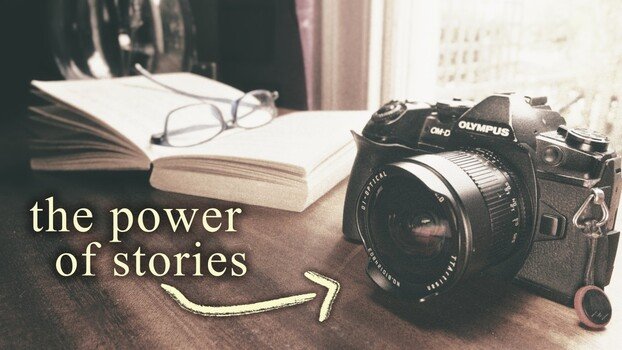
One of the more useful ideas Banner raises is the distinction between making an image of something versus making an image about something. His book-on-a-table photograph is sharp only on the book itself, but the surrounding detail, the reading glasses left behind, the lamp, the window light, tells you everything about the person who was just there. If he had moved in close and isolated the book, the story disappears. The surroundings provide context, and context is what generates actual visual interest. He also introduces a surprisingly effective prompt technique: give yourself a single adjective and go shoot it. His bluebell image, built around the word "delicate," won a club competition against entries featuring spider webs, dandelion clocks, feathers, and an ICM shot of a child dancing. One word, one clear feeling, one strong image.
Check out the video above for the full rundown from Banner, including his specific lighting setup for the book scene and the rest of his techniques for building images with real narrative weight.
What's Your Reaction?
 Like
0
Like
0
 Dislike
0
Dislike
0
 Love
0
Love
0
 Funny
0
Funny
0
 Wow
0
Wow
0
 Sad
0
Sad
0
 Angry
0
Angry
0






Comments (0)